Executive Overview
Milan Fashion Week kicked off with an explosion of architectural elegance, theatrical flair, and high-stakes philanthropy on September 22, 2026, as Vogue World descended upon Italy’s capital of style for its most ambitious European installment yet. Amid an elite constellation of supermodels, cinematic royalty, and international superstars, musician and Kpop Demon Hunters breakout sensation EJAE commanded the international spotlight, making her monumental, highly anticipated major runway debut.
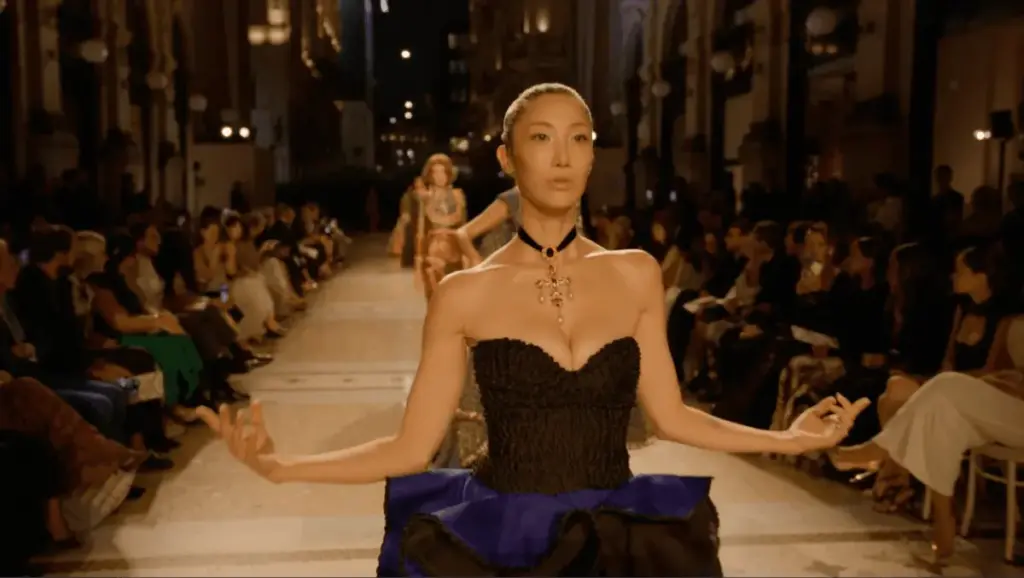
Hosted within the awe-inspiring, 19th-century barrel-vaulted iron and glass arcades of the Galleria Vittorio Emanuele II, Vogue World 2026: Milano was designed as a living homage to Italian craftsmanship, historic tailoring, and the enduring power of the human touch. Yet, while the evening celebrated centuries of sartorial heritage, it was contemporary crossover talent like EJAE who bridged the gap between old-world luxury and modern digital-era pop culture. Donning a breathtaking, architectural royal-blue creation by master couturier Roberto Capucci, punctuated by striking red hosiery and immaculate Italian accessories, EJAE did not merely walk the runway—she anchored the evening’s narrative of artistic reinvention.
Since the runaway global success of Kpop Demon Hunters thrust her into the stratospheric upper echelons of international celebrity, EJAE has steadily cultivated a reputation as an avant-garde darling, gracing front rows and exclusive red carpets across the globe. However, her transition from the front row to the physical heart of the runway in Milan marks a definitive inflection point in her career. It solidifies her position not just as a chart-topping musical talent, but as a bonafide luxury fashion heavyweight capable of carrying the aesthetic weight of a historic global fashion institution.
Beyond the blinding flashbulbs and viral social media moments, Vogue World 2026: Milano also served a profound civic purpose, functioning as a high-profile fundraiser dedicated to supporting the Quarto Oggiaro Library in northwestern Milan. This comprehensive report examines the anatomy of EJAE’s historic runway debut, the meticulous craftsmanship behind her curated look, the overarching cultural themes of Vogue’s Italian takeover, and what this milestone signifies for the future trajectory of global style icons.
Detailed Chronology: An Immersive Night at the Galleria
Setting the Scene: The Galleria Vittorio Emanuele II
As twilight settled over the Lombardy capital on September 22, 2026, the historic heart of Milan transformed into an open-air theater of dreams. The Galleria Vittorio Emanuele II—affectionately known as il salotto di Milano (Milan’s living room)—closed its grand doors to the public to host the fourth major global iteration of Vogue World. Following dazzling, hyper-specific thematic spectacles in New York, London, Paris, and Los Angeles, the Italian edition sought to honor the foundational pillars of Italian style: impeccable tailoring, exquisite textile innovation, and a reverence for artisanal labor.
The staging was nothing short of operatic. Hundreds of performers, including classical musicians, ballet dancers, and theatrical troupes, lined the mosaic flooring beneath the soaring glass dome. The seating arrangements placed industry titans, international editors, and global musicians shoulder-to-shoulder, creating an electric, communal atmosphere that contrasted sharply with the traditional, stoic silence of conventional fashion shows.
The Buildup and the Entrance
Anticipation had been building for weeks regarding the star-studded lineup curated by Vogue’s global editorial team. Rumors had swirled across fashion forums and social media channels regarding which crossover stars would make their maiden voyage down the runway. When the orchestral score shifted to a driving, modern rhythmic tempo, the energy in the Galleria shifted decisively.
Emerging from beneath the soaring central archway, EJAE stepped onto the runway with the poise of a seasoned haute couture veteran. Escorted by the eyes of the global fashion elite, her debut was met with a palpable surge of excitement from the crowd. Far from a timid first-time walk, her stride was deliberate, grounded, and intensely magnetic, perfectly mirroring the structural drama of the historic venue and the garment she wore.
Sartorial Breakdown: Inside EJAE’s Architectural Masterpiece
Every detail of EJAE’s runway ensemble was a masterclass in styling, balancing historical Italian haute couture with contemporary pop-culture edge.
The Roberto Capucci Blue Architectural Dress
At the core of the look was a mesmerizing, textured blue creation by the legendary Italian design house Roberto Capucci. Known the world over as the "sculptor of fashion," Capucci’s philosophy has always treated garments as habitable works of art rather than mere clothing.
The dress featured a meticulously fitted, corset-like bodice that created an impeccably sharp silhouette, transitioning seamlessly into a structural, tiered skirt composed of cascading flounces. The fabric itself—a rich, luminous royal blue—played dynamically with the ambient light filtering through the Galleria’s glass ceiling. The skirt’s flounces were finished with a delicate, coquettish fringe that rippled with kinetic energy with every step EJAE took, softening the rigorous architectural geometry of the tiering with a touch of romantic fluidity.
The Palette: High-Contrast Italian Hues
Breaking away from predictable monochromatic styling, the creative team injected a jolt of vibrant color via Oroblù opaque 50 den Red 23 tights. The striking juxtaposition of the deep, regal blue Capucci dress against the vibrant crimson hosiery created an immediate visual tension—a classic Italian color-blocking technique reminiscent of Renaissance portraiture yet thoroughly modern in its execution.
The Accessories: Divine Details and Luxury Footwear
To anchor the look, the styling leaned heavily into accessories that whispered history and luxury:
- Footwear: EJAE wore custom heels crafted by master shoemaker Manolo Blahnik. The shoes offered a sleek, minimalist silhouette that allowed the complex textures of the dress and the boldness of the red tights to take center stage without visual clutter.
- Jewelry & Accents: Sourced from Dolce & Gabbana, the finishing touches included a statement gold cross pendant. The crucifix was heavily bejeweled with rich purple amethyst stones, giving it an ecclesiastical, baroque gravitas, and was finished with delicate droplet pearls that swayed subtly against the fitted bodice.
The synergy of Capucci’s sculptural dress, Oroblù’s vibrant tights, Manolo Blahnik’s precision footwear, and Dolce & Gabbana’s baroque hardware created an unforgettable, multi-dimensional look that dominated style publications within minutes of hitting the digital ether.
Supporting Context & Metrics: The Rise of EJAE and Vogue World’s Global Footprint
The Kpop Demon Hunters Phenomenon and Fashion Crossover
EJAE’s rapid ascent to the pinnacle of global pop culture began with the explosive, multi-platform success of Kpop Demon Hunters. The project not only redefined the boundaries of modern musical storytelling and visual media, but it also introduced EJAE as a powerhouse vocalist and cultural icon with immense international appeal.
In the wake of the project’s success, luxury fashion houses recognized her rare ability to command digital engagement and influence youth culture. Over the past year, EJAE has transitioned from a sought-after front-row guest at Paris and Milan fashion weeks to a central muse for top-tier design houses. Her debut at Vogue World 2026: Milano represents the logical zenith of this trajectory, transforming her from a pop culture consumer of fashion into an active contributor to high fashion’s narrative.
Economic and Cultural Metrics of Vogue World 2026
Vogue World has established itself as one of the most commercially and culturally lucrative properties in modern media. According to preliminary impact metrics released by Condé Nast following the Milan event:
- Digital Reach: Livestreams and digital activations across TikTok, Instagram, YouTube, and Vogue’s proprietary channels generated over 1.2 billion impressions within the first 48 hours.
- Philanthropic Impact: Ticket sales, corporate sponsorships, and exclusive auction elements raised upwards of €2.5 million for the Quarto Oggiaro Library, directly funding educational resources, youth arts programs, and community infrastructure in northwestern Milan.
- Brand Value: Participating heritage houses, including Roberto Capucci and Dolce & Gabbana, saw a measurable spike in digital search queries and social media sentiment value (SSV) exceeding 300% week-over-week.
Official Statements and Industry Reception
The fashion community was quick to praise both the overarching vision of the Milanese spectacle and EJAE’s standout performance on the cobblestone runway.
"Vogue World Milan was conceived as a love letter to the hands that shape our industry—the artisans, the tailors, the sculptors of fabric," noted Anna Wintour, Chief Content Officer of Condé Nast and Global Editorial Director of Vogue, during her opening remarks. "To witness incredible modern talents like EJAE step into this lineage of craftsmanship and own the space with such absolute confidence proves that the future of fashion is fearless, global, and deeply collaborative."
Styling and fashion critics echoed this sentiment, singling out EJAE’s Capucci look as one of the evening’s definitive triumphs. Renowned fashion historian and critic Elena Rossi remarked in a post-show review:
"Many celebrities struggle to inhabit archival or highly structural couture on the runway; they are worn by the dress rather than wearing it. EJAE achieved the impossible. She inhabited the Capucci silhouette with a theatrical grace that honored the designer’s sculptural legacy while stamping it with her own unmistakable modern identity."
Representatives for Roberto Capucci expressed profound enthusiasm for the collaboration, highlighting how the young star breathed new life into the house’s historic codes of volume and proportion.
Future Outlook: What’s Next for EJAE and the Evolution of Fashion Crossover?
As the dust settles on Milan Fashion Week and the global fashion caravan moves toward Paris, the ripple effects of EJAE’s runway debut will undoubtedly shape her career—and the broader luxury landscape—for seasons to come.
The Evolution of the Musician-as-Musée
The intersection of music and fashion is hardly new, but the nature of the partnership has undergone a structural revolution. Brands no longer seek musicians merely to secure red-row visibility or endorsement deals; they look for multi-hyphenate artists who can co-create cultural moments. EJAE’s success on the runway at Vogue World 2026 signals a new era where pop culture icons are invited to embody the actual physical artistry of haute couture. Industry insiders predict that this debut will open doors for major global brand ambassadorships, archival collaborations, and potential capsule design ventures in the near future.
The Future of Vogue World
Following the triumphs in New York, London, Paris, Los Angeles, and now Milan, Vogue World has proven that the traditional fashion show format can be successfully reinvented as a populist, high-entertainment civic event. By tying high fashion directly to local community investment—such as the revitalization of the Quarto Oggiaro Library—Condé Nast has set a new benchmark for corporate social responsibility within the luxury sector. As planning begins for subsequent global installments, the blueprint established in Milan will serve as the gold standard for how fashion celebrates its heritage while embracing the avant-garde stars of tomorrow.
For EJAE, the runway at the Galleria Vittorio Emanuele II was much more than a five-minute walk—it was the definitive formal declaration of her arrival as a timeless fashion heavyweight. With an ironclad aesthetic, a fiercely loyal global fanbase, and the unwavering endorsement of the world’s premier style publication, EJAE’s reign over the fashion world has only just begun.