Executive Overview
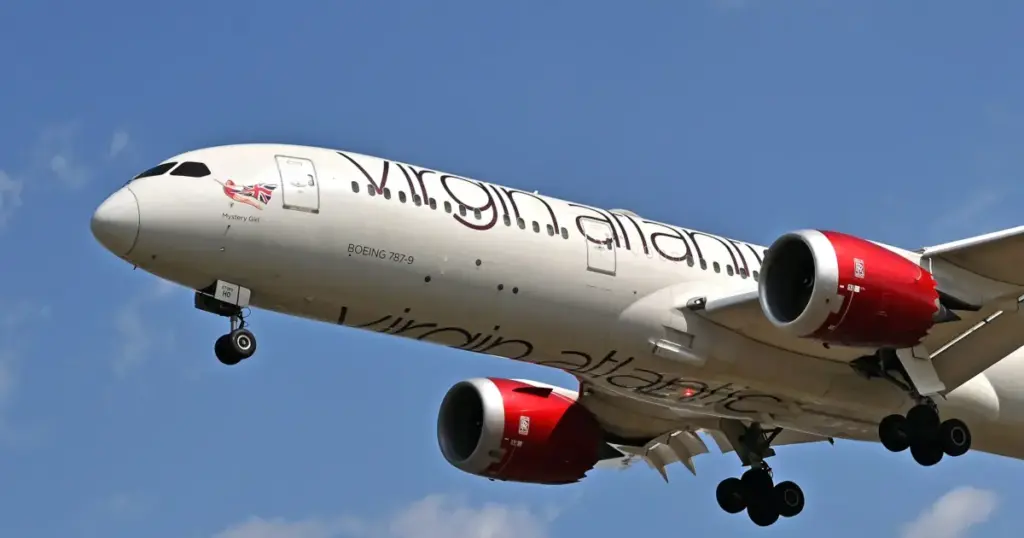
In an alarming near-miss that highlights the growing threats posed by rogue unmanned aerial vehicles (UAVs) to commercial aviation, a Virgin Atlantic passenger flight narrowly avoided a catastrophic collision with a large drone earlier this week. The incident occurred on June 8, 2026, shortly after the aircraft departed from London Heathrow Airport—the United Kingdom’s busiest aviation hub—en route to Johannesburg, South Africa.
Operating as flight VS449, the wide-body Boeing 787-9 Dreamliner was carrying approximately 260 passengers and crew members as it climbed through the skies above Woking, Surrey. Without warning, the cockpit crew spotted a large, cream-colored drone passing perilously close to the right side of the aircraft. Official investigations by the UK Airprox Board subsequently revealed that the drone was hovering at an altitude of approximately 5,500 feet—roughly fourteen times higher than the legal UK limit for recreational drone use.
Most chillingly, proximity data compiled in the safety report indicated that the aircraft and the unauthorized device missed each other by a mere 16 feet (5 meters). Due to the high closure rate and the sudden appearance of the object, the flight crew had no time to execute evasive maneuvers. Although a disaster was ultimately averted, safety officials categorized the risk of a mid-air collision as "high."
This terrifying episode has reignited urgent debates regarding airspace security, the enforcement of Flight Restriction Zones (FRZs), and the escalating dangers unauthorized drone operators pose to millions of commercial airline passengers each year.
Detailed Chronology: How the Near-Miss Unfolded
The sequence of events on June 8 began routinely enough, but quickly escalated into a high-stakes emergency within minutes of wheels-up at London Heathrow.
Departure and Climb
Flight VS449 pushed back from its gate and executed a standard departure from Heathrow, navigating the complex web of controlled airspace that surrounds the British capital. As a massive Boeing 787-9 Dreamliner climbs, the flight deck crew is heavily occupied with monitoring engine parameters, communicating with departure control, configuring aircraft flaps and slats, and maintaining strict adherence to Standard Instrument Departures (SIDs).
The Sighting Over Woking
As the aircraft ascended through 5,500 feet and tracked over the Surrey town of Woking, the pilots were suddenly confronted with an unexpected obstacle. Off the right-hand side of the flight deck windows, a large, stationary or slowly moving object materialized. The drone—described by the flight crew as being white or cream in color and measuring approximately three feet in diameter—flashed past the massive commercial jet at an astonishingly close proximity.

According to the official UK Airprox Board safety assessment, the event happened "too late and too fast" for the pilots to take any evasive action. In aviation terms, a "closure rate" this rapid provides human reaction times virtually zero window to maneuver a 250-ton aircraft out of harm’s way. The physical distance separating the multimillion-dollar jet and the illicit hobbyist device was measured at a razor-thin 16 feet.
Immediate Response and Air Traffic Coordination
Immediately following the terrifying pass, the captain and first officer initiated standard emergency reporting protocols. Recognizing the extreme danger posed to their own aircraft and subsequent departures, the flight crew alerted Heathrow Air Traffic Control (ATC).
Air traffic controllers immediately took defensive action, broadcasting warnings to other inbound and outbound aircraft operating in the vicinity of Surrey and the western approaches to Heathrow. The alertness of the aviation network paid off shortly thereafter, when a subsequent commercial flight reported spotting the same rogue drone still lingering at roughly 5,000 feet in the area.
Local police and regulatory authorities were notified, launching an investigation to track down the operator responsible for flying a heavy drone at commercial airliner altitudes.
Supporting Context & Metrics: The Scale of the Drone Threat
To fully comprehend the severity of the June 8 incident, one must examine the strict legal parameters governing airspace in the United Kingdom, alongside the technical realities of modern drone capabilities and commercial flight profiles.
The 400-Foot Legal Ceiling
Under current UK Civil Aviation Authority (CAA) regulations, recreational and commercial drone operators must adhere to strict altitude limits. The absolute maximum height a standard drone is legally permitted to fly is 400 feet (120 meters) above the surface. This limit is intentionally designed to keep unmanned aircraft well clear of the lower altitudes utilized by helicopters, general aviation, and the critical departure and arrival corridors of major international airports.
The drone encountered by the Virgin Atlantic Dreamliner was operating at 5,500 feet—meaning it was flying nearly 14 times higher than the legal limit. At this altitude, small hobbyist drones cross paths with heavy commercial airliners that are still climbing aggressively to reach their cruising altitudes.

The Heathrow Flight Restriction Zone (FRZ)
Every major airport in the United Kingdom is protected by a designated Flight Restriction Zone (FRZ). At Heathrow Airport, the FRZ encompasses a strict circular radius extending approximately 5 kilometers (3.1 miles) around the airfield, alongside extended protection corridors aligned with the main runways.
Within an FRZ, flying any drone without explicit, prior permission from both airport operators and the CAA is a serious criminal offense under the UK Air Navigation Order. Violators can face heavy financial penalties, confiscation of equipment, and even custodial sentences.
While investigators are still working to determine the exact launch point of the Woking drone, operating a device capable of reaching 5,500 feet several miles outside the immediate perimeter boundary demonstrates a reckless disregard for aviation safety laws.
The Physics of a Bird-or-Drone Strike at 5,500 Feet
A Boeing 787-9 Dreamliner is constructed of advanced composite materials and powered by massive, highly sophisticated turbofan engines (such as the Rolls-Royce Trent 1000). While these aircraft are engineered to withstand extreme structural stresses, they are not invincible.
A drone ingestion into a high-bypass turbofan engine at a climb rate of several hundred knots can trigger catastrophic engine failure, uncontained rotor bursts, or severe structural compromise to the wings and fuselage. At 5,500 feet, a sudden emergency forces flight crews into high-stress, split-second mitigation scenarios where margin for error is non-existent.
Official Statements and Industry Reactions
The near-miss over Surrey has drawn sharp condemnation from airline operators, air traffic management, and safety advocates, all of whom are calling for heightened vigilance and stricter enforcement against reckless drone pilots.
Virgin Atlantic Airways
A spokesperson for Virgin Atlantic issued a definitive statement to the press following the publication of the safety findings:

"Virgin Atlantic can confirm that pilots operating flight VS449 from London Heathrow to Johannesburg on 8 June 2026 reported seeing a drone shortly after taking off from Heathrow.
The safety and security of our customers and crew is always our priority, and the pilots immediately reported the incident to Air Traffic Control in line with our procedures."
NATS (National Air Traffic Services)
As the primary provider of air traffic control services in the UK, NATS plays a frontline role in safeguarding the nation’s skies. A NATS spokesperson pulled no punches when addressing the dangers of illegal drone operations near controlled airspace:
"Flying any kind of drone near an airport or controlled airspace without permission is dangerous and unacceptable.
Drone pilots must remember that the same legal obligations apply to them as to any other pilot. NATS continues to work closely with manned and unmanned aviation industries, the Government, and the Regulator to create an environment that ensures the safety of all airspace users while supporting the legal use of drones."
Future Outlook: Protecting Skies in an Era of Consumer UAVs
The proliferation of consumer and commercial drones has fundamentally transformed modern airspace. While drones offer immense utility in photography, infrastructure inspection, agriculture, and logistics, their misuse by careless or malicious operators remains one of the fastest-growing headaches for global aviation authorities.
Technological Countermeasures and Detection
As incidents like the Heathrow near-miss become increasingly documented, airports worldwide are investing heavily in advanced counter-UAV (C-UAV) technologies. These systems integrate radar, radio-frequency (RF) sensors, acoustic detectors, and optical cameras to detect, track, and identify rogue drones long before they can pose a threat to arriving or departing airliners.

In the UK, regulatory bodies are also pushing for mandatory geo-fencing technology built into consumer drones—software-based boundaries that automatically prevent a drone from taking off or entering restricted airspace near airports and critical national infrastructure.
Educational Campaigns and Accountability
Beyond technological barriers, aviation experts emphasize the ongoing need for public education. Many dangerous drone incidents are driven not by malicious intent, but by profound ignorance of aviation laws among amateur hobbyists who purchase powerful devices online without understanding airspace classifications.
Efforts by the CAA, major retailers, and aviation unions continue to focus on making pilot registration and safety testing more accessible, while simultaneously advocating for harsher legal penalties to deter repeat offenders.
For the 260 passengers aboard Virgin Atlantic flight VS449, June 8, 2026, began as an ordinary journey to South Africa. Thanks to the exceptional situational awareness and professionalism of the flight deck crew, it ended safely. However, the 16-foot margin serves as a stark, sobering reminder that the skies above Britain’s busiest airports demand absolute respect, compliance, and vigilance from every user sharing the airspace.