Published: September 4, 2026
Last Updated: September 4, 2026
Author: Global Desk, Investigative News Unit
Source/References: Ministry of Energy, Nepal; BBC News Reports
Executive Overview
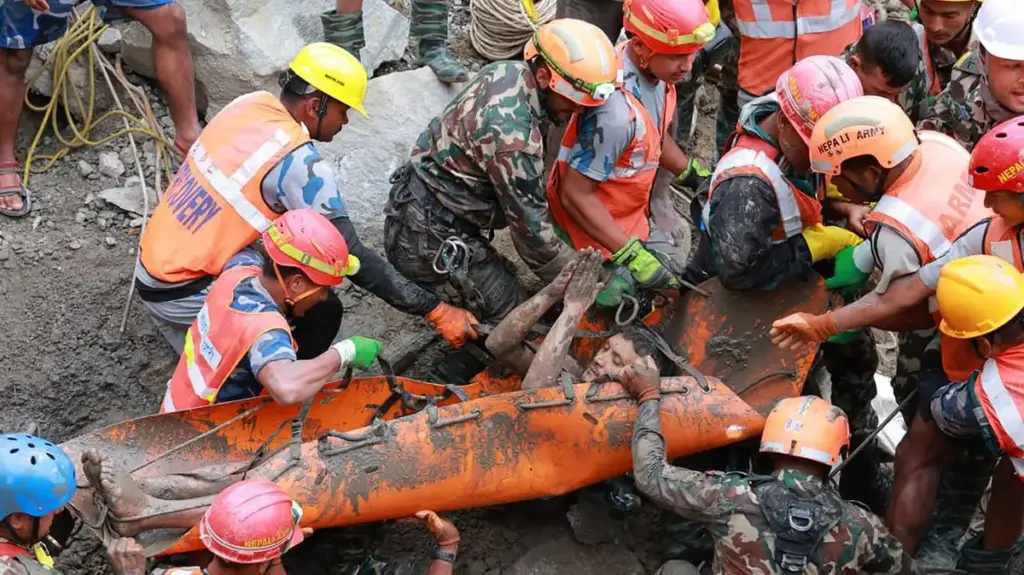
In a stunning turn of events that has pierced through an atmosphere of profound national grief, rescue teams in Nepal have successfully pulled two workers alive from a subterranean hydropower tunnel. The daring rescue comes more than a week after a catastrophic flash flood tore through the region, inundating river valleys and trapping scores of laborers deep underground.
The breakthrough occurred early Friday morning when search and rescue personnel, navigating treacherous debris and lingering pockets of toxic air, detected faint human voices echoing from deep within the infrastructure of the Trishuli 3A Hydropower Project. The extraction of the two men has injected a desperate measure of hope into an otherwise grim disaster relief operation. According to official briefings from Nepal’s Ministry of Energy, authorities now hold high expectations that at least 42 additional workers—believed to be trapped in air pockets within the expansive subterranean network—can be located and rescued.
However, this glimmer of light shines against the backdrop of an unfolding humanitarian catastrophe of staggering proportions. More than 5,000 individuals remain unaccounted for following the catastrophic weather event, with hundreds feared to be construction and maintenance laborers who were working within the sprawling network of subterranean tunnels carved into the Himalayan foothills. As heavy machinery continues to clear tonnes of silt, rock, and twisted metal, the international community watches anxiously as the race against time enters a critical new phase.
Detailed Chronology: From Cataclysm to Breakthrough
The Prelude and the Strike (Late August 2026)
The disaster began with unseasonal, torrential monsoon downpours that unleashed unprecedented volumes of water down Himalayan river basins. Without warning, massive walls of water, mud, and debris swept down valleys, overwhelming flood defenses, destroying infrastructure, and washing away entire communities in a matter of minutes.
Among the most vulnerable sites were the region’s numerous green-energy facilities. Hydropower construction sites, characterized by extensive underground complexes, drainage shafts, and diversion tunnels, bore the brunt of the deluge. When the flash floods hit, workers stationed deep inside the tunnel networks had mere seconds to react. Many were cut off as floodwaters rushed in, sealing entry points with thick walls of dense silt, boulders, and tree trunks.
The Days of Silence (Late August – Early September 2026)
For over a week, rescue efforts were severely hampered by continuous rain, unstable terrain, and the sheer volume of debris blocking access points. Initial attempts to clear the entrances to the Trishuli 3A project and other nearby tunneling sites yielded little fruit. Hopes began to fade as experts calculated the diminishing odds of survival without food, clean water, or adequate oxygen in a sealed subterranean environment.
Families gathered at makeshift staging areas outside the disaster zones, holding vigil and demanding accelerated recovery efforts. The general consensus among initial emergency assessment teams was shifting from active rescue to body recovery.
The Breakthrough: Friday Morning (September 4, 2026)
The paradigm shifted abruptly at dawn on Friday. Rescue squads, utilizing acoustic listening devices and manually probing blockages inside the secondary access corridors of the Trishuli 3A Hydropower Project, heard faint, desperate sounds cutting through the ambient hum of dripping water and shifting rubble.
Recognizing the human cadence of the sounds, specialized extraction teams immediately halted heavy excavation techniques that could trigger secondary collapses. Instead, they meticulously carved a narrow breach through the compacted sediment.
Hours later, emergency responders successfully brought out the first survivor, identified by authorities as Sanjay Shah. Shortly thereafter, a second worker, Kabir Maharajan, was extracted into the cool mountain air. Both men were immediately wrapped in thermal blankets, administered emergency medical aid, and airlifted to a regional medical facility for trauma care and observation.
Supporting Context & Metrics: The Scale of the Crisis
To fully comprehend the magnitude of the ongoing rescue operation, one must examine the vast structural geography of Nepal’s hydropower sector and the unprecedented nature of the environmental shock it has endured.

Subterranean Infrastructure and Labor Dynamics
Nepal, blessed with immense riverine topography, has invested heavily in hydroelectric power generation over the past two decades. These projects often require the construction of massive subterranean labyrinths—desilting basins, headrace tunnels, powerhouse caverns, and tailrace channels—stretching for miles beneath mountain ranges.
- The Workforce: These projects employ tens of thousands of migrant and local laborers. Shifts often run 24 hours a day, meaning that when sudden disasters strike, hundreds of workers are deep inside spaces with limited egress.
- The Silt Hazard: Unlike open-air floods where victims are swept downstream, tunnel flooding introduces a unique hazard: the deposition of thick, heavy sediment. As water slows down inside confined tunnels, it drops tons of sand and mud, effectively cementing exits and creating air pockets that can either sustain life temporarily or become suffocating tombs.
Statistical Overview of the Disaster
- Total Missing Persons: Over 5,000 individuals still unaccounted for nationwide.
- Estimated Subterranean Trapped Laborers: Hundreds remain missing specifically within various river-valley hydropower tunneling networks.
- Projected Immediate Rescues: Ministry of Energy estimates at least 42 individuals may still be alive in survivable air pockets, galvanized by Friday’s successful extraction.
- Key Site of Interest: Trishuli 3A Hydropower Project.
Official Statements and Human Impact
The miraculous survival of Sanjay Shah and Kabir Maharajan has transformed the psychological landscape of the rescue camps.
Suresh Chaudhari, a fellow worker and colleague of the rescued men who had spent days waiting at the perimeter of the site, shared his overwhelming relief with reporters:
"I am so, so happy, I have been waiting for the news. This has given hope that others will also be rescued alive."
Government officials have echoed this sentiment while urging caution against premature optimism, balancing relief with the grim reality of the broader disaster. Representatives from the Ministry of Energy issued a joint statement acknowledging the heroism of the rescue teams:
"The extraction of Mr. Shah and Mr. Maharajan proves that resilience exists in the darkest places. Based on the atmospheric conditions inside the secondary chambers of the Trishuli project and the acoustic mapping conducted this morning, our models suggest that up to 42 additional workers may have found shelter in high-level air pockets. Every resource at our disposal is now concentrated on reaching them."
Medical personnel overseeing the care of the two survivors noted that while both men are suffering from severe dehydration, exhaustion, and psychological trauma, their vital signs are stable. Their ability to survive more than seven days without standard provisions points to the presence of localized air pockets and residual moisture within the tunnel segment where they were trapped.
Future Outlook: Challenges Ahead and Preventive Reforms
As the clock ticks past the critical ten-day threshold—traditionally considered the outer limit of human survival without water in disaster scenarios—the focus remains intensely tactical, yet long-term questions are already emerging.
Immediate Operational Objectives
- Precision Drilling and Acoustic Monitoring: Rescue coordinators are deploying fiber-optic micro-cameras and seismic listening devices along the entire length of the Trishuli 3A tunnel complex to identify further signs of life before deploying heavy excavation units.
- Ventilation and Lifeline Deployment: As air pockets degrade, engineering teams are working frantically to push small-diameter air and water lines into suspected survivable zones.
- Multinational Assistance: Foreign disaster response teams equipped with advanced subterranean detection gear and canine units have arrived in Nepal to bolster local capabilities.
Systemic Implications for Nepal’s Energy Sector
The catastrophe has laid bare the vulnerabilities of rapid infrastructural development in regions increasingly susceptible to climate-induced extreme weather events. Experts argue that future hydropower projects in the Himalayas must incorporate:
- Enhanced Early-Warning Systems: Integrated meteorological sensors tied directly to automated pneumatic safety bulkheads that can seal off tunnel networks at the first sign of abnormal water volume.
- Independent Subterranean Refuges: Built-in, reinforced safety chambers stocked with long-term rations, oxygen, and independent communication lines positioned at strategic intervals within deep tunnels.
- Rigorous Environmental Risk Assessments: Re-evaluating the placement of worker accommodations and operational facilities in active floodplains and unstable geological corridors.
For now, however, strategic policy debates take a back seat to the immediate human drama playing out in the dark corridors of Trishuli. As searchlights cut through the dust and rain on Friday afternoon, the nation holds its breath, praying that Sanjay Shah and Kabir Maharajan are only the first of many to emerge from the shadows.
This is a developing story. Further updates will be provided as new information becomes available from the Ministry of Energy and on-site rescue coordinators.