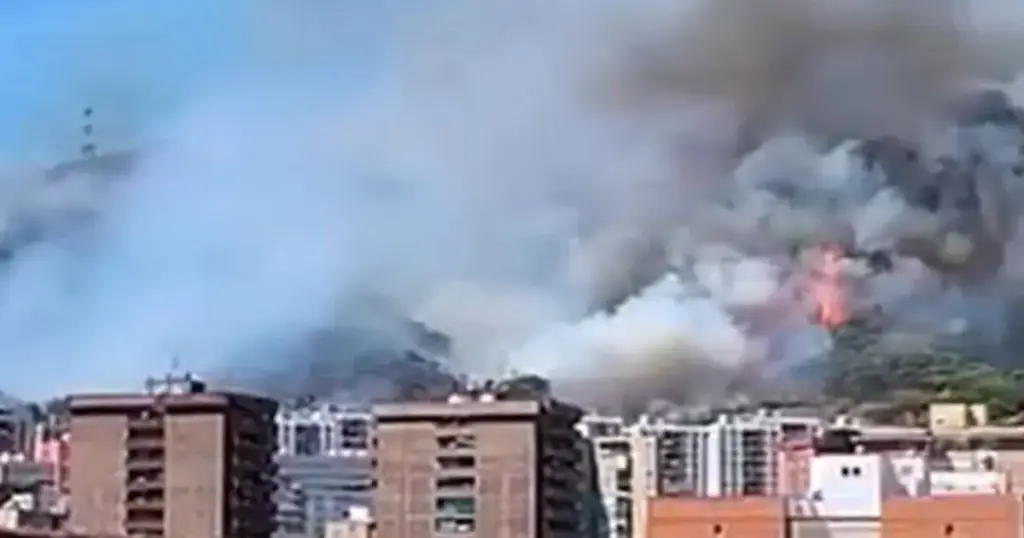
BARCELONA, SPAIN — A rapidly spreading wildfire broke out in the picturesque Collserola mountain range on the outskirts of Barcelona, sending towering plumes of toxic black smoke billowing into the Mediterranean sky and triggering immediate emergency protocols across the region.
The blaze, which erupted around midday, has already scorched approximately 25 hectares of dense vegetation, bush, and scrubland. Chilling footage shared widely across social media captured the sheer scale of the inferno, including the catastrophic explosion of a high-voltage transmission tower near the coastal town of Canyelles.
As regional firefighting forces and civil protection authorities scramble to bring the wall of fire under control, mandatory lockdowns have been enforced in multiple neighborhoods. Motorists, international tourists, and local residents alike have been warned to give the affected zones a wide berth as emergency services battle what is rapidly evolving into one of the most threatening urban-periphery fires of the season.
Executive Overview
The crisis began shortly before noon local time on Tuesday, August 25, 2026, when a vegetation fire ignited in the brush and scrubland near the Canyelles neighborhood within Barcelona’s sprawling Nou Barris district. Fueled by dry terrain and regional winds, the flames quickly leaped through the rugged topography of the Collserola mountain range—a sprawling natural park highly frequented by hikers, local residents, and international tourists.
Within hours, the sheer volume of smoke generated by the fire created an ominous canopy visible for miles, drawing hundreds of panicked eyewitness reports. The Catalan emergency dispatch service, 112, was inundated with more than 1,000 calls in a matter of hours as residents watched flames march dangerously close to residential sectors.
The disaster escalated significantly when a high-voltage electricity tower suffered a catastrophic structural failure, reportedly exploding amid the intense heat and further compounding the risks for emergency responders on the ground. Catalan civil protection authorities wasted no time, deploying mobile phone emergency alerts to enforce strict stay-at-home orders in the path of the advancing flames, while municipal police closed down vital regional roadways to facilitate the transit of heavy firefighting equipment.
Detailed Chronology of the Disaster
11:30 AM – 12:00 PM: Ignition and Initial Spread
According to localized accounts and municipal sources, the fire ignited in an area of dense brush and low-lying vegetation near the Canyelles neighborhood. Dry summer conditions provided ideal fuel for the nascent blaze. Driven by localized updrafts along the Collserola ridge, the fire quickly transitioned from a localized brush fire into a fast-moving front, generating thick, carbonaceous smoke that prompted early alarms from nearby communities.
12:00 PM – 1:30 PM: Surge in Public Alarm and Aerial Visibility
As the fire front expanded across the rugged terrain, passengers aboard an incoming Ryanair flight caught terrifying aerial glimpses of the billowing black plumes dominating the horizon above Barcelona. On the ground, social media platforms began flooding with user-generated content showing massive walls of fire consuming timber and undergrowth. At the height of this phase, Spain’s 112 emergency hotline logged an astonishing 1,074 calls within a compressed timeframe, reflecting deep public anxiety.
1:30 PM – 2:30 PM: Infrastructure Failure and Neighborhood Lockdowns
The situation took a perilous turn when the intense heat caused a high-voltage transmission tower to fail, resulting in a dramatic explosion witnessed by locals and captured on camera. Recognizing the imminent danger of smoke inhalation and unpredictable fire behavior, the Generalitat de Catalunya (Catalan Government) authorized emergency mobile alerts. Residents in the vulnerable Torre Baró and Ciutat Meridiana neighborhoods were placed under an immediate, mandatory stay-at-home lockdown.
2:30 PM – 4:00 PM Onward: Road Closures and Containment Operations
With the fire having consumed roughly 25 hectares of land, civil authorities took sweeping measures to secure the perimeter. Major transit arteries, including Alta de les Roquetes Road, the Horta-Cerdanyola Road, and the access route leading to the Collserola Cemetery, were entirely shut down. Traffic was frozen in both directions at the critical junction of Roquetes Road and the Ronda de la Guineueta, creating significant commuter gridlock as emergency teams prioritized clearing pathways for water tenders and specialized wildfire suppression units.
Supporting Context & Metrics: The Anatomy of the Collserola Blaze
Understanding the severity of Tuesday’s incident requires examining the unique geographical and ecological factors that define the Collserola mountain range. Serving as the green lung of the Barcelona metropolitan area, the Serra de Collserola is a massive park spanning over 8,000 hectares, separating the dense urban expanse of Barcelona from the Vallès Occidental and Baix Llobregat regions.
- Land Affected: Official sources from the Barcelona City Council confirmed that approximately 25 hectares (approx. 62 acres) of land had been reduced to ash within the first few hours of the emergency.
- Emergency Response Volume: The public response was unprecedented for a regional incident of this scale, with 1,074 emergency calls logged by the 112 dispatch center.
- Infrastructure Impact: At least one major high-voltage transmission tower suffered a structural explosion, raising immediate concerns over potential localized power stability and electrical hazards for firefighters.
- Demographic Impact: Thousands of residents residing in the elevated neighborhoods of Torre Baró and Ciutat Meridiana were subjected to emergency confinement orders, restricted from leaving their homes due to toxic particulate matter suspended in the air.
The Collserola range is historically vulnerable to wildland-urban interface fires. Because the park directly borders densely populated residential zones—housing numerous British expats and international tourists alongside native Barcelonans—even a medium-scale brush fire instantly translates into a high-priority civil protection crisis.

Official Statements and Emergency Responses
The regional government and municipal bodies acted in swift coordination to mitigate casualties and property damage. The Catalan Ministry of Interior, alongside local municipal emergency committees, mobilized specialized firefighting units from the Bombers de la Generalitat, supported by urban fire engines and aerial water-dropping assets where smoke visibility permitted.
In an official public service announcement broadcast via automated mobile alerts, the Generalitat urged absolute compliance with safety directives:
"Due to a vegetation fire in the Collserola mountain range, residents within the Torre Baró and Ciutat Meridiana sectors are strictly ordered to remain indoors. Close all windows and doors to prevent smoke infiltration, and keep roadways clear for approaching emergency vehicles."
Local residents, deeply shaken by the proximity of the flames to their properties, voiced their despair online. One local user posting to X (formerly Twitter) under the handle @Mikel270201 shared a video of the darkening skyline accompanied by the chilling lament:
"By order of the Bombers, the entire Torre Baró neighborhood is under lockdown due to the fire in Collserola. Everything is burning up around us."
Transport authorities reiterated similar warnings, emphasizing that civilian interference on restricted roadways would severely hamper the deployment of heavy industrial water tankers. Motorists were strongly advised to completely avoid the northern perimeter of Barcelona until containment lines could be firmly established.
Future Outlook: Mitigation, Recovery, and Environmental Assessment
As emergency crews push into the evening hours to suppress remaining hotspots and prevent secondary flare-ups, attention is already turning to the long-term environmental and infrastructure recovery of the region.
1. Structural Repair and Grid Stability
The destruction of the high-voltage transmission tower presents a pressing engineering challenge for utility operators in Catalonia. Technicians will need to conduct rigorous safety inspections across adjacent power distribution networks once the fire zone is declared fully secure, ensuring that local power grids can be safely restored without risking further electrical faults.
2. Environmental Impact on the Collserola Park
The loss of 25 hectares of mature scrubland and brush within a protected natural park deals a temporary blow to local biodiversity. Environmental agencies will likely initiate soil stability assessments in the coming days. Burned slopes on the mountainous terrain of Collserola are exceptionally susceptible to erosion should autumn bring heavy rainfall, meaning preventative watershed stabilization may soon become necessary.
3. Review of Wildfire Preparedness
As climate patterns continue to intensify summer temperatures and dry out Mediterranean foliage, incidents like the Collserola fire underscore the growing vulnerability of urban-adjacent natural reserves. City planners and regional authorities will face mounting pressure to enhance preventative clearing, expand firebreak networks, and deploy advanced early-warning thermal detection sensors across high-risk mountain corridors.
For now, the immediate priority remains the total extinguishment of the blaze, the lifting of neighborhood lockdowns, and the safe return of displaced or confined citizens to their daily routines. Authorities continue to monitor weather conditions closely as shifting winds pose the primary threat to containment efforts moving forward.