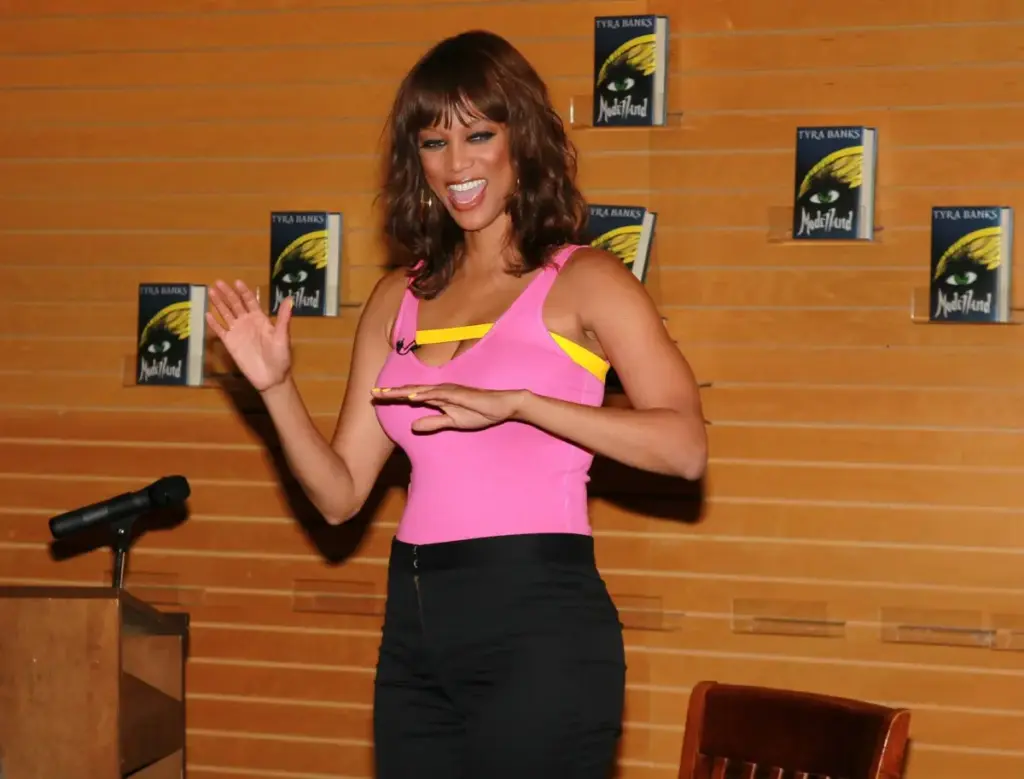
Fifteen years after its initial, largely baffling publication, Tyra Banks’ sprawling young-adult dystopian novel, Modelland, has violently clawed its way back into the cultural zeitgeist. Driven by a sudden, inexplicable viral renaissance on social media platforms like X (formerly Twitter)—sparked by the unearthing of Banks’ avant-garde, proto-hyperpop theme song for the book—the internet is once again grappling with a piece of media that defies standard literary analysis. At nearly 600 pages, the door-stopping hardcover volume rivals John Steinbeck’s East of Eden in sheer physical heft, yet it operates on a surreal, fever-dream logic that forces readers to question object permanence, the sanctity of the English language, and their own neuroses.
For the uninitiated, Modelland was intended to be the crown jewel of Banks’ post-America’s Next Top Model empire. Alongside a heavy promotional push that included an ominous promotional trailer, a dedicated Google+ page, a tie-in challenge during ANTM Cycle 17, and plans for a physical theme park, the novel was designed to launch a multi-media juggernaut. Instead, it faded quietly into obscurity.
Today, however, the book’s bizarre world-building—featuring "Forgetta-Girls," "Silent Protests by Lying Down," and water-supply-infiltrating "SMIZEs"—has become a badge of honor for internet sleuths brave enough to request it from the basement archives of public libraries. This investigative report explores the chaotic chronology of Modelland, examines the staggering metrics of its literary design, evaluates the cultural fallout of its digital resurrection, and asks the ultimate, terrifying question posed by its techno-pop theme song: Can you survive Modelland?
Detailed Chronology: A Descent Into Metopia
To understand the scope of Modelland, one must trace the harrowing journey of its protagonist, Tookie De La Crème. As a self-proclaimed "Forgetta-Girl," Tookie’s daily existence is defined by profound social neglect. She attends the Bangle, Bauble and Bead Institute (B3)—located in the factory district of Peppertown within the broader region of Metopia—where she frequently stages an SPLD (Silent Protest by Lying Down). Pronounced "spilled," an SPLD involves lying inert on the cold hallway floor while consuming whipped cream straight from the can, unnoticed by her peers as she approaches world-record status.
The Lead-Up to T-DOD
Life in Metopia operates under the looming shadow of Modelland itself: a towering mountain crowned by an all-seeing green eye. The narrative’s inciting tension builds toward the Day of Discovery (T-DOD), a momentous occasion when the clouds above the mountain part and Scouts descend to select young girls to become "Bellas." These chosen few will undergo rigorous schooling in Modelland, aspiring to join the elite class of the "7Seven Intoxibellas," avoid the fate of menial servitude, or dodge the absolute worst-case scenario: becoming actresses.
Compounding the societal pressure are the SMIZEs—seven mystical entities sent down from Modelland through the local water supply. Manifesting as yellow bubbles that emerge from household faucets before popping into gold talismans worn on the forehead, these magical drops grant citizens a precise 91% chance of being "Discovered" at T-DOD.
The Catalyst and the Quest
Tookie, despite speaking 28 languages (which she meticulously logs in her "T-Mail Jail" journal using color-coded pens), is decidedly not Modelland material. Her heart belongs to class president Theophilus Love, whose perpetual re-election campaign features buttons bearing the slogan "VOTE FOR LOVE." When one such button is accidentally scratched into reading "T O O K E," Tookie takes it as a profound cosmic sign.
The plot thickens with the introduction of superstar Intoxibella Ci~l (pronounced "see-el") and rival characters like Zarpessa, Theophilus’s girlfriend who secretly dumpster-dives for provisions. Following an absurd encounter with a Scout camouflaged as a car—a creative choice seemingly lifted straight from a Transformers mood board—Tookie miraculously finds a SMIZE and is "Discovered."
Thrust into the dark, labyrinthian world of Modelland, she acquires the obligatory plot companions: Dylan (who lives in a structure resembling a Walmart), Shiraz (a Bollywood nepotism baby), and Piper (a member of an ethnic group of genius albinos). Together, they navigate creatures like the LeGizzâcœurds, who subsist on Colorian sweetbreads, embarking on a labyrinthian trial that tests every boundary of narrative cohesion.
Supporting Context & Metrics
Evaluating Modelland requires a dataset that accounts for both its physical enormity and its conceptual absurdity.
- Page Count: Approaching 600 pages, the novel places an immense physical and psychological burden on the reader. For comparison, it matches the literary real estate of classic American epics, yet utilizes its pages for concepts like "dee-nay-nay" (how Tookie’s sister Myrracle pronounces DNA).
- Linguistic Diversity: Protagonist Tookie is fluent in 28 languages, though her linguistic gymnastics are largely eclipsed by the book’s own invented lexicon, which includes terms like Forgetta-Girl, Intoxibella, Chameeleone, and SMIZE.
- Digital Virality: The resurgence was sparked by a single X post sharing Banks’ avant-proto-hyperpop theme song. The refrain—"can you, can you, can you, can you survive Modelland?"—quickly amassed hundreds of thousands of impressions, driving traffic to local library systems where archival copies are meticulously hidden away in youth sections like TeenScape.
- The ANTM Cross-Pollination: The promotional campaign reached its zenith during Cycle 17 of America’s Next Top Model, where contestants were forced to hold the very same "VOTE FOR LOVE" buttons in an editorial shoot while declaring, "I am Tookie."
Official Statements and Industry Reception
When Modelland debuted in 2011, the literary establishment was largely left speechless, and marketing executives struggled to position a high-concept YA fantasy written by a supermodel icon. While Tyra Banks promoted the book with relentless enthusiasm—framing it as an empowering allegory for embracing one’s flaws and unconventional beauty—critics and readers found themselves disoriented by its hyper-stylized prose.
In recent weeks, as archivists and pop-culture historians revisit the text, public sentiment has shifted from polite bewilderment to morbid fascination. Social media commentary characterizes the reading experience as "an act of confronting one’s own neuroses head-on" and "what I imagine waterboarding to feel like."
Though Banks has not released a formal statement regarding the 2026 digital resurgence of the Modelland theme song or the viral rediscovery of Tookie De La Crème, cultural critics note that the renewed interest speaks to a broader modern appetite for camp, early-2010s internet nostalgia, and unbridled, unfiltered artistic ambition.
Future Outlook: Can We Ever Escape Modelland?
As the internet continues to dissect the dizzying lore of Modelland—from Tookie’s enigmatic paternity to Lizzie’s tree-dwelling, mattress-bound demonic possessions—the question remains: What does the future hold for Tyra Banks’ literary outlier?
While a physical theme park never materialized and the book remains out of print in traditional retail channels, the digital age has granted Modelland a strange, immortal afterlife. Public libraries across the country are reporting an unprecedented, albeit bewildered, spike in inter-library loans for the few remaining hardcover editions tucked away in basement archives.
Whether this viral moment will translate into a broader re-evaluation of Banks’ literary output or remain a fleeting, beautiful fever dream of the queer internet is yet to be seen. What is certain, however, is that anyone brave enough to crack open its 600 pages will never look at a yellow bubble, a can of whipped cream, or a high school hallway floor the same way again.
As the hypnotic refrain echoes across social media feeds once more: Can you, can you, can you, can you survive Modelland? Only time—and an ironclad constitution—will tell.