Executive Overview
In an era where urban policing requires creative tactics to counter sophisticated criminal networks, the Metropolitan Police have once again demonstrated the value of tactical deception. In a meticulously planned operation in Poplar, east London, officers bypassed the countermeasures of a high-priority, wanted gang member by deploying two of the city’s most ubiquitous figures: a food delivery rider and a street cleaner.
The suspect, identified as Roy Hallissey, had successfully evaded law enforcement for an extended period by maintaining strict surveillance over his local haunts. Recognizing that conventional police presence immediately triggered Hallissey’s escape route, undercover operatives adopted everyday disguises to blend seamlessly into the bustling urban landscape. Approaching from multiple blind spots, the officers executed a swift, text-book ambush that caught the suspect completely off guard.
A subsequent search of Hallissey yielded not only Class A narcotics but also a lethal, concealed machete tucked tightly into his waistband. The successful apprehension brought an end to a violent spree that included a previous stabbing conviction, assaults on emergency workers, and multiple breaches of court-ordered restrictions. With Hallissey subsequently pleading guilty to a catalogue of serious offences, this high-stakes arrest highlights both the escalating dangers faced by frontline police officers and the ingenious lengths to which modern law enforcement must go to keep communities safe.
Detailed Chronology: The Anatomy of an Undercover Takedown
The Elusive Target
Roy Hallissey was no stranger to law enforcement. Known locally in the East End as a volatile figure with deep gang affiliations, Hallissey had cultivated a routine designed specifically to elude capture. He frequently frequented a bustling market area in Poplar, utilizing the crowded stalls, narrow alleyways, and dense foot traffic as natural defensive shields.
Local police intelligence revealed a clear pattern: whenever marked patrol cars entered the vicinity or officers in recognizable uniforms approached, Hallissey’s network of lookouts would sound the alarm. He would invariably vanish into the labyrinth of surrounding housing estates before any tactical containment could be established.
Furthermore, Hallissey carried a heavy burden of warrants for his arrest. He had previously been convicted of a violent stabbing—a crime that underscored his capacity for extreme, unprovoked violence. Following his conviction, he failed to surrender to the court for sentencing, effectively turning himself into a fugitive. Compounding his criminal record were active warrants for assaulting emergency workers, driving offences, and flagrant violations of a Criminal Behaviour Order (CBO) that explicitly barred him from setting foot in Poplar.
Shifting Tactics: Operation Blend-In
Frustrated by repeated failed attempts to corner the suspect using standard patrol units, specialized teams within the Metropolitan Police decided to flip the script. Intelligence units mapped out Hallissey’s daily movements, noting that he paid little attention to the everyday urban workers who populated his immediate environment.
In a densely populated metropolis like London, delivery riders weaving through traffic and street cleaners managing public sanitation are part of the visual white noise. Citizens rarely second-guess their presence. Capitalizing on this psychological blind spot, the operation was greenlit for an unconventional urban ambush.
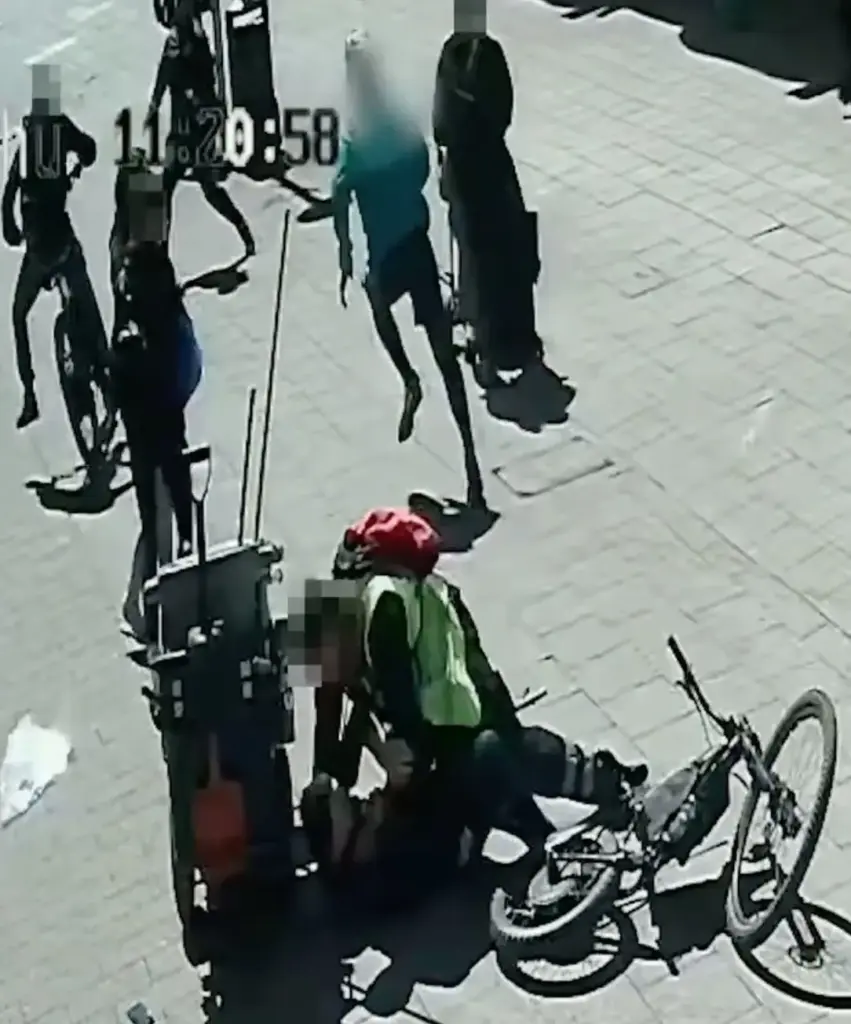
On the day of the operation, two undercover officers slipped into character. One donned high-visibility gear and assumed the role of a street cleaner, gripping a litter picker and sweeping the pavement near Hallissey’s known coordinates. The second officer dressed as a takeaway delivery rider, complete with an insulated delivery backpack, positioning themselves on a bicycle nearby.

The Springing of the Trap
The execution required split-second timing and precise coordination. As Hallissey walked into the target zone, assuming his usual posture of watchful paranoia, he scanned the perimeter for police cruisers or officers in uniform. Seeing none, his guard dropped.
Moving from opposite directions, the "street cleaner" and the "delivery rider" closed the physical gap between themselves and the suspect without raising suspicion. Within moments, the disguise was dropped. Closing in with explosive speed, the officers tackled Hallissey before he had even registered the threat.
Recognizing the extreme risk posed by the suspect, the officers immobilized him instantly. A rapid pat-down search confirmed their worst fears: concealed securely within his waistband was a heavy, razor-sharp machete. Along with the deadly weapon, officers recovered a quantity of Class A drugs, cementing the reality that Hallissey was actively engaged in serious criminality while on the run.
Supporting Context & Metrics: The Reality of Knife Crime and Urban Policing in London
The Blade Culture Crisis
The discovery of a machete on Hallissey’s person underscores a grim reality confronting the UK capital: the proliferation of bladed weapons in urban crime. While firearms remain heavily restricted and statistically less common in routine street crime compared to the United States, knife and machete culture has presented an unprecedented challenge for the Metropolitan Police.
According to recent crime statistics released by the Home Office and the Office for National Statistics (ONS), knife-enabled crime across England and Wales continues to be a primary focus of law enforcement resources. London, as the nation’s largest urban hub, bears a disproportionate share of these incidents. Gang-affiliated individuals frequently resort to large, easily accessible bladed articles—such as zombie knives, hunting knives, and machetes—to assert dominance, protect illicit drug operations, and ward off rival factions.
The danger these weapons pose to frontline officers cannot be overstated. A suspect carrying a concealed machete can deploy lethal force within milliseconds, leaving officers with virtually no reaction time. The decision by the Met Police to utilize specialized undercover tactics rather than a heavy-handed, uniformed rush was not merely a matter of catching a fugitive; it was a calculated risk-mitigation strategy designed to prevent a lethal confrontation on a crowded public street.
The Role of Specialized Undercover Units
The Metropolitan Police Service (MPS) relies on a tiered approach to combat organized crime and violent offenders. While neighbourhood policing teams build community trust and intelligence, covert and proactive taskforces are frequently deployed to handle high-risk individuals who refuse to surrender voluntarily.
Undercover operations of this nature require extensive planning, psychological profiling, and rigorous risk assessments. Operatives must undergo specialized training to blend seamlessly into fast-paced urban environments. The use of everyday civilian personas—ranging from tradespeople and delivery personnel to joggers and public transport commuters—allows law enforcement to bridge the gap between high-tech surveillance and old-fashioned street-level operational craft.
Furthermore, tackling suspects who breach Criminal Behaviour Orders (CBOs) is a cornerstone of modern London policing. CBOs are designed to protect vulnerable communities from persistent offenders, but their efficacy hinges entirely on enforcement. When individuals like Hallissey treat such orders with contempt, police must deploy innovative measures to restore public confidence in the judicial system.

Official Statements and Judicial Proceedings
Guilty Pleas and Legal Fallout
Following his dramatic capture in Poplar, Hallissey was remanded in custody and processed through the criminal justice system. Faced with overwhelming evidence—including body-worn video footage of the arrest, the recovery of the machete, and forensic links to his previous offences—Hallissey’s legal defense had little room to maneuver.
In subsequent court appearances, Hallissey formally entered guilty pleas to a comprehensive charge sheet:
- Possession of a bladed article (referencing the machete found in his waistband)
- Breach of a Criminal Behaviour Order (for entering the Poplar area where he was legally banned)
- Assaulting emergency workers (connected to his prior evasion history)
- Driving offences
- Escaping lawful custody
The accumulation of these charges guarantees a substantial custodial sentence. Legal analysts note that possessing a high-risk weapon while actively wanted for violent crimes significantly elevates the baseline sentencing guidelines in UK courts.
Judicial Timeline
Hallissey has been remanded in custody pending his final sentencing hearing, which has been officially scheduled for October 7. The presiding judge is expected to weigh the severity of his previous conviction for stabbing, his blatant disregard for court orders, and the inherent danger of carrying a lethal weapon in a public market space when handing down his punishment.
Future Outlook: Implications for Metropolitan Policing
The successful apprehension of Roy Hallissey serves as a watershed moment for tactical policing strategies in London. As criminal networks become increasingly sophisticated in counter-surveillance—utilizing lookouts, encrypted communications, and rapid-escape routes—law enforcement agencies are compelled to innovate in kind.
The Evolution of Covert Tactics
Industry observers and criminologists anticipate that the Metropolitan Police will increasingly lean on unorthodox, low-profile operational methods. The "delivery rider and street cleaner" gambit demonstrated that blending into the socio-economic fabric of modern urban life is often more effective than traditional displays of tactical force.
As the gig economy continues to reshape the landscape of British cities—with thousands of couriers traversing streets on bicycles and mopeds daily—police forces have found a ready-made blueprint for surveillance and tactical positioning.
Community Impact and Public Confidence
For the residents and business owners of Poplar, Hallissey’s removal from the streets represents a profound sigh of relief. Local communities frequently bear the brunt of gang-related intimidation, open-air drug dealing, and weapon-enabled violence. When high-profile fugitives operate with impunity, public trust in the rule of law erodes.
By utilizing ingenuity and tactical surprise to bring a dangerous individual to justice without causing collateral harm to innocent bystanders, the Metropolitan Police have reinforced their commitment to community safety. As London prepares for the autumn judicial term, the upcoming sentencing of Roy Hallissey on October 7 will close a dangerous chapter of east London crime—while simultaneously establishing a new benchmark for proactive, undercover urban policing.