Executive Overview
When the cultural lexicon invokes the name Frankenstein, it immediately summons a specific, centuries-old iconography: jagged surgical scars, heavy flannel bolts, bolted necks, and an aesthetic dominated by grim industrial decay and the grim hues of nineteenth-century gothic horror. Yet, in Yorgos Lanthimos’s cinematic reimagining of Poor Things—adapted from Alasdair Grey’s seminal 1992 postmodern novel—this traditional visual vocabulary is violently upended. Instead of wretchedness, the audience is greeted by a breathtaking explosion of color, radical silhouette manipulation, and an avant-garde pastiche of late-nineteenth-century fashion that feels strikingly contemporary. At the heart of this visual revolution is protagonist Bella Baxter, brought to life by Emma Stone, whose harrowing yet whimsical journey from a resurrected suicide victim to an autonomous, intellectually liberated woman is tracked meticulously through her wardrobe.
Spearheaded by visionary costume designer Holly Waddington, the film’s wardrobe serves as a dynamic narrative engine rather than mere background dressing. Eschewing strict historical accuracy in favor of psychological resonance and visceral impact, Waddington crafted a sartorial universe that mirrors Bella’s cognitive evolution, her rebellion against patriarchal confines, and her unquenchable thirst for experiential knowledge. From juvenile oversized bloomers to hyper-modern streetwear-adjacent ensembles and armor-like copper gowns, the costumes of Poor Things do not simply decorate the frame—they interrogate the very nature of bodily autonomy, societal conditioning, and female liberation. This in-depth analysis explores the intricate mechanics behind the film’s costume design, charting Bella’s psychological trajectory through the textiles, textures, and tailoring that define one of the most visually arresting cinematic achievements of the decade.
Detailed Chronology: The Evolution of Bella Baxter’s Wardrobe
To understand the transformative power of fashion within Poor Things, one must trace Bella Baxter’s life not merely through plot beats, but through the shifting fabrications that envelope her body. Waddington’s design arc tracks Bella from a tabula rasa—a woman with the brain of an infant housed in the fully grown body of an adult—into a self-actualized intellectual capable of dismantling the patriarchal structures that seek to contain her.
1. The Tabula Rasa: Childhood, Confusion, and the Aesthetic of the Uninhibited
We are first introduced to Bella Baxter within the sterile, eccentric sanctuary of her creator and surrogate father figure, Dr. Godwin Baxter (Willem Dafoe). Having survived a fatal leap into the Thames, Bella has been resurrected via a radical, unorthodox cerebral transplant. Initially functioning with the cognitive and motor skills of a child, her physical presentation immediately signals this arrested socialization.
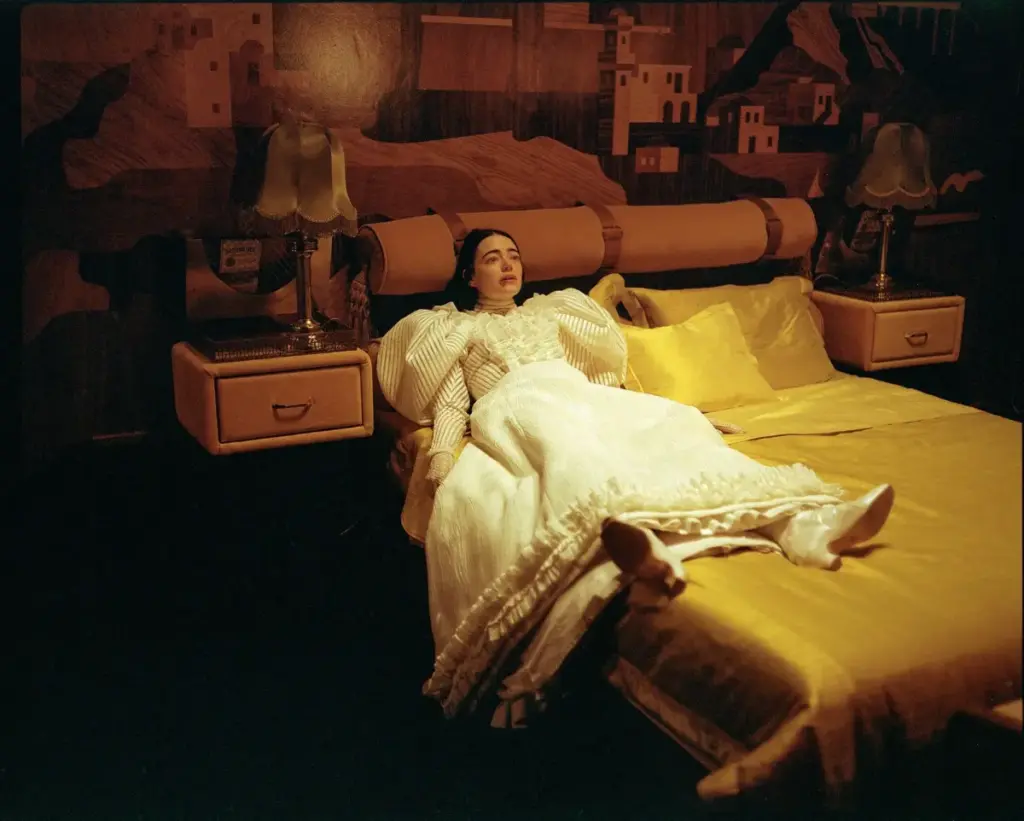
Dressed in voluminous, infantile tops and dramatic, oversized bloomers, Bella’s early garments evoke a sense of unbridled impulsivity and organic chaos. Waddington deliberately avoided historical recreation, opting instead for silhouettes that felt wild and structurally unhinged.
“[Lanthimos] did not want me to stay historically faithful with the costumes,” Waddington explains, noting her initial dive into 1890s trends—such as exaggerated sleeves—before subverting them. “I used Victorian silhouettes, but looked for ways to reinterpret the textures of the time. For me, they had to feel wild, chaotic, and organic.”
These early looks position Bella as an entity untouched by societal shame or the rigid behavioral codes of the Victorian era. She moves through the laboratory and the walled estate with an unfiltered, animalistic curiosity, her clothes serving as soft, billowing shells that accommodate her unpredictable physical jolts and uncoordinated strides.
2. The Awakening: Streetwear Sensibilities in the Victorian World
As Bella breaks free from the sole environment she has ever known, embarking on a sprawling continental odyssey alongside the hedonistic lawyer Duncan Wedderburn (Mark Ruffalo), her wardrobe undergoes a dramatic metamorphosis. Stepping out into the wider world, her fashion transforms into a vibrant pastiche of saturated hues, exaggerated proportions, and startlingly modern design choices that could easily be culled from contemporary London Fashion Week street-style blogs.
This transition marks her expanding consciousness. No longer confined to the estate, Bella’s insatiable appetite for new experiences—sexual, intellectual, and geographical—is mirrored in her increasingly complex layers:
- The Modernist Mix: In one striking sequence, Bella pairs a pristine white ruffled top with canary-yellow shorts, accessorized with micro-sized black sunglasses, a cropped cobalt-blue jacket, and utilitarian ankle boots.
- Textural Fluidity: Another iconic combination features a sheer, flowing pink skirt cascading beneath another structural white ruffled blouse.
- Class Consciousness: As her travels expose her to stark economic disparities, her garments subtly register her awakening awareness of privilege. Confronted with widespread poverty for the first time, her realization of her own upper-class standing is framed by a pristine Victorian dress boasting immaculate white puffed sleeves—a stark visual barrier between her and the suffering of the lower strata.
Waddington’s genius here lies in bridging the historical gap. By injecting modern streetwear sensibilities into a late-nineteenth-century framework, the designer creates a temporal disorientation that mirrors Bella’s own outsider status. She does not belong to the Victorian epoch; she is a futuristic anomaly dropped into its suffocating corsets.
3. The Patriarchy’s Garnish: Confinement and the Illusion of Conformity
As the narrative progresses, the film peels back layers of Bella’s past, revealing the suffocating orthodoxies of the patriarchal society she is desperately trying to outrun. In scenes depicting her former life—where she was subjugated by social expectations and marital imprisonment—Waddington pivots sharply away from the whimsical and infantile toward the severe, monumental, and oppressive.
Drawing direct inspiration from nineteenth-century photographic archives of upper-class women, Waddington encased Emma Stone in garments designed to exude visual imprisonment. Among these is a striking, deep-blue gown paired with a rigid, traditional heavy coat, alongside a breathtaking, armor-like copper dress accented with intricate golden filigree.
“I wanted a strong contrast [to the looks she wears after the experiment],” notes Waddington. “These outfits are impressive, gorgeous, very serious—and deeply telling.”
The copper dress, in particular, functions as a wearable cage. Its metallic rigidity and defensive plating symbolize the emotional and physical armor forced upon women within bourgeois Victorian marriages. It is a brilliant piece of visual metonymy: Bella is encased in precious metals, treated as a valuable possession rather than a sentient human being.
4. Self-Actualization: Stripping Away the Artifice
The culmination of Bella’s arc—her ultimate liberation from both scientific ownership and romantic subjugation—is manifested in a quiet, profoundly grounded sartorial rejection. In the film’s closing movements, having integrated her past, rejected the suffocating demands of men, and claimed her identity as a medical student and independent thinker, Bella sheds the theatricality of her wardrobe entirely.
She is seen wearing a simple, understated cream-colored knit pullover paired with a sweeping copper maxirock. The look is devoid of the structural madness of her early bloomers and the crushing weight of her aristocratic gowns.
“At that point, those are just clothes,” Waddington reflects. “I wanted her outfit to look as though she had finally found herself—as if she knew exactly who she was.”
This minimalist conclusion completes the thematic circle. The clothes no longer speak for Bella; they merely serve as the comfortable, unassuming skin of a woman who has finally learned to inhabit her own mind and body entirely on her own terms.
Supporting Context & Metrics: Deconstructing the Production
To contextualize the scale of Poor Things, one must examine the production parameters and the collaborative dynamic between director Yorgos Lanthimos and costume designer Holly Waddington. Known for his uncompromising visual style—previously displayed in The Lobster, The Killing of a Sacred Deer, and The Favourite—Lanthimos demanded an aesthetic that refused to pander to conventional period-piece expectations.
- The Silhouette Philosophy: Waddington’s department focused heavily on manipulating human proportions to evoke psychological states. The use of oversized sleeves, expanding from the shoulders, was intended to give Bella an insectoid, restless energy—as though she were perpetually about to take flight or lash out.
- Color Psychology: While male characters like Godwin Baxter and Duncan Wedderburn are largely tethered to a muted palette of earth tones, charcoal, and deep navy—signaling their adherence to the rigid, fading structures of the nineteenth-century establishment—Bella’s wardrobe operates on an escalating chromatic scale. Starting with muted tones, it explodes into electric blues, vivid pinks, sunny yellows, and stark whites as her world expands.
- The Subversion of Bridal Norms: One of the film’s most discussed ensembles is Bella’s unconventional wedding dress. Waddington deliberated for days over whether a character as radically non-conforming as Bella would ever wear a traditional bridal veil. The resulting compromise—wrapping the sheer white veil tightly across the lower half of Stone’s face—created an arresting, silencing image that simultaneously nodded to traditional matrimonial erasure while weaponizing it as an avant-garde mask. Stone herself has frequently cited this specific look as her personal favorite from the entire production.
Official Statements and Design Philosophy
The theoretical underpinnings of the costumes were shaped by extensive dialogue between Lanthimos’s distinct directorial vision and Waddington’s historical deconstruction.
Speaking on the challenges of costuming a character whose brain age and physical age are in constant tension, Waddington emphasized the necessity of effortless rebellion:
“She has spent years not participating in the real world and has undergone a brainwash,” Waddington explained during production notes. “That gives her a certain impulsivity—and I therefore loved the idea of putting her in effortless-looking yet striking styles.”
This commitment to "effortlessness" within an otherwise highly stylized, maximalist cinematic universe prevented the film from tipping into mere pastiche. Every ruffled collar, every anomalous pair of sunglasses, and every structural sleeve served to anchor Stone’s physically demanding, fearless performance. The wardrobe acted as an extension of Bella’s nervous system: twitchy, expansive, defensive, and ultimately, profoundly free.
Future Outlook: The Lasting Legacy of Poor Things on Cinematic Fashion
As Poor Things cements its status as a defining cultural touchstone of the mid-2020s, its impact on both cinematic costume design and contemporary fashion trends is already proving indelible. Holly Waddington’s work has established a fresh blueprint for period-adjacent filmmaking—proving that historical eras do not need to be treated as museum glass cases, but rather as raw clay to be molded by thematic necessity.
By fusing late-nineteenth-century silhouettes with hyper-modern textures and streetwear sensibilities, the film has opened up a new stylistic dialogue for directors tackling revisionist history and gothic fantasy. Future filmmakers working within speculative or historical-fantasy spaces will undoubtedly look to Poor Things as a masterclass in how to exteriorize internal psychological liberation through textile choice.
Ultimately, Bella Baxter’s journey from a scientific specimen encased in chaotic bloomers to a self-possessed intellectual in a simple knit sweater demonstrates the ultimate power of costume design: when executed at the highest level of artistry, clothes do not just make the character—they map the soul.