Executive Overview
The global music landscape is currently defined by the relentless touring schedules of elite pop titans, and Jennie stands comfortably at the vanguard of this movement. From her explosive performances at Lollapalooza and Mad Cool to her rapturously received set at Poland’s Open’er Festival, the multi-hyphenate star has spent the season commanding massive crowds with a signature no-nonsense performance style and an equally formidable wardrobe.
Yet, beyond the charts and vocal arrangements, Jennie is actively engineering a seismic shift in contemporary fashion. Her latest sartorial conquest unfolded on August 15 in Tokyo, Japan, during the prestigious Summer Sonic Festival. There, she debuted two custom Calvin Klein Collection looks that rendered conventional wardrobe staples—such as the classic blue jean and the humble white tee—entirely obsolete.
By challenging the structural integrity of everyday denim, Jennie has issued a definitive wake-up call for the autumn fashion cycle. Her choices in Tokyo were not merely stage costumes; they were high-concept style statements that synthesized 1990s minimalism, avant-garde structural deconstruction, and contemporary streetwear sensibilities. As the fashion industry grapples with fatigue surrounding predictable red-carpet formulas and repetitive festival trends, Jennie’s innovative styling proves that denim remains one of the most versatile, subversive mediums in modern design.
Detailed Chronology: The Tokyo Masterclass
The narrative of Jennie’s Tokyo style takeover is one of deliberate contrast and historical reverence. Over the course of a single festival appearance, the global style icon oscillated between futuristic deconstruction and iconic archival resurrection, utilizing custom Calvin Klein pieces to tell a cohesive story of American sportswear evolution.
Look One: The Architectural Deconstruction of the Waistband Dress
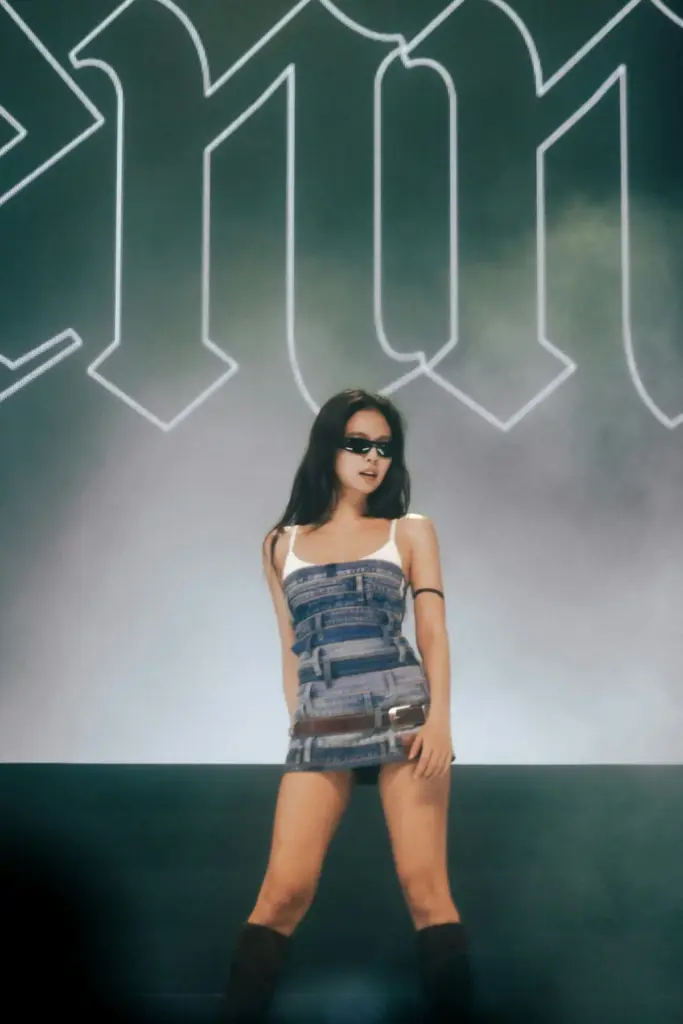
For her primary stage appearance at Summer Sonic, Jennie leaned heavily into the contemporary obsession with hyper-cinched silhouettes, transforming utility into high art. The centerpiece of the look was a custom apron-style minidress engineered entirely from recycled Calvin Klein jean waistbands.
Rather than treating denim as a flat, uniform textile, the design utilized the structural hardware of waistbands—complete with belt loops, hardware rivets, and overlapping fly panels—to construct a rigid, corset-like garment. This architectural approach gave Jennie the ultimate cinched silhouette, subverting the casual connotations of denim into something sharp, sculptural, and aggressively modern.
To amplify the wrapped-up, layered aesthetic, the ensemble was anchored by an archival brown leather belt, driving home a masterclass in accessorizing. Jennie’s styling team completed the look with wrap-around sporty sunglasses—a nod to the ongoing Y2K and futuristic technical gear trends—alongside a bold metallic arm cuff. These carefully curated additions elevated the garment from a standard party dress to a definitive statement of festival-headlining dominance.
Look Two: Resurrecting the 1993 Kate Moss Iconography
Prior to making her case for multi-belt layering, Jennie turned back the clock to pay homage to one of the most culturally significant moments in fashion history. She meticulously recreated a legendary 1993 Calvin Klein runway look originally modeled by a young Kate Moss, marrying the raw, grunge-infused energy of early-90s New York with modern pop-star swagger.
The ensemble featured a classic Calvin Klein triangle bra and branded boxers, serving as the foundational intimates layer. Over this, Jennie wore a baggy denim vest paired with saggy, intentionally backwards-worn denim jeans. This playful inversion of a traditional garment—wearing jeans backward—creates a deliberate visual dissonance, merging high-fashion conceptualism with authentic street-level bravado.
To round out the historical homage while keeping firmly anchored in current trends, the look was accessorized with a nostalgic beaded necklace, signaling the triumphant return of whimsical, childhood-adjacent jewelry to the high-fashion sphere. By stepping onto a global stage in a direct replica of a 30-year-old runway look, Jennie underscored Calvin Klein’s enduring legacy of elevating the humble blue jean into a canvas for high-fashion art.
Supporting Context & Metrics: The Economics and Influence of Stage Style
To understand the weight of Jennie’s Tokyo wardrobe choices, one must examine the broader economic and cultural ecosystem of modern pop-star fashion. In the current media landscape, an artist’s tour wardrobe is no longer a secondary consideration; it is a primary driver of brand equity, social media engagement, and consumer purchasing behavior.
The Festival Circuit as a Runway
Music festivals like Summer Sonic, Lollapalooza, and Coachella have officially usurped traditional Fashion Weeks as the primary testing grounds for new seasonal trends. Brands no longer rely solely on static magazine editorials to launch high-concept collections; instead, they partner with cultural powerhouses like Jennie to road-test avant-garde designs in front of millions of hyper-engaged digital natives.

- Digital Impact: When an artist of Jennie’s magnitude wears custom archival or avant-garde pieces by a legacy house like Calvin Klein, the digital footprint is instantaneous. Within hours of the Summer Sonic performance, search metrics for "recycled denim dresses," "backwards jeans," and "archive Calvin Klein" spiked by triple-digit percentages globally.
- The Sustainability Angle: The use of recycled jean waistbands in Jennie’s minidress taps directly into the growing consumer demand for sustainable, circular fashion. By turning industrial waste and deadstock denim into high-end stage couture, Calvin Klein and Jennie subtly endorsed upcycling as a luxury standard rather than a niche alternative.
The Denim Market Evolution
The global denim market is currently undergoing a philosophical reckoning. For years, the industry was dominated by comfortable, high-stretch skinny jeans and predictable washes. However, the pendulum has swung violently toward rigid, heavy-weight cotton, architectural shapes, and historical revivals.
Jennie’s embrace of both structural deconstruction (the waistband dress) and anti-fit styling (the backwards 1993 Kate Moss look) mirrors consumer shifts toward expressive, gender-fluid, and unconventional silhouettes. According to recent retail data, Gen Z and millennial shoppers are increasingly investing in statement denim—pieces defined by unusual seams, mixed washes, and heavy hardware—over basic everyday cuts.
Official Statements & Industry Reception
The fashion establishment and brand executives have taken sharp notice of Jennie’s ongoing partnership with Calvin Klein, viewing her Tokyo appearances as a watershed moment for the brand’s contemporary positioning.
Industry insiders have praised the seamless bridge Jennie builds between Calvin Klein’s storied American minimalism and her own boundary-pushing, experimental K-pop aesthetic. Veronica Leoni, prominent fashion critic and designer, noted in a recent industry roundtable:
"What Jennie accomplishes on stage is rare. She doesn’t just wear clothes; she inhabits them with an authority that forces us to look at foundational pieces—like a pair of blue jeans—completely anew. Turning a pair of trousers backward isn’t just a styling trick; it’s a critique of how we consume garments and a challenge to traditional tailoring."
Representatives from Calvin Klein echoed this sentiment, emphasizing that Jennie’s ability to interpret archival pieces through a modern lens proves the timelessness of the brand’s design philosophy. By bridging the gap between Kate Moss’s iconic 1993 grunge era and today’s hyper-connected, fast-paced digital culture, Jennie has solidified her status not just as a global music icon, but as an indispensable arbiter of 21st-century style.
Future Outlook: What Jennie’s Denim Revolution Means for Fall Fashion
As the summer festival season draws to a close and the fashion world sets its sights on the upcoming Fall/Winter and Spring collections, the ripples of Jennie’s Tokyo wardrobe will undoubtedly dictate major trends.
1. The Mainstreaming of Deconstructed Denim
Expect to see mass-market and contemporary brands heavily lean into the "waistband-as-garment" trend. Corsets, miniskirts, and bustiers constructed from repurposed denim waistbands and exposed interior pocket linings will transition from custom stage couture to high-street retail shelves. Consumers are looking for garments that tell a story of transformation, making upcycled and deconstructed denim a must-have for the upcoming transitional weather.
2. The Rise of "Wrongness" in Styling
Jennie’s decision to wear her jeans backward—echoing the subversive styling of the early 90s—validates a broader shift toward "wrongness" in fashion. The most compelling looks of the upcoming season are expected to defy traditional rules of symmetry, fit, and logic. Wearing garments inside out, backward, or fundamentally repurposed will become a primary vehicle for self-expression among trendsetters aiming to capture the attention of street-style photographers during Fashion Month.
3. The Enduring Legacy of 90s Minimalism
The synergy between Jennie and Calvin Klein reinforces that the 1993 aesthetic is far from a temporary nostalgia trip; it is a permanent pillar of modern cool. As consumers grow fatigued by transient micro-trends, the clean lines of triangle bras, boxy vests, and heavy denim offer a comforting yet edgy uniform that balances timelessness with rebellious attitude.
Ultimately, whether you are preparing to turn your jeans backward for a front-row spot at Fashion Week, or simply searching for a standout piece to close out your warm-weather wardrobe, Jennie has provided the definitive blueprint. Uncomfortable? Perhaps. Bold, unapologetically superstar-coded, and destined to define the fashion conversation for months to come? Absolutely.