Executive Overview
Best-selling author, television producer, and presenter Richard Osman has long captured the public imagination with his razor-sharp wit, intellectual charm, and cultural ubiquity. From his tenure as the co-host of the BBC quiz show Pointless to his phenomenal literary success with The Thursday Murder Club series, Osman is a fixture of British entertainment. However, behind the polished television persona lies a deeply moving and turbulent personal history.
In recent interviews, including an extensive profile with The Times, the 55-year-old multi-hyphenate has opened up about the formative years of his childhood—a period defined by sudden abandonment, financial scarcity, and a profound lack of personal freedom following his father’s departure. When Osman was just nine years old, his father left the family home for another woman, uprooting his domestic life and casting his mother, Brenda, into decades of single-parent financial strain.
This article explores the trajectory of Richard Osman’s life, detailing the emotional fallout of his father’s affair, the resilience of his mother, the protective drive that now fuels his immense financial success, and the creative legacy born from the retirement home community that inspired his blockbuster literary empire. Through a comprehensive look at his background, his creative output, and his intentional distance from his paternal lineage, this piece examines how childhood adversity can ultimately forge an unshakeable adult resolve.
Detailed Chronology: From Sussex Upheaval to Literary Stardom
1. The Fracture: A Nine-Year-Old’s World Turns Upside Down
The trajectory of the Osman family changed forever in the mid-1970s. Richard Osman was only nine years old when his father abruptly walked out on the family home in Sussex to start a new life in Warwickshire with a new partner. The separation was not amicable, and the departure of the household’s primary financial earner immediately destabilized the family dynamic.
For Brenda Osman, then left to raise Richard and his older brother—who would grow up to become Mat Osman, the bassist for the iconic alternative rock band Suede—the reality of single motherhood was stark. Without a safety net, Brenda was forced to navigate the British economic landscape of the era with limited resources.
Years of Menial Labor and Economic Strain
To make ends meet, Brenda took on a succession of low-paying, menial jobs just to keep food on the table and a roof over her sons’ heads. Eventually, through sheer determination and grit, she retrained and secured a position as a primary school teacher—a respectable profession, but one that offered little in the way of accumulated wealth or financial security.
Reflecting on those years, Richard Osman has been unflinchingly candid about the psychological toll of growing up without financial cushioning. In interviews, he has noted that his childhood lacked both money and the essential component that money buys: freedom.
"I’ve made sure my mum doesn’t have to struggle, because she struggled forever," Osman told The Times. "It’s freedom, money. Because I didn’t have freedom, and anybody who grew up without money knows that."
This scarcity defined the brothers’ upbringing. While both Richard and Mat ultimately carved out extraordinary, creative paths in their respective fields, the memory of those constrained years in Sussex left an indelible mark. For Richard, financial stability in adulthood has never been merely about luxury; it has been about erasure—wiping out the persistent anxiety of want that plagued his mother for decades.
Total Estrangement and the Paternal Divide
The immediate aftermath of the separation saw a complete and permanent severance of ties between the Osman children and their father. Osman has described his father’s affair and subsequent departure as the worst thing to have ever happened to him, noting that the emotional impact rippled through the household for years.
The family collectively cut off contact with the father who left. When father and son eventually crossed paths two decades later, the meeting confirmed what time had already cemented: the relationship was entirely irreparable. There was nothing left to salvage.
This total estrangement profoundly shaped Richard’s perspective on genealogy and identity. When approached in 2022 to participate in the hit BBC genealogy program Who Do You Think You Are?, Osman declined to investigate his paternal ancestry. For him, looking into that side of the family tree held no emotional resonance or psychological value. To explore his paternal heritage, he explained, would be "like learning about strangers." His true lineage was the one forged in the trenches of single motherhood alongside his mother and brother.
Supporting Context & Metrics: The Economics of Success and Creative Inception
Achieving Financial Security and Peace of Mind
Today, the narrative of struggle is balanced by a narrative of profound redemption. Driven by decades of television production, presenting, and an unprecedented run as a literary powerhouse, Richard Osman has achieved a level of financial independence that ensures his entire family is permanently insulated from hardship.
- The Publishing Phenomenon: Osman’s Thursday Murder Club series has shattered publishing records, selling millions of copies globally, translating into dozens of languages, and dominating international bestseller lists.
- The Hollywood Adaptation: The intellectual property rights were snapped up by Amblin Entertainment, culminating in a major Netflix film adaptation featuring a star-studded ensemble cast, including Dame Helen Mirren and Sir Ben Kingsley.
- Television Legacy: Before his reinvention as a novelist, Osman co-created and hosted Pointless, served as a team captain on House of Games, and worked as a creative director at Endemol UK, overseeing hits like Deal or No Deal and 8 Out of 10 Cats.
This staggering accumulation of wealth has allowed Osman to fulfill his most fundamental personal objective: ensuring that Brenda Osman, now 84, lives out her later years in absolute comfort, dignity, and security.
From Retirement Living to Global Bestseller
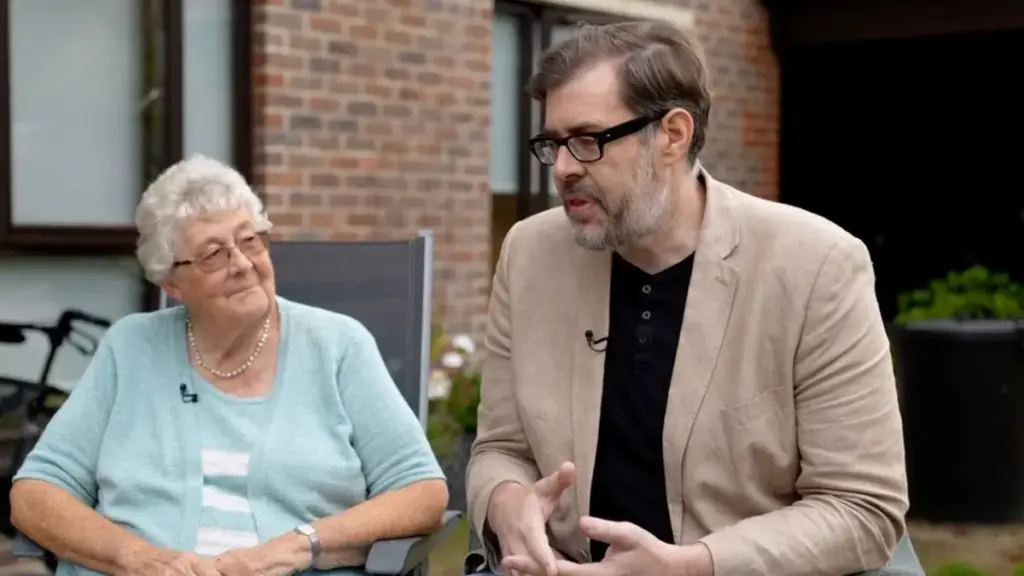
Irony often shapes art, and in Osman’s case, his mother’s living situation directly catalyzed his literary career. Brenda resides in a retirement village in Sussex—the very environment that sparked the imagination for The Thursday Murder Club.
Instead of portraying retirement communities as places of quiet decline, Osman envisioned his characters—a group of sharp-witted pensioners living in a palatial countryside estate—as active, formidable investigators solving cold-case murders. The warmth, humor, and depth of observation in the novels draw heavily from the realities of aging, community, and dignity that he observed firsthand through visiting his mother.
Official Statements and Reflections
Richard Osman’s reflections on his upbringing offer a masterclass in emotional honesty. Eschewing the tendency of public figures to sanitize their pasts, he has consistently highlighted the stark contrast between his early life and his current reality:
“I’ve made sure my family are safe and secure. I’ve got more money than when I was growing up, that’s for sure.”
Regarding the paternal side of his family and his decision to turn down the invitation to explore his ancestry on television, Osman told the Radio Times:
“My dad’s side of the family wasn’t something I was interested in because that’s not the family I grew up in. It would, in a funny way, be like learning about strangers.”
He has also emphasized that despite the trauma of his parents’ separation and the financial difficulties that followed, the absence of his father was ultimately counterbalanced by the strength of the remaining family unit:
“It’s okay. The other side of my family more than made up for it. They’re a lovely bunch. We fetishise our family a bit.”
Future Outlook: Legacy, Writing, and Protective Stewardship
As Richard Osman looks to the future, his priorities remain firmly rooted in the protective stewardship of his loved ones and the continuation of his literary endeavors. Having conquered both television and publishing, he has demonstrated that early-life disadvantage does not dictate lifelong limitation, though its emotional footprints remain permanent.
For readers and fans, Osman’s transparency serves as a powerful reminder of the human stories behind public success. His journey from a Sussex home grappling with the fallout of infidelity and scarcity to the pinnacle of international literary acclaim underscores a vital truth: true security is not merely about accumulating wealth, but about breaking destructive cycles and ensuring that those who sacrificed the most are finally allowed to rest in peace and freedom.