Executive Overview
For decades, the fitness industry has operated under a heavy barbell bias. Traditional bodybuilding splits—characterized by isolation movements, high-volume hypertrophy sets, and relentless pursuits of localized muscle growth—have dominated commercial gym floors. While these heavyweight protocols undoubtedly serve a vital purpose for individuals committed to long-haul hypertrophy, they frequently leave a significant gap in everyday athleticism. Many trainees find themselves caught in a cycle of static lifting, sacrificing movement variety, joint mobility, cardiovascular agility, and true functional power in exchange for sheer size.
Enter a paradigm shift designed not to just make you look good, but to fundamentally alter how you move. Developed by renowned kettlebell specialist and certified strength and conditioning coach Marcus Martinez, C.S.C.S., a revolutionary 31-day training program breaks the monotony of standard bodybuilding routines. By trading heavy racks of dumbbells and barbells for a single, versatile piece of cast iron—such as the widely acclaimed Bowflex SelectTech 840 Kettlebell—trainees can completely overhaul their physical capabilities.
This program shifts the fitness objective from localized muscle growth to the cultivation of explosive strength, dynamic speed, rotational power, and total-body coordination. Designed to be seamlessly integrated into a month-long training block, this minimalist yet brutally effective routine challenges the human body to perform at its athletic peak. Requiring nothing more than consistency, proper biomechanics, and a medium-weight kettlebell, this comprehensive blueprint offers a masterclass in modern functional fitness.
Detailed Chronology & Weekly Implementation
To extract maximum physiological adaptation from Martinez’s 31-day protocol, strict adherence to structure is non-negotiable. The program operates on a four-day training split, strategically interspersed with active recovery days to ensure optimal central nervous system (CNS) recovery and muscular repair.
The Weekly Schedule Framework
- Day 1: Training Session A (Warmup, Strength Circuit 1, Strength Circuit 2, Finisher)
- Day 2: Training Session B (Warmup, Strength Circuit 1, Strength Circuit 2, Finisher)
- Day 3: Active Recovery (20-minute low-intensity walk, run, or bike ride)
- Day 4: Training Session C (Warmup, Strength Circuit 1, Strength Circuit 2, Finisher)
- Day 5: Training Session D (Warmup, Strength Circuit 1, Strength Circuit 2, Finisher)
- Day 6: Active Recovery (20-minute low-intensity walk, run, or bike ride)
- Day 7: Complete Rest / Mobility Work
Phase 1: The Warmup Circuit
No high-output training session should ever begin cold. Martinez mandates a targeted, two-movement warmup circuit designed to prime the posterior chain, lubricate the shoulder girdle, and awaken dormant stabilization pathways. Trainees must execute three continuous sets with zero rest between movements.

- a. Chest-Supported Good Morning
- The Biomechanics: Stand with feet shoulder-width apart, holding a single kettlebell securely against your chest. Introduce a soft bend in the knees, then actively drive your hips backward into a deep hip hinge, allowing your torso to track downward toward the floor.
- The Execution: Descend only until your hamstrings register a strong, acute stretch, ensuring your shoulders remain elevated above the level of your hips. Pause momentarily, then forcefully reverse the motion by driving your hips forward and squeezing your glutes to return to the starting position.
- Duration: Perform continuous repetitions for 20 seconds.
- b. Bottoms-Up March
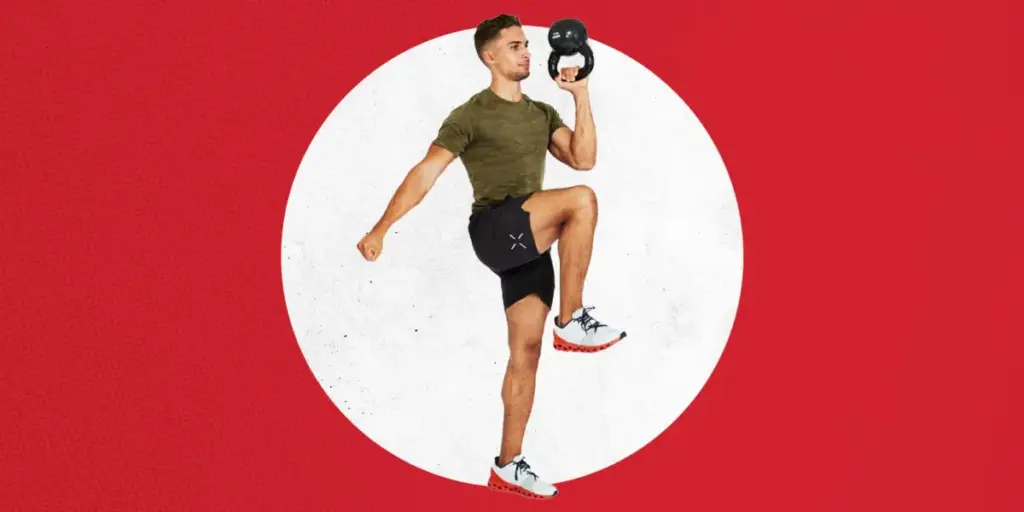
- The Biomechanics: Grip the kettlebell by the handle with the heavy bell facing upward toward the ceiling, establishing a strict "bottoms-up" position. Your forearm should remain locked in a vertical plane, perpendicular to the floor.
- The Execution: Engage your core to stabilize against the inherent instability of the inverted bell. Begin marching in place, driving your left knee high toward your chest, followed by your right. Alternate steps fluidly for 20 seconds without allowing the bell to tip or lean. Switch hands and repeat.
Phase 2: Strength Circuit 1
Transitioning from the warmup, Strength Circuit 1 targets explosive hip power, total-body balance, and unilateral upper-body stability. Trainees will perform three complete sets, resting 45 seconds between individual movements and 90 seconds upon completing a full set.
- a. Dead-Stop Swing
- The Biomechanics: Position yourself standing directly behind the kettlebell resting on the floor. Hinge deeply at the hips, maintain a neutral spine, and grasp the handle with both hands, tilting the bell slightly toward your body.
- The Execution: Hike the bell backward between your legs like a football center. In one explosive, ballistic motion, snap your hips forward and squeeze your glutes, driving the kettlebell outward and upward in front of you using pure hip power rather than shoulder elevation. Allow the natural momentum to swing the bell back between your thighs, guide it back to the floor, and come to a complete, dead stop before initiating the next repetition.
- Prescription: 8 to 10 crisp repetitions.
- b. Split Jerk
- The Biomechanics: Stand tall with your core braced and glutes locked, holding the kettlebell at your right shoulder in the traditional front-rack position.
- The Execution: Dip slightly at the knees and hips to load the lower body, then aggressively reverse direction, driving upward through the floor. Jump slightly while simultaneously pressing the kettlebell overhead. Land dynamically in a staggered split stance, with your left foot forward and your right foot back, locking your arm out securely overhead. Return under control to the standing position.
- Prescription: 8 to 10 repetitions per side.
Phase 3: Strength Circuit 2
Building upon the explosive foundations laid in Circuit 1, the second strength block targets unilateral lower-body mechanics, single-leg stability, and posterior chain resilience. Complete three sets, observing 45 seconds of rest between exercises and 90 seconds of rest between full sets.
- a. Racked Reverse Lunge
- The Biomechanics: Assume a stable standing position with the kettlebell secured in the right-side rack position at your shoulder.
- The Execution: Take a deliberate step backward with your right leg. Lower your body by bending both knees until your trailing knee kisses or hovers just above the floor, ensuring your front left thigh is parallel to the ground. From this deep position, drive explosively through your front foot to return to a standing posture.
- Prescription: 8 to 10 repetitions per side.
- b. Staggered-Stance Deadlift
- The Biomechanics: Hold the kettlebell firmly in your right hand with your core rigidly braced. Step your right foot slightly backward, lifting your right heel so that your weight shifts predominantly onto your working left foot.
- The Execution: Push your hips straight back and hinge forward at the waist, lowering the torso while maintaining a flat back. Descend until you feel maximal tension in the left hamstring, ensuring your shoulders remain perfectly parallel to the floor without rotational twisting. Drive through the heel to stand tall, squeezing the glutes at lockouts.
- Prescription: 8 to 10 repetitions per side.
Phase 4: The Finisher
To cap off the training session, Martinez implements a high-density finisher designed to push metabolic thresholds, test muscular endurance, and forge bulletproof rotational power. Perform the two-movement sequence back-to-back with zero rest, completing as many rounds as possible within a strict 5-minute window.
- a. Figure 8 to Hold
- The Biomechanics: Hold the kettlebell in your left hand. Maintain a flat back, push your hips slightly back into a mini-squat, and weave the bell cleanly through your legs, transferring the grip into your right hand.
- The Execution: As the bell clears your legs, stand tall out of the hinge and explosively pull the kettlebell up to your left hand positioned tightly at your chest. Reverse the pattern.
- Prescription: 3 sets of 10 fluid repetitions.
- b. Kettlebell Clean
- The Biomechanics: Stand centered over a kettlebell with your feet set at shoulder width. Hinge at the hips, bend your knees, and secure a firm grip on the handle with both hands.
- The Execution: Drive your feet into the floor and stand explosively—rising onto your toes at the peak of extension—while pulling the bell upward close to your chest in a tight, vertical trajectory. Effortlessly catch the bell in the rack position at your shoulders before lowering it smoothly back down to your hips and finally to the floor.
- Prescription: 3 sets of 8 repetitions.
Supporting Context & Scientific Metrics
Transitioning from traditional hypertrophy training to an explosive, kettlebell-centric functional program yields profound physiological adaptations. Understanding the underlying science clarifies why minimalist training yields maximal athletic returns.
Metabolic Demand and Excess Post-Exercise Oxygen Consumption (EPOC)
Unlike isolated machine work, ballistic kettlebell movements like the Dead-Stop Swing and Kettlebell Clean demand simultaneous recruitment of multiple large muscle groups. According to sports science literature, ballistic multi-joint lifts elicit a significantly higher heart rate and metabolic equivalent (MET) demand than traditional steady-state cardio or seated resistance training. This high metabolic cost triggers a pronounced EPOC effect, meaning the body continues to oxidize fat and expend calories at an elevated rate long after the final set of the finisher has been completed.

Neuromuscular Adaptation and Rate of Force Development (RFD)
Traditional bodybuilding heavily emphasizes time-under-tension and slow, controlled eccentric phases to maximize muscle fiber tearing and subsequent repair. Conversely, Marcus Martinez’s protocol prioritizes the Rate of Force Development (RFD). By teaching the nervous system to recruit motor units rapidly and explosively—particularly through movements like the Split Jerk and Dead-Stop Swing—trainees enhance their fast-twitch (Type II) muscle fiber responsiveness. This translates directly to superior vertical jump heights, enhanced sprinting acceleration, and superior deceleration mechanics in everyday life.
Unilateral Stability and Core Integrity
Every single movement in this 31-day blueprint leverages asymmetrical loading. Whether holding a single kettlebell in the rack position during a reverse lunge or executing a bottoms-up march, the core musculature—including the transverse abdominis, obliques, and erector spinae—must work overtime to prevent lateral flexion and rotational collapse. This constant anti-rotation challenge builds a resilient, injury-resistant core that far outperforms standard crunches or sit-ups.
Official Statements & Expert Philosophy
The philosophy underpinning this program challenges deeply entrenched fitness dogmas. For years, fitness enthusiasts have been conditioned to believe that building a formidable physique requires an arsenal of specialized machinery, cable stacks, and heavy Olympic barbells. Marcus Martinez, C.S.C.S., argues that this mindset is not only restrictive but fundamentally inefficient for the average individual seeking vibrant, real-world health.
"When we lock ourselves into rigid, machine-based bodybuilding splits, we often sacrifice the human body’s most primal design: fluid, multi-planar movement," explains Martinez. "The kettlebell is the great equalizer of modern strength conditioning. By forcing an individual to interact with an offset center of gravity, we bridge the gap between raw strength and functional agility. You aren’t just building muscle; you are teaching your nervous system how to absorb force, transfer energy, and react dynamically under stress."
Fitness industry veterans echo this sentiment, noting that minimalist training tools like adjustable kettlebells (such as the Bowflex SelectTech 840, which spans weights from 8 to 40 pounds) democratize high-level athletic training. By eliminating the friction of cluttered home gyms or crowded commercial facilities, trainees can execute high-intensity, compound-driven sessions anywhere, anytime.

Future Outlook: Sustaining Functional Fitness Beyond 31 Days
Completing a rigorous 31-day training block is merely the prologue to a lifelong journey of athletic mastery. Once the initial month-long cycle concludes, trainees are faced with the opportunity to evaluate their progress, measure performance markers—such as improved grip strength, increased vertical power, and enhanced cardiovascular stamina—and map out their next physical evolution.
Rather than returning immediately to monotonous, single-joint bodybuilding splits, fitness experts recommend adopting a cyclical approach to training. Trainees can integrate a kettlebell-dominant functional block like Martinez’s every quarter to reset neuromuscular pathways, protect joint health, and prevent overuse injuries.
Furthermore, the principles learned during this month-long immersion—such as proper hip-hinge mechanics, unilateral core bracing, and explosive force generation—permeate every other facet of physical culture. Whether transitioning back to heavy barbell squats, taking up endurance running, or simply navigating the physical demands of daily life with grace and vitality, the body that emerges from this 31-day challenge is fundamentally transformed. By breaking free from the constraints of conventional gym routines, practitioners unlock a higher tier of physical autonomy: looking exceptional, feeling unbreakable, and moving like a true athlete.