Executive Overview
In an era dominated by fleeting digital footprints, ephemeral messages, and algorithmic noise, the enduring value of physical craftsmanship stands as a radical act of preservation. Nowhere was this more palpable than inside New York City’s exclusive Crane Club, where luxury legacy house Montblanc recently hosted the most coveted celebration of the season. Marking a monumental 100 years of leather goods craftsmanship—dating back to the introduction of its pioneering leather collections in 1926—the maison transformed the Manhattan venue into an immersive sanctuary celebrating the objects we carry, the instruments we write with, and the legacy items we pass down through generations.
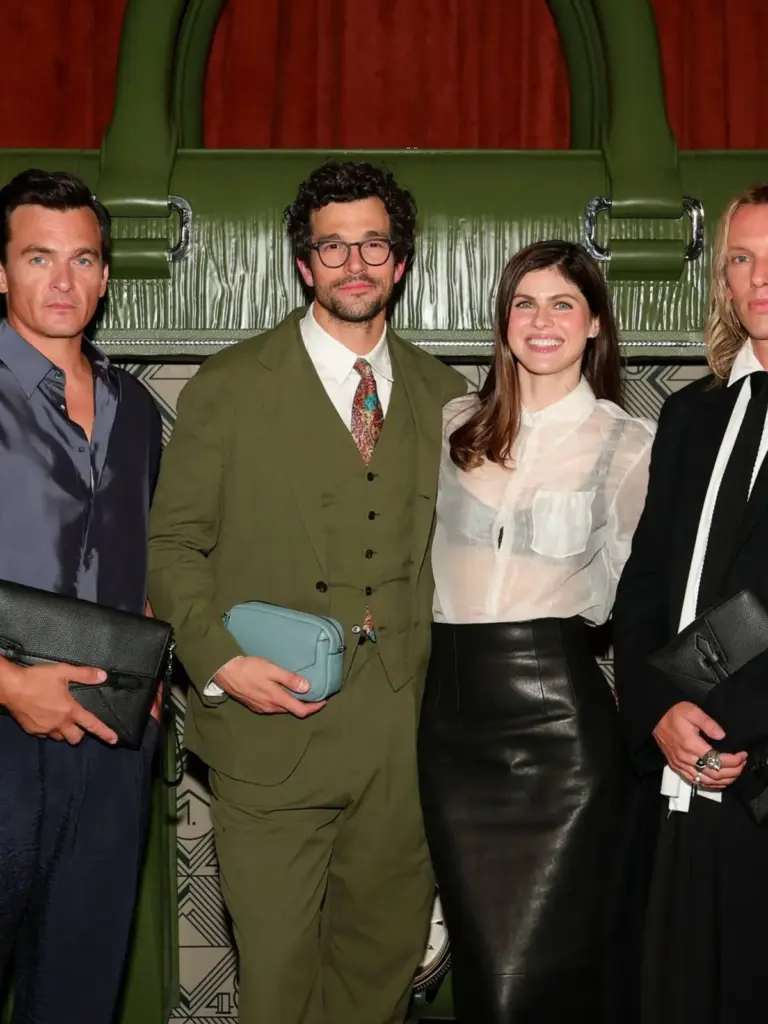
The centennial event functioned as a masterclass in experiential luxury marketing, bridging the gap between a storied European heritage and the kinetic, late-night energy of modern New York City. Drawing an elite, cross-disciplinary guest list comprising celebrated actors, visionary designers, avant-garde artists, top-tier models, and prominent cultural tastemakers, the evening underscored Montblanc’s historic and ongoing relationship with the global creative class.
At the helm of this vision was Montblanc CEO Giorgio Sarné, whose stewardship has emphasized the vital necessity of analog rituals in an increasingly virtual world. Under Sarné’s leadership, the brand has doubled down on its founding ethos: that the tactile sensations of fine leather, the satisfying weight of a precision-engineered fountain pen, and the friction of nib against paper are not merely nostalgic relics, but essential components of the human experience. Through towering spatial installations, bespoke personalization hubs, and an electrifying soundtrack curated by legendary DJ Honey Dijon, Montblanc did not simply look back at a century of excellence—it aggressively asserted its relevance for the century to come.
Detailed Chronology of the Evening
The evening’s proceedings unfolded as a carefully choreographed journey through time, space, and sensory engagement, designed to pull attendees away from their devices and immerse them entirely in the physical world of Montblanc.
8:00 PM – Arrival and the Pulse of the Crane Club
As dusk settled over Manhattan, the guest list began arriving at the Crane Club, an exclusive venue known for its discretion, refined architectural details, and historic charm. The red carpet—though understated, in keeping with Montblanc’s sophisticated aesthetic—welcomed a dazzling array of international talent.
Paul Anthony Kelly, actress Alexandra Daddario, and Princess Marie-Olympia of Greece made their entrance, draped in ensembles that balanced contemporary high fashion with timeless elegance. They were quickly joined by an eclectic roll call of the cultural elite, including actor Will Peltz, acclaimed director Roman Coppola, designer Waris Ahluwalia, and model Kenya Kinski-Jones. Global brand ambassadors added international star power to the room, with Rupert Friend, Seo Kangjun, Kerem Bürsin, and Alfonso Herrera mingling seamlessly with New York’s downtown art and fashion scenes.
9:00 PM – Soundscapes and Spatial Design
Upon stepping past the threshold, guests were enveloped in a soundscape masterminded by legendary DJ Honey Dijon. Eschewing standard corporate playlist fare, Dijon delivered a masterclass in sonic curation, blending deep, hypnotic house beats with classic New York club rhythms. Her set provided an unmistakable urban heartbeat to the evening, creating a brilliant juxtaposition between the stately, century-old heritage of Montblanc and the cutting-edge, ever-evolving creative pulse of New York City.
The interior architecture of the Crane Club was likewise transformed. Dominating the central space was a towering, architectural installation directly inspired by Montblanc’s iconic Writing Traveler briefcase. The larger-than-life structure served as both a visual anchor and a structural homage to the brand’s engineering prowess, celebrating the spirit of exploration and travel that has defined its leather goods division since its inception.
10:00 PM – Immersive Stations: The Return of the Analog
Moving deeper into the venue, attendees encountered two interactive installations that served as the emotional and philosophical core of the evening:
- The Leather Personalization Atelier: A dedicated station staffed by master artisans allowed guests to interact directly with Montblanc’s famed leathers. Attendees could select small leather goods—such as cardholders, journals, and pouches—and have them instantly monogrammed or customized, providing a firsthand look at the bespoke craftsmanship that has sustained the maison for generations.
- The Postcard Station: In a world where interpersonal communication is almost exclusively mediated through screens, keyboards, and algorithmic chat apps, Montblanc set up an analog writing desk stocked with heavy-stock stationery, fine-nib fountain pens, and custom inks. Guests were invited to write physical postcards to friends, lovers, or themselves. Montblanc committed to collecting and mailing every piece, turning a simple party favor into a tangible, deeply personal act of communication.
Supporting Context & Metrics: A Century of Leather Excellence
While the champagne flowed and the DJ set the tone, the foundational architecture of the celebration rested on a hundred-year heritage of industrial design and artisanal mastery.
The Evolution of Montblanc Leather (1926–2026)
Though Montblanc is globally recognized as a titan of writing instruments—having revolutionized the fountain pen market with the launch of the Meisterstück in 1924—its expansion into leather goods in 1926 marked a pivotal diversification. Recognizing that the modern traveler, writer, and professional required vessels to protect and transport their tools, the brand applied the same uncompromising standards of craftsmanship to hides that it did to precious resins and metals.
- The Craftsmanship Pipeline: Every piece of Montblanc leather originates from select tanneries, primarily in Italy and Germany, where skilled artisans employ traditional tanning methods combined with cutting-edge durability testing.
- Ergonomics and Utility: Over the decades, Montblanc’s leather collections have evolved from rigid, old-world attaché cases into versatile, contemporary silhouettes—ranging from the iconic Writing Traveler briefcase to modular backpacks, folio cases, and pocket accessories designed for the modern digital nomad.
- Cultural Footprint: The brand’s items have historically been the silent witnesses to history, carried by statesmen, authors, architects, and visionaries. They are engineered not merely to hold objects, but to age gracefully alongside their owners, developing a unique patina that records the journey of the individual carrying them.
Official Statements and Executive Vision
At the heart of the centenary narrative is a clear, unwavering philosophical stance articulated by the brand’s top executives. In an exclusive statement during the event, Montblanc CEO Giorgio Sarné expanded upon the deeper meaning behind the milestone:
"For a hundred years, Montblanc leather has lived for one purpose: to celebrate the act of writing," Sarné explained to an attentive audience of cultural leaders. "As the world becomes more digital, the beauty of the tangible has never felt more essential. The touch of fine leather, the weight of a fountain pen, writing on a piece of paper — these are gestures that bring us back to what is human."
Sarné’s commentary touches upon a growing cultural anxiety: the alienation caused by hyper-digitization. As artificial intelligence, cloud storage, and virtual communication threaten to render physical touch obsolete, legacy houses like Montblanc are positioning themselves as custodians of humanity. The executive’s words frame luxury not as an exercise in ostentatious wealth, but as an investment in sensory grounding.
This philosophy was echoed by the diverse array of creatives in attendance. For director Roman Coppola and designer Waris Ahluwalia, the connection between physical tools and creative output is direct and unbreakable. Whether sketching a film storyboard on loose leaf paper or detailing architectural plans in a leather-bound journal, the physical medium dictates the depth of the thought process. The evening’s festivities served as a physical manifestation of this ethos: a room full of people whose life’s work depends on creation, gathered to honor the objects that make that creation possible.
Future Outlook: Navigating the Next Century of Luxury
As the celebrations at the Crane Club wound down and guests departed into the crisp New York night—each carrying personalized leather goods and the memory of a handwritten postcard dropped into the mail—the conversation naturally shifted toward the future.
What does the next century hold for a brand whose core identity is anchored in analog traditions?
1. The Counter-Trend of Tactile Luxury
Market analysts note a fascinating sociological counter-trend: the younger generations (Millennials and Gen Z), despite being digital natives, are showing an unprecedented appetite for analog goods. Vinyl records, film photography, physical books, and mechanical watches are experiencing historic booms. Montblanc is uniquely positioned to capture this demographic. By framing its centennial not as a nostalgic trip down memory lane, but as a modern manifesto for mindfulness and tactile engagement, the maison is successfully recruiting a new generation of creators who value permanence over disposability.
2. Sustainable Craftsmanship and Ethical Sourcing
Looking forward, Montblanc is pivoting heavily toward sustainable luxury. The next era of leather goods production requires absolute transparency in supply chains, environmentally conscious tanneries, and circular design principles. Sarné’s leadership team has signaled a commitment to ensuring that the next hundred years of Montblanc craftsmanship honors not only the human hand, but the planet from which its raw materials are drawn.
3. Fostering Global Creative Communities
Moving beyond New York, Milan, Seoul, and Tokyo, Montblanc intends to continue serving as a physical and cultural nexus for international artistry. Through artist residencies, writing grants, and curated physical gatherings, the brand is cementing its identity as more than a purveyor of accessories—it is a patron of the arts.
In a city defined by perpetual motion, ruthless gentrification, and relentless reinvention, Montblanc’s centenary celebration offered a profound, calming counter-narrative. It proved that while technology will continue to accelerate the pace of modern life, the human desire to touch, to hold, to write, and to leave a permanent mark upon the world remains entirely unchanged. Some things, as Montblanc has proven over the last one hundred years, are simply meant to last.