Executive Overview
The relationship between a costume designer and an actor is built on a uniquely vulnerable foundation. As legendary, Oscar-nominated stylist and designer Arianne Phillips so candidly puts it, the introduction is rarely a leisurely affair. “The thing about being a costume designer that’s so unique,” she muses, “is that when we meet an actor, usually for the first time, it’s like, ‘Hello, nice to meet you. Take your clothes off!’”
For Phillips, that professional greeting took on an entirely new meaning during the production of director Gregg Araki’s provocative upcoming feature, I Want Your Sex. Co-designed alongside Monica Chamberlain, the film thrust Phillips straight into a world of architectural latex and restrictive fetishwear. “It was, ‘Hello, nice to meet you. Take your clothes off and try on this latex catsuit. Or this bondage lingerie,’” Phillips recalls.
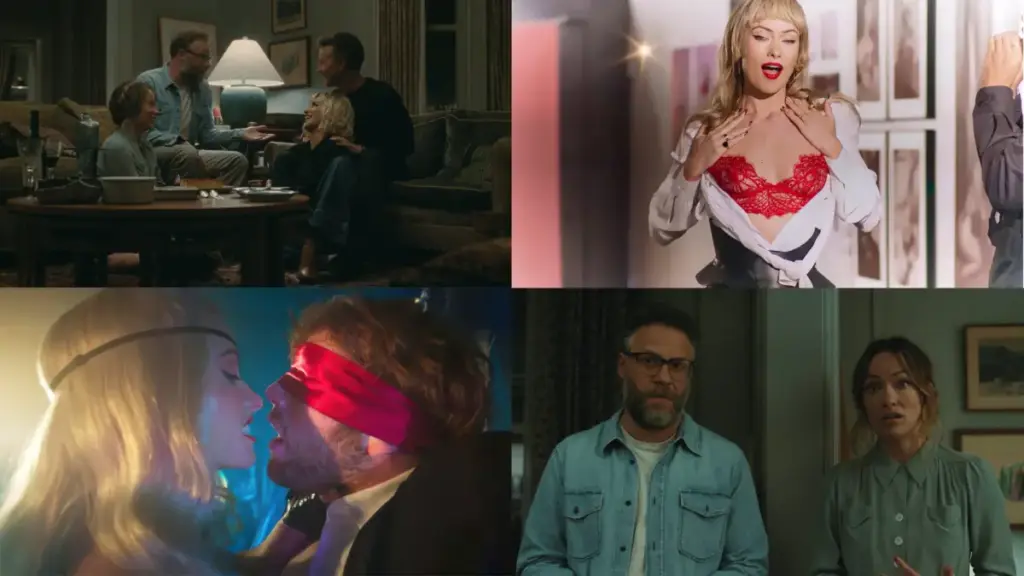
Fortunately, star Olivia Wilde proved game for anything, diving headfirst into an exploration of inverted sexual power dynamics. The film charts a complex office-environment relationship between an older, dominant woman (Wilde) and a younger, submissive man (Cooper Hoffman).
Yet, true to her chameleon-like career trajectory, Phillips followed this maximalist, fetish-adjacent playground by pivoting immediately to an entirely opposite aesthetic challenge: The Invite. Also starring Wilde alongside Seth Rogen, Penelope Cruz, and Edward Norton, the minimalist drama operates under a singular garment constraint for much of its runtime. Together, these two disparate projects highlight the staggering breadth of a career that spans over two decades of outfitting pop royalty like Madonna, alongside crafting historical visual tapestries for auteurs like Quentin Tarantino and James Mangold.

Detailed Chronology & Production Breakdown
Phase I: Constructing the Subversive World of I Want Your Sex
When Phillips first opened the script for Gregg Araki’s I Want Your Sex, she knew the visual architecture had to match the director’s distinct, uncompromising lens. Long celebrated for his hyper-stylized, counter-cultural cinema, Araki demands a deeply specific visual language.
“It always starts with the script,” Phillips explains. “And Gregg also has a specific visual language. I’m super director-oriented when I choose my projects. Working on Once Upon a Time in Hollywood with Quentin Tarantino, you’re part of a visual language. In the same way, Gregg Araki, who’s the same generation as Quentin, has his own.”
To establish the film’s sultry, transgressive atmosphere, Phillips dove deep into a curated archive of cinematic and artistic history. Her research board stretched from foundational teen memories of Paul Bartel’s 1982 dark comedy Eating Raoul—specifically highlighting Mary Woronov’s deadpan, Warhol-adjacent dominatrix—to Pier Paolo Pasolini and Bernardo Bertolucci touchstones like Last Tango in Paris and 1970s erotic dramas like The Story of O.
Layered directly over these cinematic references was the physical art of Allen Jones, the British pop artist famed for his provocative, S&M-inspired furniture. Phillips recalls encountering Jones’s work through fashion designer Rick Owens during their shared years in Los Angeles in the 1990s. This aesthetic lineage directly mirrored her own extensive two-decade tenure working alongside Madonna. Across landmark eras and massive world tours like Confessions on a Dance Floor and Rebel Heart, Phillips helped codify the pop icon’s signature deployment of undergarments as outer garments—a vocabulary that proved invaluable when outfitting I Want Your Sex.

The Fittings and the Cast
In fitting rooms located at her own home, Phillips witnessed the characters truly spring to life. Wilde approached the fittings with zero self-consciousness. “She likes to explore and she’s really curious. We had tried a lot of things that were probably a first for her,” Phillips notes.
The supporting cast matched this adventurous spirit. Cooper Hoffman, stepping into the submissive role of Elliot, was handed scripted BDSM tropes—ranging from traditional maid outfits to surreal pig masks—and embraced every iteration without hesitation. Charli XCX, rounding out the dynamic as Hoffman’s girlfriend, spent much of her screen time confined to a bed, wrapped in a narrative and sartorial cocoon that underscored the film’s claustrophobic intimacy.
Sourcing on a Deadline: A Network of Designers
Given the blistering pace of independent filmmaking, sourcing high-end fetish and avant-garde pieces required leaning heavily into a lifetime of fashion industry friendships. Alongside co-designer Monica Chamberlain, Phillips raided her own personal archives and called upon elite ateliers worldwide.
- Latex and Lingerie Houses: Legendary London-based latex couture house Atsuko Kudo supplied bespoke pieces, alongside Los Angeles-based Vex Clothing. Intimate apparel and structural bondage pieces were pulled from top-tier houses including Bordelle, Fleur du Mal, and Kiki De Montparnasse.
- The High-Fashion Vanguard: Zana Bayne, celebrated for her leather and harness work, contributed pieces alongside archival loans from Daniel Del Core—whom Phillips met during his VIP tenure with Alessandro Michele at Gucci—and Michele himself, now creative director at Valentino.
- Footwear and Styling Networks: Christian Louboutin provided specialized footwear, while stylist peers like Karla Welch (Wilde’s personal stylist) and Annie Psaltiras opened their private vaults to supply finishing elements.
Phase II: The Minimalist Constraints of The Invite
If I Want Your Sex was an exercise in maximalist leather, latex, and 28 distinct costume changes for Wilde, The Invite represented the exact inverse: a masterclass in cinematic minimalism.

The film unfolds almost entirely in real-time within a single apartment space, tracking a waning marriage (Wilde and Rogen) hosting their free-spirited upstairs neighbors (Cruz and Norton) for an evening fraught with polite tension. Wilde’s character possesses essentially a single foundational outfit.
“I have not made the choice to do a lot of contemporary films,” Phillips reflects. “And when I have done contemporary films, I’ve tried to focus on films where the characters are highly developed in the script so I could really add layers to that… I’m always looking to not repeat myself and to constantly do the opposite of what I’ve just done. I just thought it was the perfect contrast to what I had just done with Olivia.”
Treating Film Like Theater
With barely any costume changes available to signal character evolution, Phillips approached the wardrobe with the mechanical precision of a stage play. Drawing on her extensive background designing six concert tours for Madonna, she understood how to use layering as a narrative device.
For Penelope Cruz’s character, Phillips engineered garments with literal layers that could be shed as the narrative peeled back layers of psychological tension and dark revelations.

For Wilde’s character, Angela—a wealthy, non-practicing artist and stay-at-home mother—Phillips drew primary inspiration from the idiosyncratic, unmistakable style of Diane Keaton.
“She’s quirky. She has mismatched earrings. She’s wearing a ’40s-esque blouse with men’s trousers. In the beginning, we see her in overalls with ’50s cowboy boots that have embroidery,” Phillips details.
Jewelry as Character Anchors
To ground these single-outfit characters, Phillips turned heavily to statement jewelry, using accessories to compensate for the lack of wardrobe rotation.
- The Hermès Médor Watch: As a subtle personal touch, Phillips took the Hermès Médor watch off her own wrist—a rare early-1970s collector’s item with punk-rock undertones—and placed it on Wilde. It served as an anchor piece, hinting that the character had either inherited it or scavenged it on eBay.
- Artisanal Earrings and Rings: Mismatched earrings were sourced from independent designer Grainne Morton. For Cruz, whose expressive hands were captured in tight cinematic close-ups, Phillips sourced a pearl ring and a goddess-imprinted signet ring from Los Angeles artisan Hillary Heydle, paired with an interlocking chain necklace from Lizzie Mandler to symbolize her character’s role as a sexologist connecting people.
Supporting Context & Metrics
| Film Project | Primary Director | Star Cast | Key Aesthetic / Style | Notable Sourcing / Collaborators |
|---|---|---|---|---|
| I Want Your Sex (2026) | Gregg Araki | Olivia Wilde, Cooper Hoffman, Charli XCX | Architectural latex, bondage lingerie, 28 costume changes for Wilde, upscale BDSM gear. | Atsuko Kudo, Vex Clothing, Bordelle, Zana Bayne, Alessandro Michele, Christian Louboutin. |
| The Invite (2026) | Unspecified | Olivia Wilde, Seth Rogen, Penelope Cruz, Edward Norton | Real-time domestic minimalism, single-outfit focus, Diane Keaton-esque eclecticism. | Lisa Eisner, Grainne Morton, Hillary Heydle, Lizzie Mandler, Hermès. |
The Zeitgeist of Power Dynamics
The release of I Want Your Sex aligns with a broader cultural exploration of inverted power dynamics within contemporary media. Shot in the fall of 2024, the film anticipated a wave of projects examining age-gap romances and workplace authority shifts in the post-#MeToo era.

Interestingly, the script by Araki and co-writer Karley Sciortino originally featured the more traditional dynamic of an older man and a younger woman. The decision to invert the power structure—placing an older, powerful female executive opposite a younger male subordinate—injected a deliberately provocative layer into the narrative, forcing costume departments to rethink traditional signals of professional dominance.
Official Statements & Design Philosophy
Phillips’ philosophy on the intimate nature of the fitting room remains the cornerstone of her longevity in Hollywood. Where other departments rely on dialogue or camera angles, the costume trailer functions as the psychological ground zero for character creation.
"Usually, the character reveals itself in the fitting rooms. I mean, there’s no other department on a film that has that kind of intimacy."
— Arianne Phillips, Costume Designer
This intimacy requires absolute trust between the artisan and the performer, whether the task at hand involves outfitting a pop icon for a sold-out stadium tour or easing a leading Hollywood actor into restrictive latex for an independent psychological drama.

Future Outlook
As Arianne Phillips continues to balance high-budget period epics with daring, contemporary independent cinema, her career serves as a masterclass in artistic reinvention. By refusing to stay anchored to a single genre—bouncing effortlessly from Quentin Tarantino’s 1969 Los Angeles to Gregg Araki’s neon-soaked fetishistic nightscapes, and finally to the quiet, claustrophobic dining rooms of domestic drama—Phillips proves that costume design is not merely about clothing a body.
It is an active instrument of storytelling, psychological excavation, and visual world-building. As audiences prepare for the theatrical releases of both I Want Your Sex and The Invite, Phillips’ dual masterclasses in maximalism and minimalism will undoubtedly set the sartorial benchmark for years to come.