Achtung: Minor spoilers for Sofia Coppola’s ‘Priscilla’ ahead!
Executive Overview
When the world thinks of Elvis Presley, the imagery that immediately springs to mind is loud, theatrical, and aggressively vibrant: bedazzled jumpsuits, soaring capes, slicked-back pompadours, and heavy gold chains. The King of Rock ’n’ Roll was not merely a musical innovator; he was a defining architect of 1960s and 1970s pop culture aesthetics, influencing the global fashion landscape through sheer sartorial maximalism.
However, Sofia Coppola’s biographical drama Priscilla—adapted from Priscilla Presley’s 1985 memoir Elvis and Me and starring Jacob Elordi as Elvis and Cailee Spaeny as Priscilla—veers radically away from the stadium lights. Instead of celebrating the flashy, rock-god iconography, Coppola and costume designer Stacey Battat deploy clothing as a psychological instrument. In Priscilla, wardrobe tells a restrained, profoundly intimate story of a young woman slowly suffocating under the aesthetic demands of an icon, only to shed those artificial constraints and construct an independent identity piece by piece.
Battat, a longtime collaborator of Coppola who previously worked on the director’s distinct visual landscapes in The Bling Ring and The Beguiled, approached the film not as a parade of historical replicas, but as an emotional chronicle. Through meticulous archival research, high-end fashion partnerships with houses like Chanel and Valentino, and a sharp eye for the quiet nuances of subjugation and liberation, the wardrobe functions almost as a secondary protagonist. This deep-dive feature explores the costume design philosophy behind Priscilla, tracing the character’s transformation from a pastel-clad teenager in West Germany to a self-actualized woman of the 1970s.
Detailed Chronology: The Sartorial Evolution of Priscilla Beaulieu
The narrative arc of Priscilla spans over a decade, charting the evolution of a relationship from its innocent, clandestine beginnings to its inevitable fracture. Battat utilizes distinct stylistic eras to mirror Priscilla’s internal psychological shifts.
Act I: The German Innocence and the American Departure
We are first introduced to Priscilla Beaulieu at just 14 years old. Living with her military family on a U.S. Army base in West Germany, she is the epitome of late-1950s youthful innocence. Her wardrobe consists of soft pastel cardigans, sweet A-line skirts, and delicate charm necklaces.
To anchor these opening scenes in authentic historical realism, Battat and her department scoured vintage issues of Vogue and Harper’s Bazaar, analyzing the fabrics, silhouettes, and color palettes of the era. One notable visual echo in the film is pulled directly from archival photography: an image of a young Priscilla wearing a plaid dress and a translucent headscarf as she waves goodbye to Elvis as he departs Germany for the United States. Coppola and Battat painstakingly recreated this look, establishing an early visual language built on historical fidelity.
Act II: Memphis, Mandatory Glamour, and the Gilded Cage
When Priscilla relocates to Graceland in Memphis, Tennessee, to live with the global superstar, her innocent plaid skirts and hair bows are swiftly banished. Elvis swiftly assumes the role of Pygmalion, dictating not only her lifestyle but her entire physical presentation.
In a pivotal shopping scene depicted in both the memoir and the film, Elvis explicitly instructs Priscilla on what she should and should not wear. He demands that she dye her natural brown hair jet-black, pile on the heavy winged eyeliner, and adopt a more mature, glamorous aesthetic.
"That obviously influences the costumes that she wears later," Battat explains regarding this dynamic. From this juncture onward, Priscilla is boxed into a palette of Elvis-approved pinks and blues—notably devoid of patterns or earth tones, both of which the singer notoriously despised.
Yet, much of this middle chapter unfolds behind closed doors. Within the cavernous, isolated rooms of Graceland, Priscilla is frequently seen wandering in pastel-toned lingerie sets and delicate nightgowns. These intimate garments underscore her vulnerability and entrapment; she exists primarily as a domestic object of desire within her own home.
The Iconic Wedding: Recreating 1967
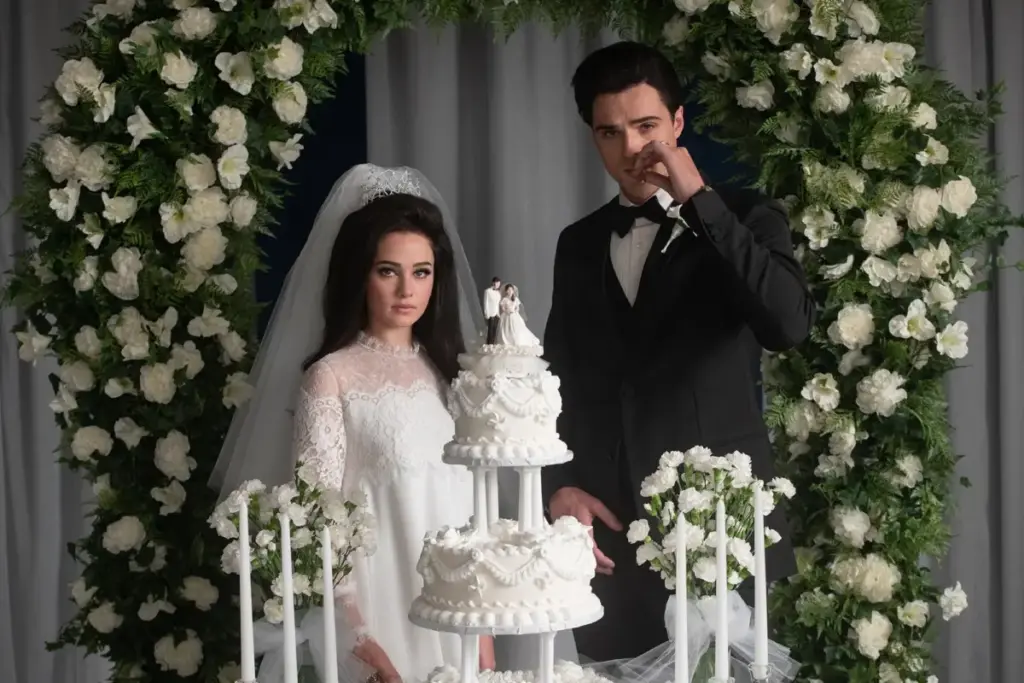
The peak of this gilded cage era culminates in the couple’s high-profile 1967 Las Vegas wedding. For this monumental sequence, Battat collaborated directly with luxury fashion houses Chanel and Valentino, who respectively designed Priscilla’s wedding dress and Elvis’s sharp wedding suit.
Mirrored precisely after historical photographs of the Las Vegas ceremony, the film features Cailee Spaeny in a floor-length, lace-trimmed A-line gown, complemented by a sparkling tiara and a waist-length veil.
"The look contains allusions to the original dress," Battat notes, addressing the technical challenges of costume recreation. "A part of it we had to adapt to fit Cailee’s height [of 1.56 meters / 5 feet 1 inch]." Similarly, the outfit Priscilla wears immediately following the birth of their daughter, Lisa Marie—a vibrant, hot-pink shift dress—is a direct, loving homage to the archival photographs of the young mother stepping out into the public eye.
Act III: Divergence, Divorce, and the Liberation of the 1970s
The second half of Priscilla splits the narrative emotionally and geographically: Elvis is at the absolute zenith of his career performing triumphant, high-octane residencies in Las Vegas, while Priscilla is increasingly isolated at home in Los Angeles.
As the couple drifts apart, their sartorial paths violently diverge. Elvis abandons his classic leather jackets and tailored suits in favor of explosive, theatrical jumpsuits—collaborating with legendary stage-costume house BK Enterprises. Meanwhile, Priscilla embraces the relaxed, fluid trends of the 1970s: sweeping wide-leg trousers, bohemian patterns, and the triumphant return of her natural, curly brown hair.
Supporting Context & Metrics: The Philosophy of the Wardrobe
To understand the weight of these visual choices, one must examine the metrics of film costume design and the specific collaborative workflow between director Sofia Coppola and Stacey Battat.
- Historical Accuracy vs. Narrative Emotion: Battat’s team processed hundreds of reference images from the Graceland archives, balancing documentary precision with the subjective emotional lens of Priscilla’s memoir.
- The Color Psychology: The strict elimination of browns and complex patterns during the Graceland years acts as a subtle cinematic prison. When Priscilla finally reclaims earth tones and natural textures in the 1970s, it signals a psychological return to earth and self.
- Scale and Proportion: With lead actress Cailee Spaeny standing at 5’1", garments had to be structurally engineered to avoid overwhelming her frame, visually emphasizing her initial fragility next to the towering, imposing physical presence of Jacob Elordi’s Elvis.
Official Statements and Design Insights
Reflecting on the collaborative process, Stacey Battat highlights a foundational piece of visual evidence that guided the entire production: a single photograph taken in 1970.
"Sofia and I looked at this picture together and both felt that Priscilla looks like she is very uncomfortable there," Battat recalls of the archival image capturing a palpable distance between the couple. "I think the photo strongly reflects how we see the two of them later in the film."
This photograph served as the North Star for the second half of the movie. While Elvis retreated further behind a fortress of greasepaint, jewelry, and theatrical stage garb, Priscilla was systematically stripping away her synthetic persona.
"We looked at historical photos of Elvis and Priscilla and thought about what image they presented to the world," Battat explains. "I think he became more and more theatrical and costume-like—lots of make-up, jewelry, and big sideburns. She, on the other hand, sheds her mask over time."
Future Outlook: The Legacy of Priscilla in Modern Cinema Fashion
Sofia Coppola’s Priscilla has already secured its place as a masterclass in cinematic minimalism and costume storytelling. By eschewing the easy trap of turning a biopic into a continuous parade of flashy rock-and-roll clichés, the film elevates costume design to a narrative necessity.
As fashion continues to cycle through 1960s mod aesthetics and 1970s bohemian ease, Battat’s work in Priscilla offers a sobering counter-narrative to the glamorous myth-making of music history. It reminds audiences that behind the rhinestones, velvet, and billion-dollar entertainment empires, real people—particularly young women in the shadows of historical titans—are often fighting a quiet, daily battle to reclaim the most precious thing of all: their own reflection.
Priscilla is now playing in theaters worldwide.