The intersection of geopolitical friction, historical revisionism, and high-stakes television drama has long served as fertile ground for prestige networks. In TNT’s eight-episode limited series, High Value Target: The Hunt for Saddam, the network tackles one of the most thoroughly scrutinized and controversial geopolitical manhunts of the 21st century: the pursuit and eventual capture of former Iraqi dictator Saddam Hussein.
At the center of this narrative is Joel Kinnaman, shedding the sci-fi gravitas of Apple TV+’s For All Mankind to adopt a bookish, mustache-sporting persona. Kinnaman stars as John Nixon, a mild-mannered Central Intelligence Agency (CIA) analyst whose academic career collides head-on with a rapidly escalating theater of war. Inspired by Nixon’s real-life memoir, Debriefing the President: The Interrogation of Saddam Hussein, the series attempts a difficult balancing act: dramatizing the vast, often clumsy bureaucratic machine of the U.S. intelligence apparatus while grounding its narrative in the claustrophobic, high-tension atmosphere of the early 2003 invasion of Iraq.
While the series suffers from uneven character writing in its domestic subplots—frequently leaning on stock tropes and underdeveloped family dynamics—it finds its footing whenever Kinnaman’s desk-bound analyst is forced out of the D.C. fluorescence and onto the volatile terrain of Iraq. Propelled by a strong central performance and a compelling eventual pivot toward the psychological chess match between captor and captive, High Value Target manages to transcend its derivative moments. For television audiences looking for a gritty, geopolitical thriller with historical anchors, the series earns a definitive recommendation to stream, provided viewers are willing to ride out a somewhat bumpy, exposition-heavy first act.
Detailed Chronology: From D.C. Desks to the Iraqi Theater
March 2003: The Gathering Storm in Washington
The series opens in Washington, D.C., in the tense weeks leading up to the U.S. invasion of Iraq in March 2003. Through a series-establishing voiceover, John Nixon reflects on the shadow of the past: "12 years since Bush Sr. pulled out of Iraq… Everyday I wake up and think, ‘Is today the day we go to war with Iraq?’"
This opening gambit establishes the thematic core of High Value Target. Nixon, a recognized expert on the Iraqi head of state, finds himself trapped in a profound ethical and professional contradiction. He understands that the impending war is largely being orchestrated by the Bush administration as a political and familial reckoning—a "do-over" for the unfinished business of the Gulf War. Yet, as a mid-level analyst, his mandate is not to question executive policy, but to supply the intelligence that justifies it. He and his colleagues are tasked with substantiating Washington’s public assertions regarding weapons of mass destruction (WMDs) and uncovering the whereabouts of high-value targets (HVTs).
Working in the windowless bowels of the CIA headquarters, Nixon’s daily routine is depicted as an exercise in futility. He sifts through what he describes as "an infinite supply of bad leads," watching as his nuanced historical analyses and reasoned probabilistic outcomes are consistently sidelined in favor of predetermined political narratives.
Transitioning to the Ground: Deploying "HVT #1"
The narrative shifts gears when the intelligence community realizes that remote analysis from Virginia is insufficient. To break the gridlock, Nixon is redeployed from his desk to the ground in Iraq. He becomes part of a specialized contingent of CIA operatives embedded alongside ongoing U.S. military operations tasked with dismantling the inner circle of the Ba’athist regime.
Saddam Hussein is officially designated as "HVT #1," with his closest family members, military generals, and loyalist ministers occupying the subsequent rungs of the target list. For Nixon, the transition from analytical observer to forward-deployed operative marks a dramatic tonal shift. The series uses this relocation to transform Nixon—at least structurally—into a frontline investigator, echoing the investigative-action tropes popularized by streaming hits like Tom Clancy’s Jack Ryan.
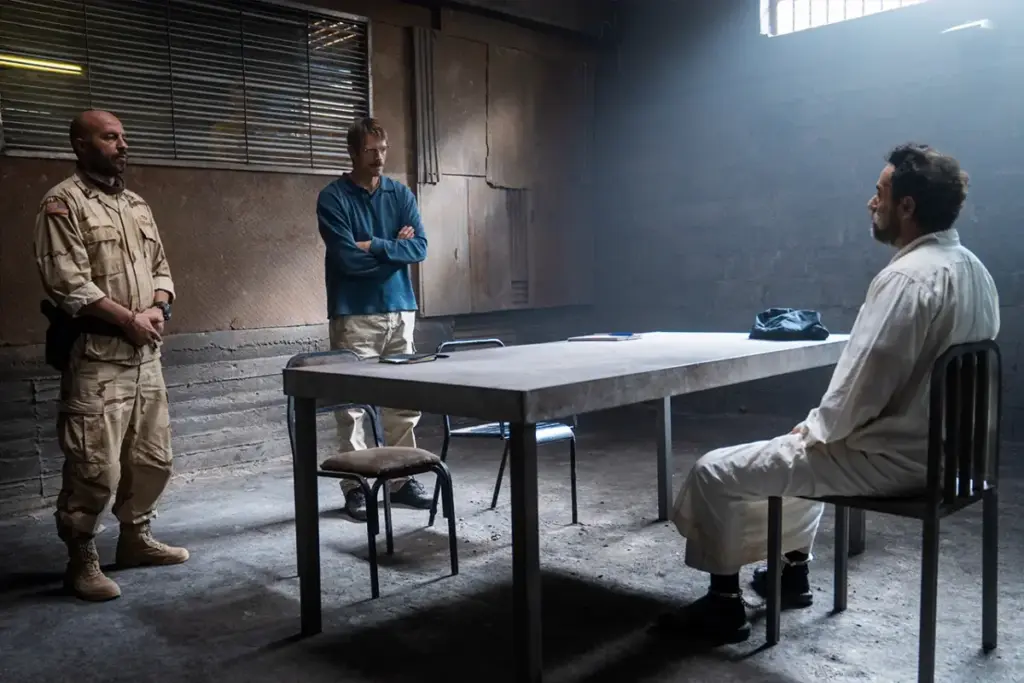
Once Nixon arrives in-country, the series accelerates toward its true narrative engine: the eventual face-to-face encounters between the American intelligence apparatus and the fallen dictator. These sequences force Nixon to strip away the abstractions of war policy and confront the human reality of a man whom geopolitical rhetoric had transformed into a mythological monster.
Supporting Context & Metrics: Behind the Scenes and Source Material
The Literary Origins: John Nixon’s Debriefing the President
To understand the dramatic liberties taken by TNT’s writers, one must examine the source material. John Nixon was not an action hero or a frontline commando; he was a political analyst whose primary responsibility was understanding the psychology, governance style, and internal dynamics of Saddam Hussein’s regime. Following the dictator’s capture in Operation Red Dawn in December 2003, Nixon was uniquely positioned to conduct formal interrogations. His book, Debriefing the President: The Interrogation of Saddam Hussein, details the stark contrast between the Western perception of Saddam as an unhinged madman and the reality of a deposed autocrat who was surprisingly detached from the day-to-day operations of his crumbling state in his final years in power.
In adapting this memoir for television, the creative team at TNT faces the classic adaptation dilemma: how to make the sedentary, cerebral work of intelligence analysis visually engaging for a broad audience. The solution—inserting Nixon directly into the kinetic, high-risk tactical operations of the early invasion—stretches historical plausibility, but it provides the necessary friction to bridge the gap between Washington’s political theater and the violent realities of post-invasion Iraq.
Production Scale and Casting Dynamics
High Value Target spans eight tightly budgeted and paced episodes, positioning itself as a prestige limited series rather than an open-ended procedural. The production leans heavily on location work and gritty, desaturated cinematography to evoke the oppressive dust and relentless tension of 2003 Iraq.
The casting choices anchor the series amidst its narrative turbulence. Joel Kinnaman delivers a performance that relies heavily on physical transformation—adopting an unassuming posture, a period-accurate mustache, and an air of academic exhaustion that contrasts sharply with his previous action-heavy roles.
However, the supporting margins of the show present a mixed bag. Domestic scenes designed to flesh out Nixon’s personal life often falter. Characters such as his wife, Rebecca (played by Rebecca Lewis), who deals with Multiple Sclerosis, and his hyper-patriotic, flag-waving father, Charles (played by Tom Berenger), who barks slogans at the television set, suffer from a lack of dimensionality. These subplots occasionally drift into melodrama, functioning more as expositional devices than fully realized human portraits.
Conversely, the supporting cast within the military and intelligence spheres provides much-needed ballast. Notably, Dar Salim delivers a standout performance as a U.S. Army translator operating in Iraq. Salim, a veteran of military-adjacent dramas (such as The Terminal List: Dark Wolf), brings an authentic gravity and cultural nuance to scenes that might otherwise default to standard Hollywood tropes.
Official Statements and Industry Reception
While TNT has positioned High Value Target as one of its flagship narrative gambits for the streaming and cable landscape, industry critics and cultural commentators have offered a nuanced evaluation of its success.
Early promotional releases from TNT emphasized the psychological depth of the project. A network representative noted during the press rollout:
"This is not merely a war story or a tactical procedural. High Value Target explores the terrifying disconnect between the men who sign the orders in Washington and the soldiers and analysts who must reconcile those decisions with the messy, human reality on the ground in Baghdad. Joel Kinnaman anchors that moral friction with remarkable vulnerability."
Cultural critics, however, have pointed out the inherent challenges of dramatizing an event as politically fraught as the 2003 Iraq War over two decades after its initiation. Reviews highlight that while the series succeeds as a propulsive manhunt thriller, its attempts to critique the Bush administration’s justifications for war occasionally clash with its adoption of traditional "manhunt" action tropes.
Despite these structural tensions, critical consensus has largely coalesced around Kinnaman’s magnetic lead performance. Reviewers note that whenever the series steps away from heavy-handed domestic drama and focuses strictly on the tactical, psychological chess match of the hunt, it achieves a high level of narrative tension that rivals major streaming competitors.
Future Outlook: The Legacy of Post-9/11 Dramas on Television
As High Value Target: The Hunt for Saddam rolls out its eight-episode arc, its reception will likely serve as a barometer for how contemporary television approaches the conflicts of the post-9/11 era. For years, Hollywood shied away from direct dramatizations of the Iraq War while the conflict was actively unfolding or fresh in the public consciousness, preferring metaphorical allegories or broad-strokes action films.
Now, with enough historical distance to permit critical re-examination, networks are increasingly willing to dissect the institutional failures, intelligence breakdowns, and human costs of that period. If High Value Target proves commercially and critically viable, it may open the floodgates for similar limited series focusing on the intricate intelligence operations that defined the early 2000s "War on Terror."
For viewers, the immediate takeaway is clear: while the series occasionally stumbles in its peripheral character writing and domestic framing devices, its muscular core—driven by Kinnaman’s compelling portrayal of a reluctant intelligence officer thrust into history’s crosshairs—makes it a worthwhile addition to the prestige thriller landscape. As the net closes around HVT #1, the psychological confrontation promised by the source material delivers enough dramatic payoff to justify staying tuned through the final episode.