Executive Overview
In the wake of one of the most catastrophic natural disasters to hit the Himalayas in recent memory, search-and-rescue operations in Nepal have entered a critical, grueling phase. International specialists—bolstered by engineering and subterranean rescue teams from neighboring India and China—are locked in an intense race against time to reach hundreds of workers still trapped deep inside subterranean hydropower tunnels.
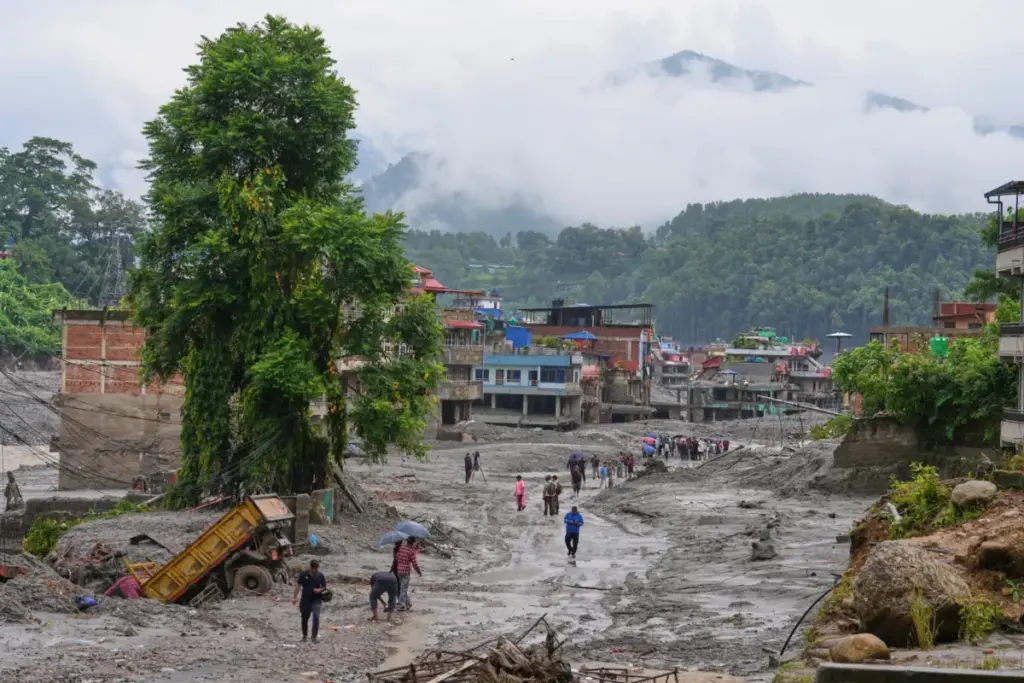
The crisis was triggered by a colossal flash flood on Wednesday, set off when a massive glacier collapse sent an avalanche of ice, rock, and mud plunging down the mountain slopes. The wall of debris tore relentlessly through the Rasuwa district north of Kathmandu, carving a devastating 62-mile (100-kilometer) path of destruction that obliterated entire valley communities, choked critical infrastructure, and left a staggering human toll in its wake.
With official death tolls soaring past 900 and thousands more listed as missing—including foreign nationals and nearly a thousand hydropower project workers—the government has declared the extraction of survivors from the water-logged, debris-choked tunnels to be its absolute highest priority. As rescue workers wade through chest-high mud in pitch-black conditions, the disaster has laid bare the extreme vulnerabilities of expanding energy infrastructure in fragile, climate-sensitive high-altitude mountain ecosystems.
Detailed Chronology: The Catastrophe Unfolds
The Trigger: Glacial Collapse and Seismic-Scale Impact
The catastrophe began abruptly in the upper reaches of the Himalayas along the borderlands shared by Nepal and China. According to data from the United States Geological Survey (USGS), a massive chunk of a high-altitude glacier destabilized and detached, precipitating a catastrophic cascade of ice, rock, and water. The sheer kinetic energy of the falling mass generated seismic waves equivalent to a 5.2 magnitude earthquake.
This sudden displacement of mass unleashed a torrential flash flood loaded with millions of tons of heavy debris. Roaring down the mountain valleys at terrifying speeds, the slurry bypassed traditional early-warning timelines, giving residents and industrial workers virtually no chance to evacuate to higher ground.
The Path of Destruction in Rasuwa
The deluge slammed directly into the Rasuwa district, north of Kathmandu, surging 62 miles downstream. Whole villages were swept away within minutes, their foundations scoured down to bare rock. As the floodwaters slowed slightly upon reaching wider valley floors, they dropped colossal volumes of mud, silt, and boulders, effectively burying entire settlements in shallow, shifting graves.
Crucially, the path of the flood intersected several major regional hydropower projects currently under development or in active operation. The subterranean networks—bored deep into the heart of the world’s highest mountain range—acted as giant funnels, catching the full force of the water, mud, and debris.
The Subterranean Nightmare: Inside the Hydrotunnels
At the time of the disaster, hundreds of engineers, technicians, and laborers were working inside the cavernous underground infrastructure.
Madan Singh Budha, a worker who had just completed his night shift at the Upper Trishuli Tunnel No. 2, recounted the terrifying moments when the disaster struck. "When I looked outside, I could see water and so I started running up the hill," he told reporters. "The hill was rocky, with grass growing in between. We used that grass to hold on to as we climbed. Those who weren’t able to climb up were swept away."

While nearly 280 workers managed to escape or were rescued in the immediate aftermath, estimates indicate that more than 900 workers remained trapped deep within the labyrinth of tunnels as mud and water sealed off the exits.
Rescuers penetrating the darkness describe harrowing conditions. Ashish Gurung, a rescuer working with Chilime Hydropower in Rasuwa, painted a bleak picture of the environment inside the subterranean network. "Inside the tunnel it was worse. It’s so difficult to move, the mud is so deep," Gurung said. "Walking in it is very difficult; at one point it was up to our chests. We got close to the first station, about 130 meters in. Inside that far, you could [see further in]; it looked like it was just bodies."
Despite the grim findings near the tunnel entrances, search teams and disaster management agencies maintain cautious optimism that pockets of air and elevated safety niches within the deep tunnels may have sheltered survivors.
Supporting Context & Metrics: Assessing the Scale of Loss
The human and structural toll of the Himalayan flash flood continues to climb as emergency teams reach previously isolated hamlets and clear arterial routes. The numbers underscore a tragedy of historic proportions:
- Confirmed Fatalities: Nepal’s national disaster agency has confirmed at least 903 deaths domestically. Across the border, Chinese authorities have reported an additional 16 fatalities in Tibetan regions affected by the same hydrological system.
- Missing Persons: The missing persons tally has ballooned to 4,247 individuals in Nepal alone, alongside 546 missing reported by Chinese authorities.
- Foreign Nationals: The global impact of the disaster is reflected in the list of missing persons, which includes 597 foreign nationals, among them 48 British citizens who were either working on regional infrastructure or traveling in the area.
- Hydropower Vulnerability: Nearly 900 of the missing are specifically tied to the construction and maintenance workforces of remote mountain hydroelectric installations, highlighting the extreme occupational hazards of industrial build-outs in active seismic and glacial zones.
Mass Burials and Hospital Crises
In Kathmandu and surrounding districts, the medical infrastructure has been pushed past its absolute breaking point. Hospital mortuaries are heavily overflowing, unable to accommodate the sheer volume of deceased victims recovered from the mud.
Faced with decomposing remains and the escalating threat of waterborne diseases, authorities have enacted grim emergency protocols. The Nepalese government announced that unidentified and unclaimed bodies will be systematically cataloged—including the mandatory collection of DNA samples for future identification—before being laid to rest in mass graves.
Outside regional medical centers, heart-wrenching scenes play out daily. Scores of frantic family members crowd hospital gates, scanning endless walls plastered with flyers, photographs, and contact lists of the missing, clinging to the fading hope that their loved ones might still emerge from the disaster zones alive.
Official Statements and International Response
National Priorities and Operational Challenges
Nepal’s Minister of Energy, Water Resources and Irrigation, Biraj Bhakta Shrestha, addressed the media to reaffirm that tunneling rescue operations represent the nation’s "highest priority." However, government officials and military spokespeople have openly acknowledged the severe logistical hurdles facing recovery units.
A spokesperson for the Nepalese Army noted that the sheer volume of compacted mud, boulders, and twisted industrial machinery blocking the tunnel mouths has rendered standard heavy equipment ineffective. "The massive amount of debris is posing an unprecedented challenge," the spokesperson stated. "We are clearing tons of dense silt foot by foot to prevent structural collapses within the tunnels while trying to push air and supplies inward."

Balancing National Sovereignty with Specialized Aid
While Nepal has maintained that it possesses sufficient domestic manpower for general surface search-and-rescue operations, the unique engineering complexities of clearing blocked, unstable hydrotunnels forced Kathmandu to look outward for specialized assistance.
Breaking from strict policies regarding broad foreign intervention, Nepal has actively called upon the specialized engineering and subterranean search expertise of neighboring India and China. Specialized rescue squads equipped with ground-penetrating radar, micro-cameras, and heavy-duty pneumatic clearing gear have been deployed directly to the hardest-hit sites, working side-by-side with the Nepalese Army and civilian volunteers.
Future Outlook: Infrastructure, Climate Risk, and Resilience
As rescue operations transition slowly from a mission of immediate survival to a broader recovery and stabilization effort, profound questions are being raised about the future of high-altitude development in the Himalayas.
The Accelerating Threat of Glacial Lake Outbursts and Collapses
Scientists and climate researchers have long warned that rapid global temperature increases are destabilizing high-altitude cryospheres across High Mountain Asia. Glaciers are retreating and thinning at accelerating rates, creating unstable hanging ice masses and swelling glacial lakes held back by fragile moraine dams.
The disaster in Rasuwa serves as a grim case study of the compounding risks when industrial infrastructure is placed directly in the path of dynamic, climate-vulnerable mountain corridors. Environmental analysts point out that traditional environmental impact assessments (EIAs) in the region have historically underestimated the kinetic scale and frequency of catastrophic mass-movement events.
Policy and Infrastructure Overhauls
Moving forward, Nepal’s Ministry of Energy faces an arduous policy crossroads. The country relies heavily on hydropower development to secure its domestic energy independence and drive lucrative export economies with energy-hungry neighbors like India. However, the catastrophic loss of life at the Rasuwa and Trishuli projects has triggered intense public and political pressure to reassess safety standards.
Experts argue that future infrastructure planning must incorporate:
- Advanced Early-Warning Systems: Deployment of real-time acoustic, seismic, and satellite-based sensors to detect glacial movements and flash floods minutes before impact.
- Subterranean Refuges: Mandatory construction of hardened, sealed emergency safe rooms equipped with independent oxygen, water, and communication lines within all underground industrial tunnels.
- Zoning Restrictions: Strict prohibitions on worker housing and surface facilities in high-risk alluvial fans and narrow valley gorges susceptible to debris flows.
For now, however, policy debates take a backseat to the immediate, agonizing work on the ground. As searchlights cut through the dust and heavy machinery hums against the backdrop of scarred Himalayan peaks, the singular focus remains fixed on the dark, muddy depths of Nepal’s blocked tunnels—and the slim, fading hope of finding life beneath the mountain.