Executive Overview
The tranquility of Portsmouth’s southern coastline was shattered on Sunday evening, September 6, 2026, when a large inflatable dinghy carrying approximately 140 to 160 migrant men docked near Eastney Landing. Representing a dramatic geographical shift from the typical arrival routes concentrated around Kent and Dover, this vessel crossed roughly 124 to 170 miles of open water after launching from Normandy, France—marking a concerning new trajectory for people smugglers operating across the English Channel.
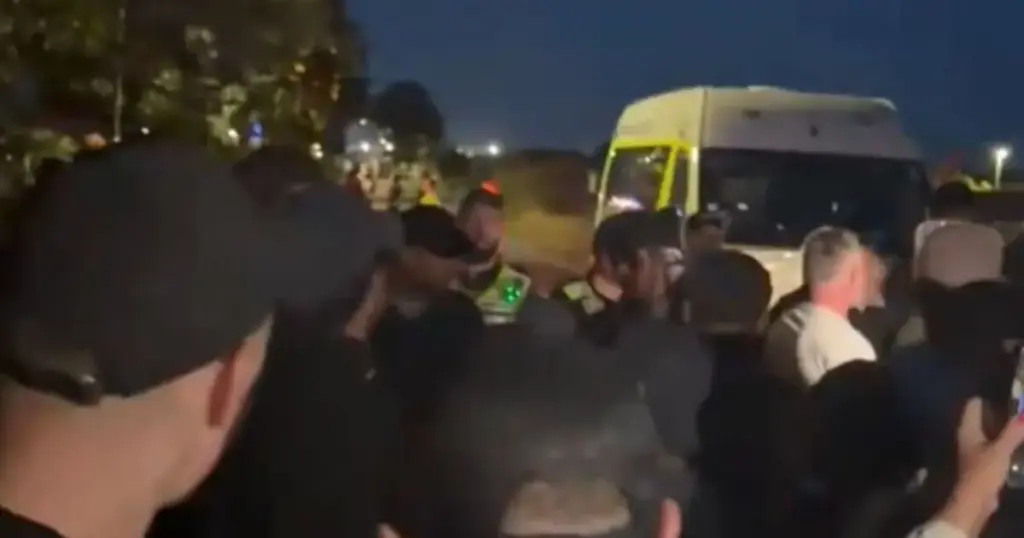
The unexpected arrival immediately triggered a massive multi-agency emergency response and mobilized around 500 anti-immigration protesters. Led in part by high-profile activist figures such as Danny Tommo, the demonstrators descended on the Hampshire coast to blockade access points, sparking volatile confrontations with law enforcement. Riot police deployed pepper spray and issued a strict dispersal order as the situation escalated into a tense, late-night standoff in the surf.
The incident has sent shockwaves through national politics, drawing sharp condemnation from prominent political leaders, raising urgent questions over border security vulnerabilities outside of traditional arrival corridors, and igniting fierce debates over public order and policing strategies.

Detailed Chronology of Events
1. The Interception and Arrival
The unfolding drama began on Sunday afternoon when maritime tracking and intelligence detected a large, motorized "mega-dinghy" making a rare, deep-westward crossing. Originating from the Baie de Seine region in Normandy rather than the standard Calais-to-Dover corridor, the vessel bypassed hundreds of miles of heavily patrolled eastern channels.
At approximately 8:26 PM, video footage circulated on social media confirming that the boat had successfully reached the shores of Portsmouth. HM Coastguard deployed lifeboats, a helicopter, an aeroplane, and rescue teams, alongside Border Force, the Border Security Command, Hampshire Police, and the South Central Ambulance Service. Between 140 and 160 men were safely disembarked by rescue personnel near Eastney Beach and the Hayling Ferry pontoon, transforming a quiet residential and fishing community into a heavily secured zone featuring over 15 police vehicles and emergency units.
2. Protesters Descend and Blockades Form
Almost simultaneously, word of the landing spread rapidly across social media channels, drawing an estimated 500 demonstrators to the Eastney area. Many participants, echoing the aesthetics and mobilization tactics seen during similar demonstrations in Dover just 24 hours prior, wore dark clothing and attempted to seal off access roads to prevent transport vehicles from moving the arrivals into the city.

Local residents found themselves caught in the lockdown. Christine Martin, a 64-year-old resident stranded on a boat at the Eastney Cruising Association pontoon, described the surreal and frightening atmosphere:
"Being on my own in the boat, I am a little bit worried. The Coastguard has been here some time not letting anyone in or out. I just don’t know what to do. There have been lots of ambulances turning up. There is maybe 50 or 60 police and ambulance officers down near the Hayling Ferry pontoon."
3. The Sea Confrontation and Standoff
As police lines attempted to secure the perimeter, tensions boiled over into the water. Livestreamed footage captured far-right activist and Patriot Platform founder Danny Tommo wading into the sea wearing a life jacket, directly negotiating with police officers. Tommo reportedly told officers: "If you put those migrants back on the boat to France, and take them back to France, we will get out of the water."

As the standoff intensified, extraordinary scenes unfolded: local supporters delivered provisions to protesters isolated by police cordons via canoe, while videos posted online showed police and activists engaging in a brief water-splashing face-off in the surf.
4. Police Intervention and Dispersal Orders
With the situation threatening to spiral out of control, Hampshire Police escalated their tactical response. Riot police equipped with protective shields were deployed to the scene, utilizing pepper spray to disperse the hostile crowds.
By late evening, Hampshire Police issued a formal dispersal order effective until the following morning. The police statement read:

"This evening, we have been working alongside and assisting our partners from Border Force, Maritime & Coastguard Agency and Portsmouth City Council at Eastney Marina following the arrival of a boat crossing the Channel. We have officers in the area to ensure the prevention of any disorder. We ask that people please avoid the area. A dispersal order is in place until tomorrow evening. Anyone who refuses to comply with the direction to leave the area is liable for arrest."
Authorities confirmed that despite the local protests, the migrants were safely disembarked and would be transported outside of Hampshire for standard processing.
Supporting Context & Metrics
The Shifting Geography of Channel Crossings
Sunday’s event marks a stark departure from traditional small-boat landing patterns. Historically, the vast majority of cross-Channel arrivals have targeted the beaches and ports of Kent—predominantly around Dover, Folkestone, and Dungeness.

The decision by people smugglers to launch from the Normandy coast (Baie de Seine) and target Hampshire represents a massive 120-to-170-mile transit. Security experts note that this route introduces severe challenges for maritime defense, forcing authorities to spread resources far beyond the narrow Dover Strait.
Context of Weekend Unrest
The Portsmouth incident occurred less than 24 hours after a separate large-scale anti-immigration protest at the Port of Dover on Saturday, September 5. During the Dover demonstration, approximately 300 individuals—many clad in black and wearing balaclavas—blocked commercial roadways for several hours, causing major traffic disruptions before Kent Police cleared the area. While Saturday’s protest primarily affected commercial ferries and holidaymakers with no actual small boat arrivals recorded at Dover that day, the weekend as a whole demonstrated an escalating trend of coordinated, rapid-response activism across southern coastal hubs.
Official Statements & Political Reactions
The breach of Hampshire’s coastline immediately resonated across the political landscape, drawing fierce reactions from national figures, local politicians, and government representatives:

- Nigel Farage, Leader of Reform UK:
"This week Andy Burnham struck an agreement for 45 more officers on French beaches. Today a boat launched from Baie de Seine, 170 miles from Calais, arriving on the beaches of Hampshire for the very first time. This is a joke. Only Reform will send the boats back."
- Robert Jenrick, Conservative MP:
"The invasion comes to Portsmouth. Home of the Royal Navy. Reform will end this humiliation."
- Joe Robertson, Conservative MP for Isle of Wight East:
"Extremely concerning to see an illegal migrant crossing this far west. We don’t know if this migrant boat was headed for the Isle of Wight, but I’ll be contacting the Home Office first thing. We need to know exactly what happened and if new routes are being used for mega-dinghies by people smugglers."

- Councillor George Madgwick, Reform UK Hampshire Leader:
Confirmed on social media that local protesters successfully blocked key routes to prevent immediate transport into the city center.
- The Home Office:
Defending government strategy amidst the criticism, a spokesperson stated: "This Government is bearing down on dangerous small boat crossings and restoring control at our border. Joint efforts have seen over 48,000 crossing attempts prevented and 1,100 boats and engines seized since the election. We are making progress, with the number of small boat crossings down this year… But we must go further, which is why we have signed a payment-by-results deal with the French to put 40 percent more boots on the ground on French beaches."
Future Outlook
The events in Portsmouth signal a critical inflection point in the ongoing UK migration debate. Several key challenges now face policymakers, law enforcement, and local authorities:
- Vulnerability of Extended Coastlines: The successful navigation and landing of a mega-dinghy in Hampshire exposes potential blind spots in maritime surveillance along the English Channel’s western approaches. Security agencies will likely be forced to reallocate naval and aerial assets to cover wider stretches of the southern coast.
- Rising Public Discontent and Public Order Risks: The seamless mobilization of hundreds of demonstrators within hours of a landing—linked to networks established by figures like Danny Tommo—indicates that domestic anti-immigration protests are becoming increasingly agile and confrontational. Police forces across non-traditional entry points must prepare for rapid-response civil unrest.
- Political Fallout: With opposition figures amplifying public frustration over border control efficacy, the pressure on Whitehall to deliver tangible results through international agreements—such as the recent French border security pact—will intensify exponentially in the coming weeks.