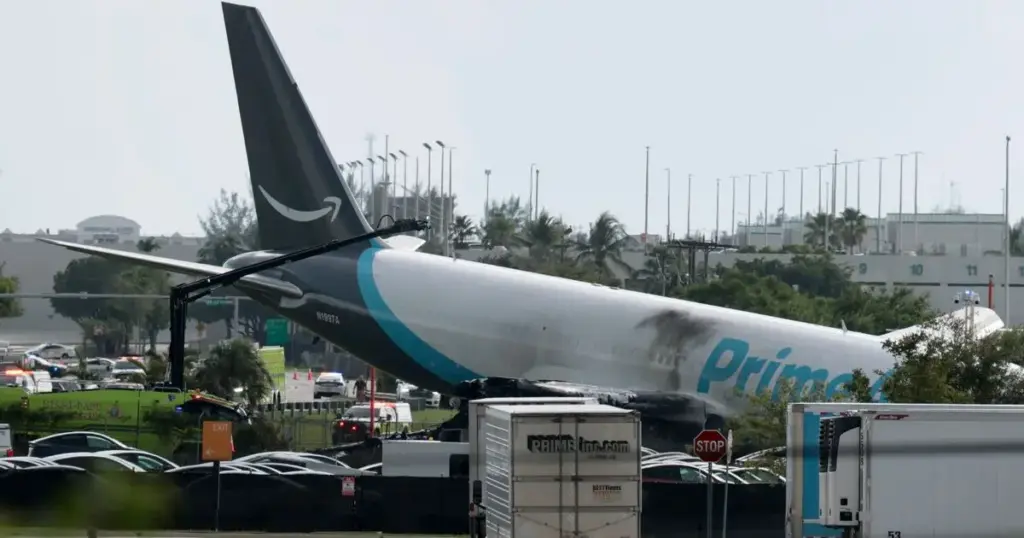
MIAMI, FLORIDA — In what has rapidly unfolded as one of the most devastating aviation incidents at a major U.S. transportation hub in recent years, a Boeing 767-300 cargo aircraft operating for Amazon Prime Air violently overran a runway at Miami International Airport (MIA) on Sunday afternoon, September 6, 2026. The catastrophic event, which occurred at approximately 2:00 PM local time, resulted in the aircraft breaching the airport perimeter and striking multiple ground vehicles before erupting into a massive, multi-alarm fire.
Miami-Dade County Mayor Daniella Levine Cava confirmed that at least five people have tragically lost their lives in the disaster. The scale of the catastrophe prompted an immediate, unprecedented multi-agency response, bringing together more than 60 specialized Miami-Dade Fire Rescue units, local law enforcement, the Federal Aviation Administration (FAA), and the National Transportation Safety Board (NTSB).
The flight, designated as 21 Air Flight 7598 and operated on behalf of Amazon Air, had originated from Luis Muñoz Marín International Airport in San Juan, Puerto Rico. Initial findings from federal aviation regulators indicate that the wide-body cargo jet failed to decelerate adequately upon landing, overshooting the airport’s diagonal runway and coming to a rest at the northwest boundary of the airfield.
The resulting inferno generated towering plumes of thick black smoke that could be seen for miles across the South Florida skyline. The disaster triggered an immediate, full ground stop at Miami International Airport, throwing global supply chains and passenger travel itineraries into disarray as federal investigators descend on the scene to piece together the sequence of events that led to the tragedy.
Detailed Chronology of the Disaster
1:45 PM – 2:00 PM: The Final Approach and Landing
Flight 7598, utilizing a converted Boeing 767-300 cargo freighter, was on the final leg of its routine cargo route from San Juan, Puerto Rico, to Miami, Florida. Weather conditions at Miami International Airport at the time of arrival were reported as typical for early September in South Florida—warm with scattered convective activity, though visibility and crosswind parameters are yet to be formally scrutinized by investigators.
According to preliminary automated flight tracking data captured by platforms like Flightradar24, the aircraft touched down on the airport’s designated diagonal runway slightly past the optimal touchdown zone. Rather than slowing down through standard reverse-thrust application and heavy braking, the aircraft failed to shed its landing velocity effectively.
2:00 PM – 2:15 PM: Runway Excursion and Ground Impact
At approximately 2:00 PM local time (7:00 PM BST), the Boeing 767 ran off the end of the paved surface, plowing through the runway safety area (RSA), breaching the airport perimeter infrastructure, and colliding directly with multiple motor vehicles operating in the immediate vicinity of the airfield’s perimeter.
The violent impact ruptured the aircraft’s fuel tanks, instantly igniting a ferocious fire that engulfed both the cockpit section of the cargo plane and the struck vehicles.
Within minutes of the impact, automated crash alarms sounded across the airfield, dispatching airport rescue and firefighting (ARFF) teams to the northwest end of the facility. Realizing the immense scale of the fire and the threat to human life, Miami-Dade Fire Rescue escalated the response, ultimately deploying over 60 units to combat the escalating blaze.
Simultaneously, federal authorities took swift, decisive action to secure the airspace. U.S. Transport Secretary Sean Duffy announced an immediate, full ground stop at Miami International Airport.
"We’ve issued a full ground stop at Miami International while first responders assess the scene after an Amazon cargo plane overran the runway," Secretary Duffy wrote in an urgent public statement via social media. "If you’re traveling through the area, please expect significant delays and potential cancellations."
Miami Airport management formally confirmed that all runways and taxiways were entirely closed, halting both incoming and outgoing air traffic while emergency responders performed the grueling task of dousing the flames and searching the wreckage.
Afternoon to Evening: Confirming Casualties and Launching the Probe
As firefighters worked tirelessly through heavy black smoke to suppress the volatile fuel-fed fire, triage stations were established near the perimeter. Tragically, despite the rapid deployment of medical personnel, local authorities confirmed that at least five individuals had perished in the crash and subsequent ground collision.
By early evening, the NTSB formally announced the deployment of a specialized "go-team" to spearhead the federal investigation into the runway excursion. NTSB Chairwoman Jennifer Homendy confirmed that investigators would examine every facet of the flight, from mechanical telemetry and maintenance logs to pilot communications and runway surface conditions.
Supporting Context & Metrics
The Aircraft and Operator Profile
The aircraft involved in the incident was a Boeing 767-300, a twin-engine wide-body jet widely utilized by global logistics giants for high-capacity, medium-to-long-range cargo operations.
Flight Designator: 21 Air Flight 7598 (operated for Amazon Prime Air)
Route: Luis Muñoz Marín International Airport (SJU), San Juan, Puerto Rico to Miami International Airport (MIA), Florida
Aircraft Type: Boeing 767-300 Cargo Freighter
Operating Carrier: 21 Air (contracted cargo carrier for Amazon Prime Air)
Amazon’s Prime Air fleet relies heavily on contracted carriers like 21 Air to maintain its rapid delivery guarantees across North America and the Caribbean. The loss of a wide-body 767 represents a significant logistical and structural blow to the e-commerce titan’s dedicated air network.
Miami International Airport (MIA): Operational Impact
As one of the premier international gateways in the United States and a primary cargo hub connecting North America with Latin America and the Caribbean, Miami International Airport handles immense daily traffic volumes.
The total ground stop paralyzed operations at one of the nation’s busiest economic conduits. While outbound departures and inbound arrivals were temporarily halted or severely restricted during the initial rescue phase, airport authorities managed to gradually resume limited departures later in the evening as emergency vehicles cleared sections of the unaffected taxiways. However, cascading delays rippled across international flight paths, affecting tens of thousands of travelers and disrupting international cargo sorting facilities.
Official Statements and Corporate Responses
Local Government and Emergency Services
Miami-Dade County Mayor Daniella Levine Cava addressed the media and public following the confirmation of fatalities, emphasizing that local authorities were throwing all available resources behind the emergency response and subsequent investigation.
"We are closely monitoring the situation at Miami International Airport following this afternoon’s incident involving a Prime Air cargo aircraft," Mayor Levine Cava stated. "Miami-Dade Fire Rescue and our airport teams are on the scene. Right now, our focus is on everyone involved and making sure our first responders have what they need. We will provide updates as we learn more."
Miami-Dade Fire Rescue released an operational update detailing the intensity of the scene:
"Over 60 Miami-Dade Fire Rescue units are on the scene of an incident involving a plane that overran a runway and struck multiple vehicles near Miami International Airport. Units arrived to find an airplane that had caught on fire as a result of this crash, with heavy flames and smoke showing. Firefighters are working to extinguish the fire and assess patients."
Amazon and Corporate Air Operations
In the wake of the disaster, Amazon released an official corporate statement addressing the incident through Kelly Nantel, Director of Corporate Global Media Relations:
"We can confirm that an Amazon Air plane operated by 21 Air experienced an incident while attempting to land at Miami International Airport today. This is a fast-moving situation and we’re still gathering details. We’re working closely with local authorities and officials to understand exactly what happened.
Right now, our absolute priority is the safety, well-being, and care of everyone involved. We’re doing everything we can to support those affected."
Federal Aviation Administration & NTSB
The Federal Aviation Administration issued a preliminary timeline confirming that Prime Air Flight 7598 overran the diagonal runway at approximately 2:00 PM local time. The agency noted that all collected data at this early stage remains preliminary and subject to revision as physical evidence is analyzed.
The NTSB, holding exclusive jurisdiction over civil aviation accidents in the United States, confirmed that its investigative team has secured the flight data recorders ("black boxes") and cockpit voice recorders. These devices will be transported to the NTSB laboratory in Washington, D.C., for forensic extraction and analysis.
Future Outlook: The Road Ahead
The disaster at Miami International Airport has immediately reignited intense scrutiny regarding runway safety margins, perimeter security, and the operational oversight of high-frequency cargo logistics networks.
As the NTSB’s "go-team" begins its meticulous on-site reconstruction of the accident, investigators will focus on several critical hypotheses:
Braking and Deceleration Performance: Did mechanical failure, hydraulic issues, or runway contamination (such as standing water from tropical downpours) compromise the aircraft’s stopping capability?
Human Factors and Crew Procedures: What were the communication logs between air traffic control and the flight deck during the final descent and landing roll?
Runway Safety Area (RSA) Infrastructure: The fact that the aircraft breached the perimeter and struck vehicles highlights ongoing global concerns regarding the length and protective buffers of airport safety zones designed to catch overrunning aircraft.
For Miami International Airport, the immediate challenge lies in clearing the massive wreckage without destroying forensic evidence, repairing damaged airfield infrastructure, and fully restoring normal commercial and cargo operations. Meanwhile, Amazon Air and its operating partners face profound institutional questions regarding safety protocols and fleet management as federal regulators demand comprehensive answers to prevent a repeat of this Sunday afternoon catastrophe.