EXECUTIVE OVERVIEW
The geopolitical landscape of the Middle East experienced a volatile escalation on Sunday, September 6, 2026, when Iranian state media reported that military forces had successfully struck a United States vessel attempting to navigate the contested Strait of Hormuz. The incident—which Tehran claims involved an unmanned American craft—has been forcefully rejected by Pentagon officials, who dismissed the assertion as a "total lie."
This latest maritime flashpoint shatters a fragile, month-long lull in hostilities and underscores the precarious nature of the ongoing conflict. The exchange follows a punishing retaliatory campaign by the United States military just 24 hours prior, which targeted and struck three Iranian oil tankers in response to incoming missile fire directed at US Navy warships operating in the region.
As the Strait of Hormuz remains effectively shuttered to routine international traffic, the conflict has evolved into a grinding war of attrition characterized by direct kinetic engagements at sea, broader economic warfare, and deadlocked diplomatic channels. With Washington deploying a dual-pronged strategy of military deterrence and aggressive financial sanctions, and Tehran’s newly empowered hard-line leadership signaling a deep resolve to weather the storm, the specter of a prolonged regional crisis looms larger than ever over global energy markets.
DETAILED CHRONOLOGY: A ESCALATING TALE OF RETALIATION
The events of this weekend represent a dangerous intensification of hostilities that trace their roots back to the outbreak of open warfare earlier this year.
February 28, 2026: The Conflict Ignites
Open hostilities officially commenced when a coordinated series of preemptive and retaliatory military strikes were launched by the United States and Israel against strategic targets within the Islamic Republic of Iran. The strikes were ostensibly designed to neutralize mounting security threats and halt Tehran’s advancing nuclear enrichment activities. The initial bombardment shocked global markets, sending immediate shockwaves through crude oil futures and forcing a rapid recalibration of security postures across the Persian Gulf.
Mid-June 2026: The Fragile Ceasefire and Collapse
Following months of high-intensity conflict, diplomatic backchannels managed to produce a brief window of optimism. In mid-June, the US and Iran signed a memorandum of understanding aimed at establishing a durable ceasefire. Central to these diplomatic efforts was a framework intended to address Iran’s contentious nuclear program.

However, the agreement proved exceptionally fragile. Negotiations collapsed almost as quickly as they began, fundamentally deadlocked over the scope, verification, and timeline of Iran’s nuclear concessions. With political pathways exhausted, both Washington and Tehran reverted to a posture of coercive pressure, attempting to inflict maximum military and economic pain on one another.
Early September 2026: The Resumption of Open Warfare
After a month of relative calm that offered a brief respite to international shipping and regional populations, the conflict violently reignited last week. The human toll of the renewed hostilities became starkly apparent earlier in the week when a heavy US bombardment of southern Iranian positions resulted in the deaths of at least five individuals, according to local reports.
The tempo of kinetic operations accelerated dramatically over the weekend:
- Saturday, September 5: US military forces launched targeted strikes against three Iranian oil tankers in the Persian Gulf. According to the Pentagon, this action was taken in direct self-defense following a missile attack launched by Iranian elements targeting US Navy warships patrolling the vital waterway.
- Sunday, September 6: Escalating the war of words and actions, Iran claimed its forces struck a US vessel attempting to enter the Strait of Hormuz. While Iranian authorities asserted that the targeted vessel was unmanned, Washington categorically denied the occurrence of any such strike, calling the narrative a fabricated propaganda piece designed to bolster domestic morale in Tehran.
SUPPORTING CONTEXT & METRICS: THE GEOPOLITICS OF THE STRAIT OF HORMUZ
To fully understand the gravity of the ongoing clashes, one must examine the critical economic and strategic geography that forms the epicenter of the conflict.
The Chokepoint of Global Energy
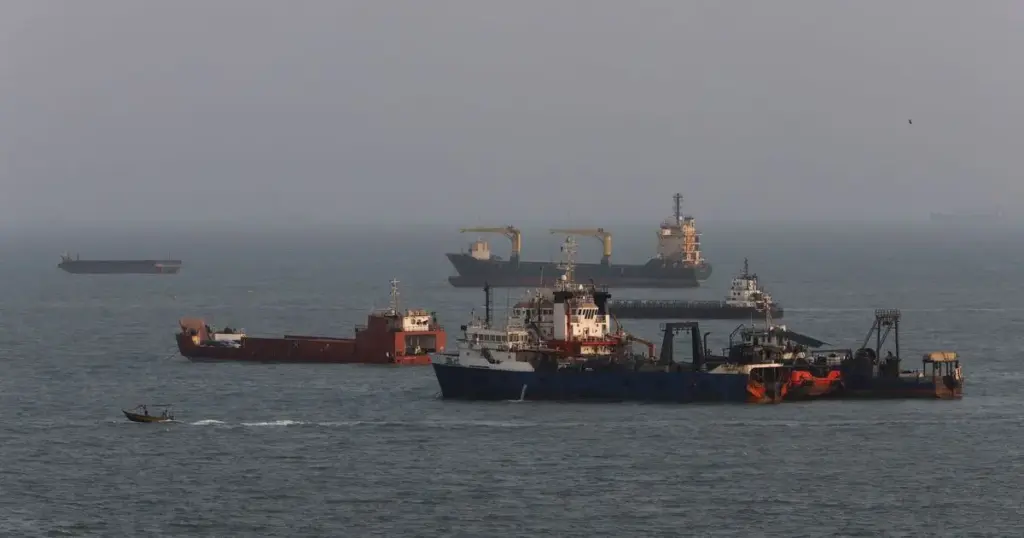
The Strait of Hormuz is arguably the most vital maritime chokepoint on Earth. Connecting the Persian Gulf with the Gulf of Oman and the Arabian Sea, this narrow corridor—measuring roughly 21 miles wide at its narrowest point—historically handles a staggering percentage of the world’s petroleum and liquefied natural gas (LNG) shipments.
Before the outbreak of the war on February 28, the strait was recognized as an international waterway governed by international maritime law, ensuring the unhindered flow of global commerce. Today, the waterway remains effectively closed to commercial shipping. Tehran has transformed the geographic reality of the strait into its primary strategic lever, utilizing the threat of anti-ship missiles, naval mines, and fast-attack craft to assert territorial dominance and extract geopolitical concessions.
Iran’s "Shadow Fleet" and Economic Resilience
Faced with decades of punishing Western sanctions, Iran has spent years perfecting mechanisms to bypass international blockades. The core of this evasion strategy relies on a sophisticated "shadow fleet"—an unflagging network of aging, often transponder-disabled oil tankers that covertly transport Iranian crude to willing buyers, primarily in Asia.

Despite the enforcement of a tight US naval blockade and secondary sanctions aimed at foreign financial institutions handling Iranian assets, Tehran has proven remarkably resilient. The country’s new, hard-line senior leadership has embraced a bunker mentality, betting that their economy can endure the financial pain longer than the West can sustain the military and economic costs of an open-ended maritime blockade.
OFFICIAL STATEMENTS AND THE INFORMATION WARFARE FRONT
As kinetic operations unfold at sea, a parallel battle is being fought in the realm of strategic communications and official state declarations.
Tehran’s Narrative of Defiance
Iranian state media and military spokespersons have framed recent actions as a legitimate defense of national sovereignty against American aggression. By claiming the successful targeting of a US vessel entering the strait, Tehran seeks to project an image of military capability and deterrence. Furthermore, Iranian leadership has introduced stringent new demands regarding the conditions under which the Strait of Hormuz might eventually be reopened to international shipping, signaling that normalization will only occur on terms favorable to the Islamic Republic.
Washington’s Dual-Pronged Strategy
The administration of US President Donald Trump has adopted a multifaceted approach to counter Tehran’s moves. Militarily, the Pentagon has maintained a robust posture of active defense, responding swiftly and disproportionately to any hostile overtures directed at American naval assets or regional allies.
Simultaneously, Washington is waging an aggressive financial campaign. Moving beyond traditional military deterrence, the US Treasury and diplomatic corps are actively targeting foreign financial institutions, intermediaries, and front companies that facilitate the laundering or movement of Iranian oil revenues. By squeezing the financial pipelines that feed the shadow fleet, Washington hopes to starve Tehran’s military apparatus of the funds required to sustain its regional posture.
FUTURE OUTLOOK: WHERE DOES THE CRISIS HEAD NEXT?
As the calendar turns through September 2026, the trajectory of the US-Iran conflict remains fraught with peril. Several critical factors will determine whether the current localized skirmishes escalate into a broader regional conflagration:
- The Status of the Strait: The continued closure of the Strait of Hormuz places immense upward pressure on global energy prices. Should independent shipping fail to find safe passage, industrial nations dependent on Middle Eastern crude may face severe economic headwinds, potentially forcing international coalitions to consider more aggressive escort or clearance operations.
- Diplomatic Impasse: With the mid-June memorandum of understanding completely deadlocked—primarily over the intractable issue of Iran’s nuclear enrichment ambitions—there are currently no active diplomatic frameworks capable of bridging the chasm between Washington and Tehran.
- Internal Politics in Iran: The consolidation of power among hard-line senior leaders in Tehran suggests little appetite for compromise. Having weathered decades of sanctions and initial wartime bombardment, the regime appears culturally and politically prepared to dig in for a protracted standoff.
- Risk of Miscalculation: In narrow, congested waterways like the Strait of Hormuz, the proximity of hostile naval forces creates a continuous risk of tactical miscalculation. A single errant missile, a misidentified radar contact, or a misunderstood warning could easily spiral a localized skirmish into an all-out military engagement.
For now, the international community watches nervously as the Persian Gulf remains a powder keg, where every passing day brings new claims, counter-claims, and the lingering threat of wider war.