Executive Overview
Nestled within the picturesque and tranquil Suffolk countryside, the small rural village of Barnham is bracing for an unprecedented transformation. With a resident population hovering at around 600 people, the community is now at the center of a national firestorm. Under controversial Home Office proposals first confirmed in June, the former Royal Air Force base at RAF Barnham has been earmarked to house up to 1,250 single male asylum seekers.
If approved, this influx would more than triple the population of the tiny village almost overnight, upending local infrastructure, intensifying security anxieties, and drawing fierce resistance from residents and local politicians alike. The Barnham development is not an isolated initiative; it forms part of a broader government strategy aiming to accommodate 3,750 asylum seekers across three former military properties nationwide—including MoD Bicester in Oxfordshire and MoD Linton-on-Ouse in North Yorkshire.
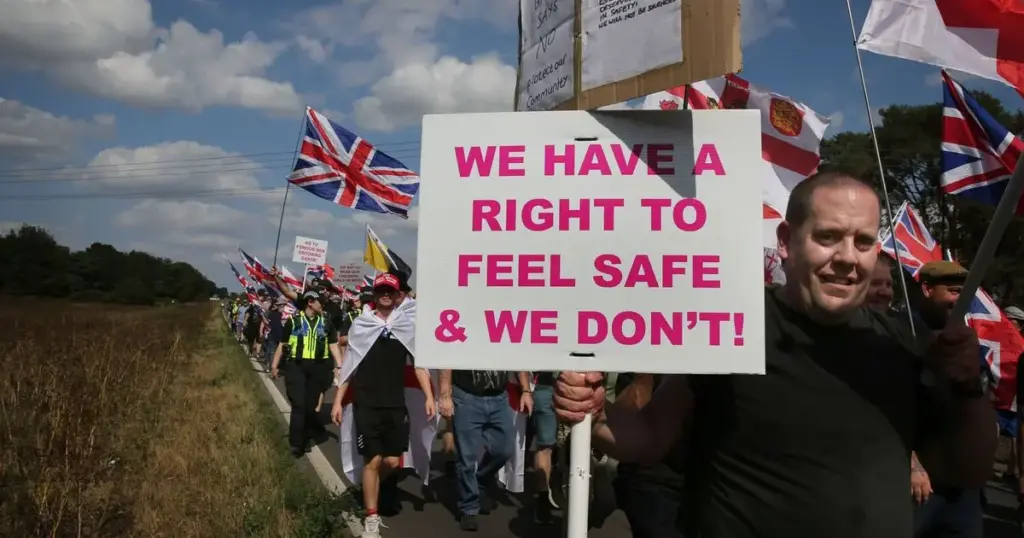
However, the proposal has collided with a volatile socio-political landscape. Coming on the heels of violent anti-migrant disorder in the nearby market town of Thetford, the Barnham plans have triggered weekly peaceful protests, defiant banners lining country lanes, and deep-seated fears regarding community safety, vetting procedures, and the strain on local resources. As the Home Office seeks to bypass traditional local planning mechanisms through an Urgent Crown Development application, tensions continue to escalate. With a critical public meeting scheduled this week, the battle lines are drawn between national immigration policies and the fierce resilience of a community fighting to protect its way of life.
Detailed Chronology of the Controversy
The friction surrounding RAF Barnham has evolved rapidly since the government first unveiled its intentions for the former military installation.
June: The Initial Announcement
The government formally confirmed its proposal to repurpose RAF Barnham—which was sold off by the Ministry of Defence during the 1960s—as part of a nationwide effort to transition away from expensive asylum hotels and into alternative, large-scale accommodation. Plans outlined the installation of temporary portacabins alongside the use of existing structural blocks to house 1,250 single male asylum seekers for a projected minimum duration of a decade.
Summer Protests and Escalation
Almost immediately following the announcement, local residents mobilized. The rural perimeters of the former base quickly became a focal point for public demonstrations. Flags and defiant banners materialized overnight, carrying slogans such as "No illegals now or ever," "Stop the boats. Stop the problem," and "Unvetted foreign men: we are afraid to walk our streets at night." Peaceful weekly protests commenced in June and have continued to draw sizeable crowds as residents voice their mounting frustrations.
August: The Thetford Flashpoint
Tensions metastasized beyond the village boundaries into the neighboring market town of Thetford. Over three turbulent nights in late August, violent disorder erupted when anti-migrant crowds targeted residential properties believed to be housing asylum seekers. The unrest resulted in occupants fleeing in terror, injuries sustained by two responding police officers, and 19 arrests. The psychological and physical scars remain vividly apparent: windows still coated in dried egg yolk and unrepaired shattered windowpanes serve as grim reminders of the community’s volatility.
September: Legal Challenges and Impending Showdowns
By September, institutional pushback began to match grassroots opposition. West Suffolk Council leader Cliff Waterman stepped into the fray, formally writing to government ministers to argue that the development directly violates environmental protections safeguarding endangered bird species nesting in close proximity to the site. Meanwhile, local political figures like Reform councillor Scott Hussey warned that Home Office officials have consistently refused to guarantee a hard cap on numbers, raising alarms that the arrival of the first occupants could trigger catastrophic civil unrest.
Supporting Context & Metrics: Scale, Security, and Socio-Economic Impact
To fully understand the gravity of the resistance in Barnham, one must examine the stark demographic realities and complex geopolitical backdrop defining the region.

The Demographic Imbalance
The primary driver of local apprehension is the sheer scale of the proposal relative to the host community. Barnham is a tight-knit rural settlement with a population of approximately 600. Introducing 1,250 single male asylum seekers into this environment represents a population surge of over 200%. Residents argue that local infrastructure—ranging from healthcare services and policing to sewage systems and transport links—is entirely unequipped to absorb a transient population more than twice the size of the native village.
Security and Proximity Concerns
Compounding the numerical disparity are heightened anxieties regarding security, vetting, and the proximity of strategic military installations. Clinton Warner, a 37-year-old local resident and used-car business owner whose property sits directly opposite the proposed camp, summarized the pervasive sentiment to the i newspaper:
"There is a general concern that you’re taking potentially 1,300 people, and you’re going to put them there. You have no control of them. You’re going to allow them to wander around local towns."
Furthermore, residents point out that the region already hosts high-security and sensitive military assets, including the nearby US air bases at Mildenhall and Lakenheath. This dense concentration of military and defense-related infrastructure has led locals to question the strategic wisdom of placing a large, unvetted population center directly adjacent to these sensitive zones.
A Community Divided
While the prevailing sentiment is one of deep apprehension and opposition, the community is not entirely monolithic.
- The Skeptics and Fearful: A 29-year-old local dog walker voiced a widespread personal safety concern, noting: "It’s the fact you don’t know their history. That’s the scary part. There’s no documentation." Wayne Berry, 50, echoed these thoughts, bluntly branding the plan "disgusting" and expressing acute discomfort at the prospect of undocumented men arriving in such proximity to residential areas.
- The Pragmatic and Sympathetic: Conversely, pockets of nuanced opinion exist. Toby Lucken, a 29-year-old resident, indicated he could accept the camp under the condition that the government executed the project competently, while simultaneously condemning the Thetford violence as "disgusting" and akin to "terrorising individual people." Another anonymous resident in Thetford noted that the asylum seekers previously targeted in the town "were never any problem," though she retained fiscal reservations regarding the potential burden placed on local taxpayers.
Official Statements and Institutional Stances
The conflict over RAF Barnham has created a sharp ideological wedge between local governance, grassroots representatives, and the central government in Westminster.
Local Leadership and Environmental Objections
Local authorities have thrown up institutional roadblocks to halt the project. West Suffolk Council leader Cliff Waterman, a Labour councillor, has spearheaded a formal defense based on environmental law. Waterman formally notified government ministers that the proposed development violates crucial legal protections designed to safeguard endangered bird species nesting in the immediate vicinity of the RAF base.
Political Warnings Over Public Safety
Elected representatives on the ground have warned of an impending security crisis. Reform councillor Scott Hussey expressed deep frustration after revealing that Home Office representatives have repeatedly refused to legally guarantee a firm cap on the number of asylum seekers housed at the site. Hussey cautioned that pushing forward with the development or processing the first arrivals without adequate guarantees risks transforming the village into "a huge potential flashpoint."
The Home Office Defense
In response to mounting local outrage, the Home Office has defended its approach, maintaining that community concerns remain a foundational pillar of its broader strategy to dismantle the expensive asylum hotel network and repurpose alternative properties. The government has utilized an Urgent Crown Development application—a legal mechanism designed to bypass standard local planning permission rules.

A Home Office spokesperson defended the strategy, stating:
"Community concerns are central to reforms that are closing asylum hotels and moving people into alternative sites including former military bases, while actively engaging with local councils to reduce local impact."
Despite these assurances, critics argue that "engagement" has amounted to little more than lip service, failing to address the fundamental objections raised by residents and civic leaders.
Future Outlook: What Lies Ahead for Barnham
As the calendar turns and the government pushes forward with its timeline, the immediate future of Barnham hangs in the balance.
The deployment of the Urgent Crown Development application signals that Westminster intends to force the project through despite municipal opposition, setting up a definitive constitutional and legal showdown with West Suffolk Council over environmental protections and planning sovereignty.
Locally, the immediate battleground shifts to this week’s scheduled public meeting in Barnham. The gathering is expected to be intensely heated, serving as a pressure valve for a community that feels ignored by central government planners. With weekly protests continuing unabated and the painful memory of the Thetford riots still fresh in the regional consciousness, law enforcement and local authorities will be monitoring the situation with extreme vigilance.
Ultimately, the controversy at RAF Barnham transcends local zoning and housing debates. It serves as a microcosm of the broader, intractable challenge facing the United Kingdom: how to reconcile national immigration management and the systematic closure of asylum hotels with the legitimate safety concerns, infrastructure limits, and democratic self-determination of rural communities. Whether the government can successfully navigate these turbulent waters—or whether Barnham will indeed become the volatile flashpoint that local leaders fear—remains one of the most pressing questions in contemporary British domestic policy.