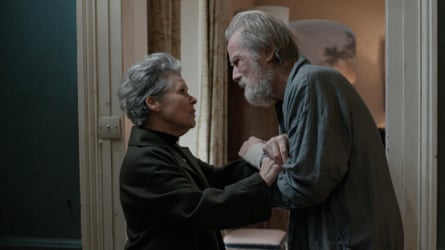
At 76 years of age, Bill Nighy remains one of the most distinctive and universally cherished figures in contemporary cinema. Known for his immaculate tailoring, deadpan delivery, and an unmistakable vocal cadence that combines theatrical precision with disarming warmth, Nighy has carved out a singular niche in the British and international cultural landscape. Whether he is portraying a washed-up, brutally honest rock star in Love Actually, a tentacle-faced maritime captain in the Pirates of the Caribbean franchise, or a buttoned-up, terminally ill bureaucrat in Living—a role that earned him his first Academy Award nomination—Nighy approaches his craft with a deceptive casualness.
In this comprehensive profile, we examine Nighy’s latest cinematic venture, the sci-fi-infused family drama & Sons, alongside a retrospective look at a career spanning more than five decades. From his early, unfulfilled aspirations of becoming a novelist in Paris to his accidental stumble into acting, Nighy’s journey is one defined not by aggressive ambition, but by what he describes as "reckless restraint." As he launches the third season of his award-winning, hit podcast Ill-Advised and continues to challenge typecasting through abrasive, complex roles, Nighy proves that true longevity in the arts comes from embracing evolution while retaining an enduring, self-deprecating wit.
Detailed Chronology: From Caterham to the Trocadéro and Beyond
Formative Years and the Literary Spark
Born in Caterham, Surrey, Nighy’s early life was marked by the typical milestones of a mid-century British upbringing, albeit underscored by an early, intense fascination with the written word. Long before the greasepaint of the theatre or the blinding lights of Hollywood beckoned, Nighy’s ambitions were literary. He idolized giants of twentieth-century fiction such as Ernest Hemingway and F. Scott Fitzgerald.
The trajectory of his imagination shifted permanently during his time at a Catholic grammar school, courtesy of an English teacher named Mr. Weir. At the tender age of fourteen, Nighy was given a piece of advice that would echo through his life: "You might want to try your hand at the novel." Though Nighy jokingly dismisses this as anything other than an ordinary pedagogical suggestion, he recalls the moment as feeling "like a bomb going off in my head."
Before embarking on his acting career, a teenage Nighy briefly entered the workforce through an eclectic series of odd jobs. At fifteen, he secured employment at the prestigious hunting and fishing magazine The Field. His responsibilities included the decidedly unglamorous task of changing the roller towel in the ladies’ restroom—a duty complicated by the typing pool staff who routinely sought to make the shy teenager blush. Another early lesson in professional decorum came courtesy of the magazine’s CEO, who reprimanded Nighy after catching him jumping up and down with excitement upon seeing a Rolls-Royce drive down a suburban street. "That’s not what I expect from an employee," the executive coldly informed him.
The Parisian Interlude and the Pivot to Acting
True to the bohemian clichés of his generation, a young Nighy eventually "ran away to be a writer." Packing his bags for the French capital, he gravitated toward the legendary Parisian bookshop Shakespeare and Company, nurturing romantic fantasies of composing immortal prose and finding love. When neither materialized, he found himself reduced to begging on the Trocadéro.
Rather than experiencing a dramatic epiphany, Nighy’s literary ambitions simply wilted under the weight of procrastination. When an acquaintance suggested he try drama school, Nighy pivoted toward the stage, operating under the comforting assumption that he would eventually return to his novel. Decades later, that novel remains unwritten, though Nighy wryly admits he is still "just very good at procrastination."
Breakthroughs and the Evolution of a Career
Nighy’s theatrical and television career gained steady momentum throughout the 1970s and 1980s, but it was the 1991 raunchy BBC television series The Men’s Room that thrust him into the national consciousness. His explicit, uninhibited performances as a libidinous academic earned him considerable acclaim—and the unexpected censure of the Broadcasting Standards Council.
Despite crossing into mainstream cinematic blockbusters—most notably as the loveable, self-aware cad Billy Mack in Richard Curtis’s 2003 romantic comedy Love Actually, and later hiding behind motion-capture tentacles as Davy Jones in the Pirates of the Caribbean series—Nighy’s true cinematic identity is anchored in nuanced, flawed characters. Cate Blanchett, reflecting on their time working together in Notes on a Scandal, famously articulated his enduring appeal: "What thinking western woman do you know who wouldn’t want to embrace him?"
Supporting Context & Metrics: The Cultural Footprint of Bill Nighy
To understand Nighy’s cultural resonance, one must examine the metrics of his enduring popularity across mediums:
The Academy Award Milestone: After decades of prolific stage and screen work, Nighy secured his first-ever Oscar nomination for his devastatingly restrained performance as Mr. Williams in Oliver Hermanus’s Living (2022).
Podcast Phenomenon (Ill-Advised): Despite expressing initial reluctance to enter the digital audio space, Nighy’s improvised agony-uncle podcast, Ill-Advised, currently commands more than 300,000 monthly listeners.
Critical Acclaim: In recognition of its sharp wit, meandering wisdom, and Nighy’s soothingly eccentric counsel, Ill-Advised was crowned Podcast of the Year at the 2026 Broadcasting Press Guild Awards.
Typecasting and Longevity: At 76, Nighy remains unfazed by Hollywood typecasting. Drawing inspiration from minimalist icon Steve McQueen—whose work ethic he defines as possessing "reckless restraint"—Nighy accepts that audiences often seek comfort in familiarity, much like viewers watching McQueen in The Great Escape.
Official Statements and Personal Philosophy
In recent interviews surrounding the release of his latest project, & Sons, Nighy offered rare, candid insights into his personal philosophy on parenting, technology, and the perils of modern professional culture.
On the Sci-Fi Family Drama & Sons
In & Sons, Nighy stars as AN Dyer, a reclusive, misanthropic novelist cut from the cloth of JD Salinger and Catweazle. Summoning his estranged family for a dramatic announcement that edges the narrative into science-fiction territory, Dyer exemplifies the archetype of the brilliant, emotionally abusive patriarch who believes his artistic genius excuses his interpersonal failures.
Nighy has zero patience for this romanticized trope:
"It’s like when footballers behave badly on the pitch and people say, ‘Temperament is part of his genius.’ Give me a break. That’s anathema to me. I don’t believe it in the least."
Unlike his fictional counterpart—whose parenting strategy consisted of doing "no harm" while remaining abrasive and absent—Nighy approaches his role as a father to director Mary Nighy (shared with his partner of 27 years, actor Diana Quick) with pragmatic humility. Asked if he began fatherhood with a grand philosophy, Nighy laughed:
"Blimey, Ryan. It’s a long time ago. But no. Not really. You make it up as you go along. You make mistakes, then correct them, and hopefully you arrive at something that works. My parents were not oppressive or unkind, and I didn’t want to be either."
On Modern Technology and Workplace Boundaries
Nighy is famously selective about how he spends his time, maintaining a strict boundary between his professional obligations and personal peace. When asked about digital communication, he reveals a surprisingly nuanced relationship with technology:
"I spend a lot of time on the phone. I’m also an enthusiastic texter. I was always very quick on the old Nokia. Quite proud of myself, I was."
On the subject of emojis, Nighy maintains strict aesthetic criteria:
"I used to be philosophically opposed. Most of them are a bit naff. I like the flamingo and the purple dahlia. I like the leaping shark. Sometimes I combine it with the leaping dolphin. Very occasionally, I like the golfer in mid-swing if I’m congratulating someone. I don’t do smiley faces."
However, video communication is strictly off-limits:
"It got to the point where every time I had a Zoom call, it made me unhappy. I’m old enough to be able to say, ‘Can I retire from Zoom?’"
Similarly, Nighy has eliminated "working lunches" and industry socializing from his routine:
"Food where you talk about work. That’s one. Particularly lunch. You have to sit there for so long and it just confuses the issue. Working lunches are absolutely out of the question now."
He adds that he long derived a quiet satisfaction from simply tossing prestigious party invitations straight into the dustbin. When pressed on the ultimate dealbreaker for accepting an acting role, his answer is instantaneous: "Togas."
Future Outlook
As Bill Nighy enters his late seventies, his career shows no signs of slowing down, even as he carefully curates his professional engagements to protect his peace of mind. The release of & Sons marks another bold departure into complex, unlikable territory, allowing him to shed the cozy, lovable persona that many fans project onto him.
Concurrently, the runaway success of Ill-Advised—now heading into its third series and newly decorated with prestigious audio awards—proves that Nighy’s unscripted, rambling musings on trousers, etiquette, and life hold an enduring fascination for audiences worldwide. Whether he is advising listeners on fashion faux pas or embodying the haunted, cantankerous literary giants he once idolized in his Parisian youth, Nighy continues to practice his own brand of artistic economy.
There are no fireworks, no desperate reaching for prizes—just the enduring, effortless charm of a master operating with reckless restraint.