Executive Overview
In an extraordinary and terrifying display of mid-air turbulence caused entirely by human behavior, an American Airlines flight from Dallas, Texas, to Newark, New Jersey, devolved into chaos when an allegedly intoxicated passenger launched into a violent, alcohol-fueled rampage. The incident, which reads like a cinematic thriller but played out in the confined space of a commercial airliner at 30,000 feet, forced a mid-flight diversion and required extraordinary intervention from both quick-thinking fellow passengers—including a retired law enforcement officer—and the flight crew.
According to horrified eyewitnesses and official reports, the unidentified male passenger initiated an unprovoked physical and verbal assault on his seatmate. The escalation was swift, moving from slurred shouting to physical battery, the destruction of personal property, and a barrage of racist and homophobic slurs. The aggression soon expanded to target other travelers and flight attendants, including attempts to bite multiple individuals and physical altercations with women on board.
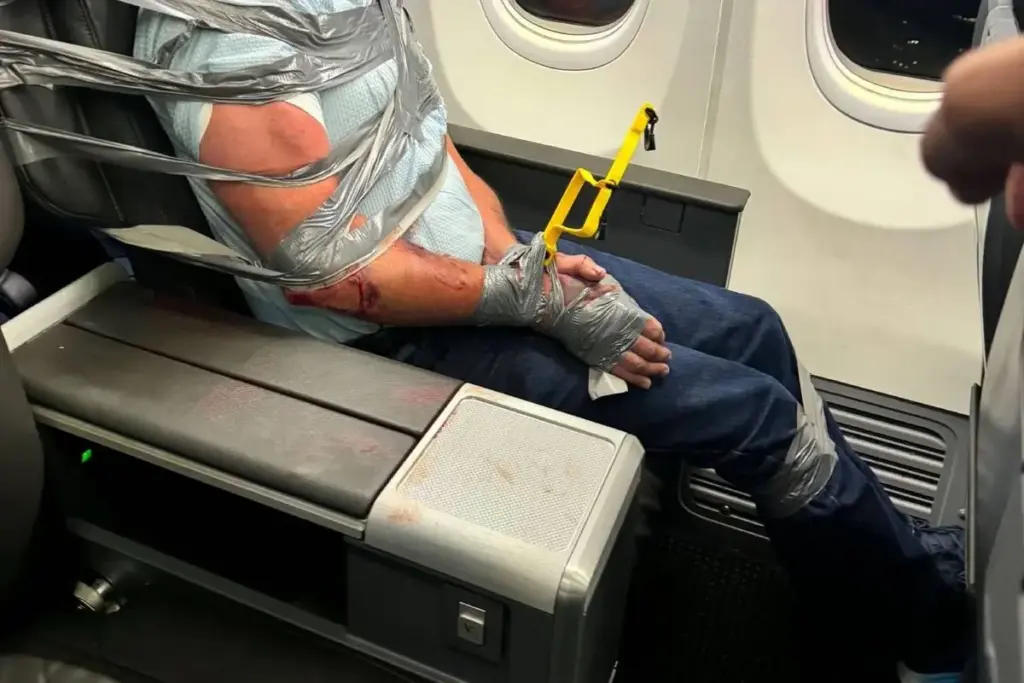
Faced with an imminent threat to the safety and security of everyone on board, civilian heroes stepped in, utilizing improvised measures—famously including duct tape supplied by the flight crew—to securely fasten the aggressive individual to his seat. The flight was swiftly diverted to Baltimore/Washington International Thurgood Marshall Airport (BWI), where law enforcement agencies, including local police and federal authorities, met the aircraft on the tarmac.
This harrowing event highlights the ongoing, deeply concerning trend of unruly airline passengers in the post-pandemic era, casting a glaring spotlight on aviation safety, the protocols surrounding in-flight security, the serving of alcohol at altitude, and the legal consequences awaiting those who threaten the peace of the friendly skies.
Detailed Chronology: From Quiet Cabin to Mid-Air Chaos
The flight began as a routine domestic journey. Operating as an American Airlines service from Dallas/Fort Worth International Airport (DFW) to Newark Liberty International Airport (EWR), the cabin environment was initially calm. Passengers were settling in for the standard cross-country trek, engrossed in inflight entertainment, reading, or catching up on sleep.
However, the atmosphere shifted drastically in a matter of seconds. Juan Mejia, a retired police officer who happened to be seated a few rows away, described the transition with chilling clarity: "Just like a light switch, all of a sudden, it went from quiet to yelling and chaos."
The Escalation
Eyewitness accounts and statements gathered after the incident piece together a horrifying timeline of events:

- The Initial Outburst: The suspect, who appeared heavily intoxicated upon boarding or after consuming further substances in flight, began directing loud, aggressive verbal abuse at the traveler sitting directly beside him in the aisle seat.
- Physical Assault Begins: Without warning, the verbal abuse crossed into physical violence. Witnesses reported seeing the suspect wrap his hands around the neck of his seatmate, initiating a chokehold and assaulting him physically.
- Property Destruction: Amid the struggle, the aggressor targeted the victim’s personal belongings, violently smashing a laptop computer into pieces, rendering it entirely destroyed.
- Bigoted Tirade: As cabin crew and nearby passengers tried to comprehend the sudden violence, the man launched into an uncontrolled tirade featuring explicit racist and homophobic slurs directed at various individuals within earshot.
- Broadened Attacks: The violence quickly escalated beyond the initial seatmate. Reports confirm that the man physically shoved a female passenger who attempted to intervene or calm the situation. In a bizarre and dangerous escalation, he also attempted to bite at least two other passengers who stepped forward to assist.
Civilian Intervention and Restraint
Realizing that the physical safety of the cabin was severely compromised, retired police officer Juan Mejia and another unnamed male passenger sprang into action. Leaving their seats, they physically intervened to pull the violent attacker off his victims, wrestling him back into his designated chair.
With the aggressor continuing to thrash, kick, and scream threats, the cabin crew took decisive action. Providing industrial-strength duct tape—a tool that has increasingly become an unorthodox standard for immobilizing violent flyers—the crew and passengers worked collaboratively to secure the man. His wrists, torso, and even his head were taped firmly to the seat, neutralizing his ability to strike, bite, or lunge at anyone else.
Diversion and Landing
With the immediate physical threat neutralized but the cabin environment understandably shaken, the flight crew made the executive decision to divert the aircraft. The plane altered its flight path away from Newark and headed toward the nearest major operational hub, touching down safely at Baltimore/Washington International Thurgood Marshall Airport (BWI) approximately 15 minutes after the decision was made.
Upon landing, local law enforcement and emergency medical services met the aircraft at the gate. Police officers boarded the plane, took the restrained passenger into custody, and escorted him off the aircraft. The remaining passengers endured a mandatory delay while federal authorities and airline officials processed the incident report, after which the aircraft resumed its journey to Newark, finally landing hours behind schedule.
Supporting Context & Metrics: The Crisis of Unruly Passengers
This alarming American Airlines incident is far from an isolated occurrence; rather, it represents a persistent and dangerous chapter in modern commercial aviation history. While the peak of the unruly passenger crisis occurred during the COVID-19 pandemic—spurred largely by federal mask mandates—disruptive behavior fueled by alcohol, mental health crises, and entitlement remains a severe operational hazard.
Statistical Overview of In-Flight Incidents
According to data compiled by the Federal Aviation Administration (FAA):
- Historical Spikes: In 2021, the FAA tracked a historic high of nearly 6,000 reports of unruly passengers, an unprecedented surge that prompted the agency to adopt a "zero-tolerance" policy.
- Ongoing Trends: Although numbers have dropped from their pandemic-era peaks due to aggressive enforcement and heavy fines, thousands of incidents continue to be reported annually. In recent years, the FAA has referred hundreds of the most severe cases directly to the FBI for criminal prosecution.
- Alcohol as a Catalyst: A significant percentage of violent or disruptive mid-air outbursts are directly linked to alcohol consumption, whether passengers overindulged in airport bars prior to boarding or smuggled illicit alcohol onto the aircraft.
Legal and Safety Ramifications
When an individual behaves violently at 30,000 feet, the legal landscape is exceptionally unforgiving. Under United States federal law, interfering with a flight crew is a serious felony.

- Federal Charges: Perpetrators face severe penalties under 49 U.S.C. § 46504, which criminalizes assault, intimidation, or interference with crew members. Convictions can carry hefty prison sentences of up to 20 years or more, depending on the severity of the violence and whether a weapon was simulated or used.
- Civil Penalties: Beyond criminal prosecution by the Department of Justice and the FBI, the FAA possesses the authority to levy massive civil penalties directly against unruly travelers, frequently reaching tens of thousands of dollars per violation.
- No-Fly Lists: Major commercial carriers, including American Airlines, maintain strict internal no-fly lists that permanently ban disruptive individuals from ever stepping foot on their aircraft again. Furthermore, federal proposals have periodically pushed for a centralized, cross-airline no-fly database for violent offenders.
Official Statements
In the wake of the incident, both corporate representatives and law enforcement agencies released statements detailing their response and reiterating their stance on safety.
American Airlines Official Statement
American Airlines issued a formal statement addressing the mid-air emergency, prioritizing the wellbeing of its staff and patrons:
"The safety and security of our customers and team members is our top priority, and we do not tolerate violence of any kind on our aircraft. We thank our team members for their exceptional professionalism and swift handling of a volatile situation, and we express our gratitude to our customers for their patience, understanding, and assistance during this unexpected diversion."
Law Enforcement and Legal Action
Following the plane’s arrival at Baltimore/Washington International Thurgood Marshall Airport, local police transferred custody of the suspect to federal authorities. According to reports from celebrity and legal news outlet TMZ, the Federal Bureau of Investigation (FBI) is actively reviewing the case and weighing formal federal charges against the passenger.
Federal prosecutors are expected to scrutinize the elements of the assault, the alleged hate speech (racist and homophobic slurs), the destruction of property, and the severe disruption of a commercial flight route. Because the incident crossed state lines and occurred within the special aircraft jurisdiction of the United States, federal jurisdiction supersedes local municipal laws, setting the stage for a potentially landmark prosecution.
Future Outlook: Securing the Skies for Tomorrow
As the aviation industry looks toward the future, incidents like the Dallas-to-Newark American Airlines flight serve as stark reminders of the vulnerabilities inherent in commercial air travel. Protecting hundreds of passengers packed into a pressurized metal tube requires a delicate balance of vigilance, rapid physical intervention, and unforgiving legal deterrence.
What Changes Are on the Horizon?
- Enhanced Crew Training: Flight attendants are increasingly receiving specialized training in de-escalation techniques, psychological profiling of aggressive behaviors, and coordinated physical restraint methods to handle violent actors safely before civilian intervention becomes necessary.
- Stricter Airport Alcohol Policies: Industry watchdogs and labor unions representing flight crews have repeatedly called for stricter regulations regarding alcohol sales at airport terminal bars and restaurants, arguing that intoxicated passengers should be systematically barred from boarding.
- Cross-Industry Accountability: Pressure continues to mount on lawmakers to establish a unified, federal no-fly database shared across all commercial airlines. This would ensure that an individual banned from American Airlines for violent behavior cannot simply purchase a ticket on Delta, United, or Southwest the following day.
- Public Awareness Campaigns: Federal agencies and airlines have stepped up public messaging campaigns warning travelers that unruly behavior is not merely a nuisance—it is a federal crime with life-altering legal and financial consequences.
For the passengers aboard that fateful flight, the journey to Newark was delayed, stressful, and terrifying. However, thanks to the cool-headed bravery of a retired police officer, alert fellow travelers, and a highly professional flight crew, a potential tragedy was averted. As federal authorities prepare their case against the detained passenger, the message to the traveling public remains unmistakably clear: safety in the skies is non-negotiable, and violence will be met with immediate restraint and uncompromising justice.