Pop culture and fashion frequently collide, but few contemporary figures navigate this intersection with the deliberate artistic precision of Olivia Rodrigo. On a brisk Tuesday evening in Los Angeles, the Grammy-winning singer-songwriter stepped onto the red carpet at the Grammy Museum to celebrate the grand opening of her dedicated exhibition, “Olivia Rodrigo: the cure unraveled.” While the retrospective itself serves as an immersive deep-dive into her latest musical output, it was Rodrigo’s sartorial choice that once again commanded the global fashion conversation.
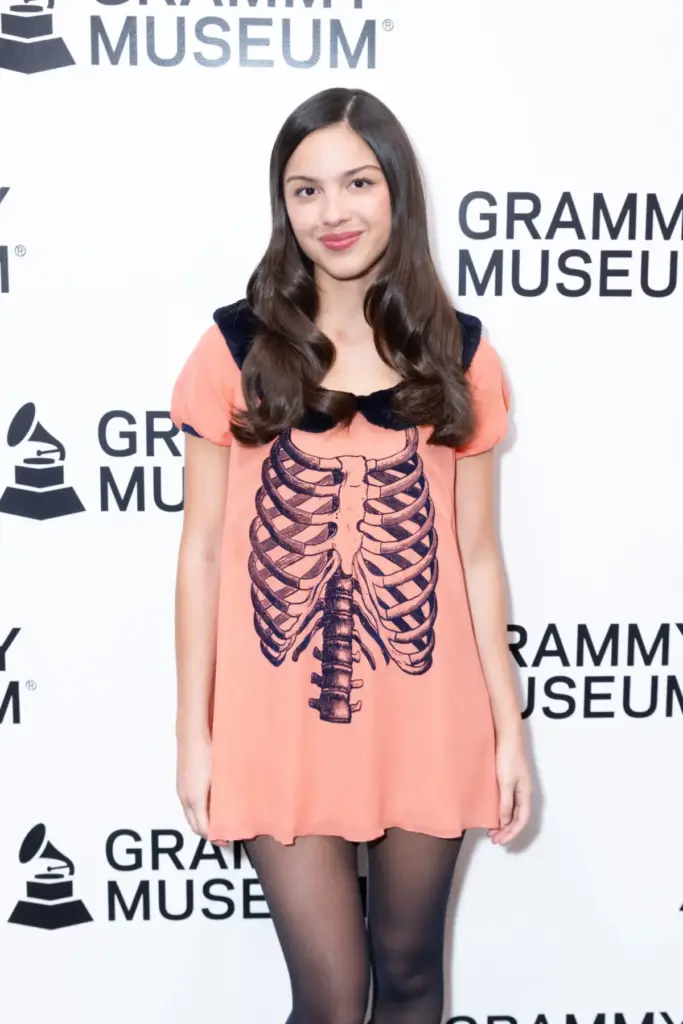
Clad in an archival Undercover piece designed by Jun Takahashi, Rodrigo offered a masterclass in modern punk subversion. The Halloween-orange garment carried all the traditional markers of the classic babydoll silhouette: a crisp velveteen Peter Pan collar, dainty cap sleeves, and a provocative, short hemline. Yet, it was the dress’s striking skeletal motif—a stark, graphic black rendering of a human rib cage and spine stretching across the front—that immediately transformed a historically saccharine garment into an aggressive statement of intent.
By bypassing the runway’s maximalist styling—such as light-up accessories and novelty headwear—in favor of clean patent leather Mary Janes, Rodrigo demonstrated a mature command of personal branding. More importantly, this look doubles down on a broader cultural battlefield that the young artist has found herself at the center of. For months, Rodrigo’s affinity for the babydoll dress has sparked intense online debate, drawing unwarranted critiques regarding infantilization and the male gaze. Rather than retreating from the controversy, Rodrigo’s latest appearance reframes the garment on her own terms: as a piece of armor, a nod to riot-grrrl forebears, and a visual extension of her ongoing artistic renaissance.
Detailed Chronology: From Runway Archive to Museum Floor
To fully understand the weight of Rodrigo’s recent appearance, one must trace the lineage of the look and the timeline of her ongoing fashion-forward narrative.
The Undercover Fall/Winter 2013 Archive
The dress worn by Rodrigo at the Grammy Museum is not a contemporary design, but rather a treasured piece of fashion history sourced from Japanese label Undercover’s Fall/Winter 2013 collection. Conceived by avant-garde designer Jun Takahashi—a figure revered for blending streetwear sensibilities with punk rock rebellion—the collection originally debuted on the Paris Fashion Week runways over a decade ago.
In its initial runway presentation, the skeletal babydoll dress was styled with heavy-handed theatricality. Models walked the runway adorned with whimsical bunny ears, quirky T-strap heels, and carrying futuristic, light-up skeleton bags. It was a look deeply embedded in early-2010s indie sleaze and quirky subcultural aesthetics.
Rodrigo’s Contemporary Refinement
When Rodrigo pulled the archival piece from the Undercover archives, she consciously edited out the runway’s more whimsical props. By stripping away the bunny ears and light-up accessories, she allowed the stark architecture of the dress to speak for itself. Paired simply with glossy patent leather Mary Janes, the look transitioned from a dated runway costume into a razor-sharp, modern statement. It bridged the gap between historical avant-garde fashion and today’s Gen-Z aesthetic, proving that true style is as much about what you omit as what you wear.
The Exhibition Opening: “Olivia Rodrigo: the cure unraveled”
The setting for this sartorial display was equally deliberate. The Grammy Museum’s newly launched exhibition focuses heavily on Rodrigo’s latest musical chapter, anchored by her single “the cure.” In the track’s visually arresting music video, Rodrigo is depicted performing literal emotional triage, operating on felted human hearts in a search for an antidote to heartbreak and existential dread.
The skeletal print on her Undercover dress served as a brilliant, literal manifestation of this artistic theme. By wearing a dress that displays the skeletal framework of the human body to an exhibition celebrating a song about dissecting human emotion, Rodrigo demonstrated a cohesive synergy between her visual identity and her musical catalog.
Supporting Context & Metrics: The Babydoll Dress Wars
The discourse surrounding Rodrigo’s style choices is not isolated to a single evening; it is part of a larger, ongoing cultural war regarding how young women in the public eye are permitted to dress.
The Spark: May’s Era Kickoff
The current wave of babydoll controversy began in earnest in May, when Rodrigo officially kicked off her “you seem pretty sad for a girl so in love” promotional era. Stepping out in a Generation78 puff-sleeve floral minidress, the singer immediately triggered an avalanche of online commentary across TikTok, X (formerly Twitter), and mainstream fashion publications.
The discourse quickly polarized the internet. While fashion historians and feminist critics praised the look as a continuation of indie-sleaze and riot-grrrl nostalgia, a vocal faction of online commentators accused Rodrigo of playing into tropes of infantilization. Critics argued that the silhouette—historically associated with youth, innocence, and doll-like passivity—catered too heavily to the male gaze.
Historical Lineage: Reclaiming the Silhouette
What these critics fundamentally misunderstood is the rich, rebellious history of the babydoll dress within alternative music culture. Far from being a passive garment designed for male approval, the babydoll dress has long served as a tool of reclamation for women in rock and punk.
During the 1990s grunge movement, icons like Courtney Love (of Hole) and Kathleen Hanna (of Bikini Kill) weaponized the babydoll dress. By pairing torn, delicate, doll-like garments with heavy combat boots, smeared makeup, and ferocious vocal delivery, these women subverted traditional expectations of femininity. They took a symbol of constrained girlhood and turned it into an armor of defiance.
Rodrigo’s recent fashion choices place her squarely in this lineage. By wearing archival pieces featuring skeletal prints and pairing them with unpretentious footwear, she is actively participating in a decades-long tradition of female artists utilizing clothing to challenge societal discomfort with female autonomy.
Official Statements & Public Discourse
Rather than letting stylists or publicists issue sanitized statements regarding her wardrobe choices, Rodrigo has confronted the critics head-on, offering candid reflections on the double standards applied to young female celebrities.
Confronting the Rhetoric of Control
In a candid and widely discussed interview on The New York Times’ Popcast, Rodrigo addressed the vitriol surrounding her fashion choices, laying bare the psychological conditioning imposed on young women from an early age.
"It’s just this rhetoric we’re fed as girls since we’re so little, which is, ‘Don’t wear that because then a man is going to sexualize your body and it’s your fault,’" Rodrigo explained during the podcast appearance.
Her frustration highlights a persistent societal paradox: women in the public eye are perpetually damned if they dress too provocatively, and equally damned if they lean into modesty, innocence, or playful silhouettes. Any aesthetic choice made by a young pop star is aggressively scrutinized and weaponized to imply a hidden motive or an internal compromise of agency.
Rejecting the Male Gaze
Rodrigo went on to dismantle the notion that her clothing choices are calculated to appeal to male desires, expressing genuine bewilderment at the internet’s obsession with sexualizing her wardrobe.
"It’s so weird. I didn’t think I looked sexy in that at all. I was like, ‘This is so cool. I feel like I look like Kathleen Hanna or Courtney Love’—all these people who are my heroes, and I felt cool and comfortable in it."
This statement is the cornerstone of Rodrigo’s fashion philosophy. Her style icons are not passive sex symbols; they are fierce, uncompromising architects of the 1990s underground music scene. When Rodrigo puts on a babydoll dress, she is not thinking about male validation; she is channeling the ferocious, unapologetic energy of the women who paved the way for her generation of alternative pop artists.
Future Outlook: The Evolution of Rodrigo’s Aesthetic
As Olivia Rodrigo continues to cement her status as a defining voice of her generation, her relationship with fashion will undoubtedly remain a focal point of public fascination. The success of “Olivia Rodrigo: the cure unraveled” exhibition at the Grammy Museum proves that her cultural footprint extends far beyond streaming numbers and chart positions; she is curating a multi-disciplinary artistic world.
The Intersection of Music and Fashion
Looking ahead, the line between Rodrigo’s musical eras and her red-carpet wardrobes will only become more blurred. As she prepares for future releases and global tours, fans and fashion critics alike can expect more archival deep-dives, punk-infused nostalgia, and deliberate subversion of traditional pop star styling.
By refusing to back down in the face of internet pearl-clutching, Rodrigo has established a powerful precedent. She has signaled to her millions of young fans that self-expression is non-negotiable and that clothing should be a vehicle for personal empowerment rather than public appeasement.
In a modern entertainment landscape that often demands conformity and predictability, Olivia Rodrigo’s skeletal babydoll dress is a welcome antidote. It reminds us that pop music—and the fashion that surrounds it—is at its best when it has a little bit of bite.