Executive Overview
Salma Hayek’s journey from the humid coastal port of Coatzacoalcos, Mexico, to the glittering, high-stakes echelons of Hollywood superstardom is one of the most compelling narratives in modern cinematic history. Over a career spanning more than three decades, Hayek has transcended the limitations imposed by an industry historically hostile to Latina performers. She has transformed herself from a beloved fixture of Mexican telenovelas into an internationally recognized icon, an Academy Award nominee, a prolific producer, and a cultural trailblazer.
As she marks her milestone 60th birthday, the cinematic landscape looks back not only at her enduring beauty and magnetic screen presence, but also at the grit, tenacity, and pioneering spirit that allowed her to break systemic barriers. Long before diversity and inclusion became corporate talking points in Hollywood boardrooms, Hayek was fighting for substantive representation, funding her own projects, and carving out space for narratives rooted in Latin American heritage.

This retrospective examines the extraordinary trajectory of Hayek’s career. It explores her early days mastering the craft in Mexico, the grueling crucible of her immigration to Los Angeles, the breakthrough roles that established her as a global box-office force, and her historic, glass-ceiling-shattering turn in Frida. Furthermore, this piece analyzes the socio-cultural metrics of representation during her rise and evaluates her ongoing influence as a formidable industry power player.
Detailed Chronology
Roots in Veracruz: The Telenovela Years
Salma Hayek Pina was born on September 2, 1966, in Coatzacoalcos, Veracruz, to a prominent and affluent family. Her mother, Diana Jiménez Medina, was an opera singer and talent scout, while her father, Sami Hayek Domínguez, was a wealthy industrial equipment firm executive and politician. Growing up in a multicultural household—her father of Lebanese descent and her mother of Spanish ancestry—Hayek was exposed early on to the arts, though acting was not her immediate, singular ambition.

Sent to school at the Academy of the Sacred Heart in Grand Coteau, Louisiana, at the age of twelve, Hayek demonstrated an independent spirit early on, reportedly diagnosed with dyslexia before returning to Mexico to study international relations at the Universidad Iberoamericana. However, the pull of the dramatic arts proved irresistible. Inspired by the magic of cinema—particularly after watching Willy Wonka & the Chocolate Factory as a child—she dropped out of university against her family’s wishes to pursue acting full-time.
Hayek’s professional breakthrough came rapidly. In her early twenties, she secured roles in Mexican television that instantly catapulted her to household-name status. Her portrayal in the 1989 telenovela Un Nuevo Amanecer showcased her natural screen magnetism, but it was her starring role as the titular character in the 1989-1990 hit series Teresa that turned her into a national phenomenon. Teresa was a massive ratings success, earning Hayek critical acclaim and multiple awards. Yet, despite her soaring domestic stardom, Hayek felt creatively constrained by the limitations of the Mexican television industrial complex. She harbored grander ambitions: a crossover into American cinema.

The Crucible of Los Angeles: Breaking the Hollywood Mold
In 1991, at the age of 25, Hayek took a monumental gamble. She packed her bags and moved to Los Angeles, driven by an unshakeable belief in her talent despite possessing only rudimentary English-language skills. The landscape she entered was fiercely inhospitable to Latina actors. In the early 1990s, Hollywood casting directors routinely pigeonholed Hispanic performers into highly stereotyped, one-dimensional roles: maids, gang members, hyper-sexualized temptresses, or tragic victims.
Hayek plunged into rigorous English lessons to neutralize her accent and began the grueling, often demoralizing circuit of open casting calls and auditions. In numerous retrospective interviews, Hayek has recounted how studio executives openly told her that her accent would prevent her from ever becoming a leading lady, or that a Mexican woman could never carry an American box-office film.

Instead of capitulating, Hayek leaned into her resilience. Her early American television and film appearances were modest—a guest spot on The Sinbad Show and a small role in Allison Anders’ critically acclaimed indie drama Mi Vida Loca (1993). However, her fortunes shifted permanently when she caught the attention of visionary director Robert Rodriguez.
The Breakthrough: Desperado and the 1990s Ascendancy
Robert Rodriguez cast Hayek opposite Antonio Banderas in the 1995 action thriller Desperado. As Carolina, an independent bookstore owner caught in the crossfire of a bloody cartel war, Hayek delivered a blistering, sultry, and confident performance that instantly stole the film. Desperado was not merely a box-office success; it was a cultural watershed moment that redefined the archetype of the Latina action star. Hayek’s sizzling chemistry with Banderas and her commanding physical presence turned her into an overnight international sex symbol and a bankable Hollywood commodity.

Capitalizing on this momentum, Hayek rapidly expanded her cinematic footprint. She teamed up with Rodriguez again for the cult-classic vampire horror-comedy From Dusk till Dawn (1996), delivering an iconic, hypnotizing snake-dance sequence that remains etched in pop-culture history. She then transitioned into romantic comedy and mainstream studio fare, starring opposite Matthew Perry in Fools Rush In (1997)—a film that showcased her sharp comedic timing and emotional vulnerability—followed by high-profile studio projects like Wild Wild West (1999) and Dogma (1999).
Frida: The Masterpiece and the Oscar Milestone
Despite her commercial success, Hayek grew frustrated by the superficial nature of the roles Hollywood continued to offer her. She recognized that if she wanted to play complex, multidimensional women of substance, she would have to create the opportunities herself. Her greatest passion project became the cinematic adaptation of the life of legendary Mexican surrealist painter Frida Kahlo.

Securing the rights proved to be a multi-year odyssey fraught with studio politics, resistance from Miramax executives (specifically Harvey Weinstein, with whom Hayek would later famously and publicly clash over creative control and abuse of power), and near-constant financial hurdles. Undeterred, Hayek served as a producer on the project, fighting tooth and nail to ensure artistic integrity. She cast Julie Taymor to direct and surrounded herself with an elite ensemble cast including Alfred Molina, Antonio Banderas, Edward Norton, and Ashley Judd.
Released in 2002, Frida was a triumph of visual artistry and emotional depth. Hayek’s performance as the brilliant, tempestuous, and physically afflicted Kahlo was nothing short of transformative. She buried her own glamorous persona under unibrows, traditional Tehuana dresses, and raw, unflinching vulnerability, capturing Kahlo’s artistic genius, political fervor, and profound physical pain.

The industry took notice. Hayek received a Best Actress Academy Award nomination for her work in Frida. In doing so, she etched her name into the history books as the very first Mexican woman ever to be nominated in the Best Actress category at the Oscars. (To date, nearly a century into the Academy’s existence, only one other Mexican woman—Yalitza Aparicio for Roma in 2018—has achieved this distinction). Although she lost the award to Nicole Kidman (The Hours), the nomination cemented Hayek’s status not merely as a movie star, but as a legendary dramatic actress and an industry power player.
Supporting Context & Metrics
Box-Office Dominance and Career Longevity
Salma Hayek’s financial and commercial footprint within the global film industry is staggering. Over her multi-decade career, films starring Hayek have collectively grossed billions of dollars worldwide. Her versatility has allowed her to transition effortlessly across genres—from gritty independent biographies and high-octane action blockbusters to animated family features (Puss in Boots, Sausage Party) and prestige dark comedies (House of Gucci, The Hitman’s Bodyguard franchise).

| Metric Category | Data Points & Milestones |
|---|---|
| Total Global Box Office | Estimated cumulative gross exceeding $3.5 billion across live-action and animated features. |
| Academy Recognition | 1 Best Actress Oscar Nomination (Frida, 2002); 1 BAFTA Nomination; 1 Golden Globe Nomination. |
| Producing Ventures | Co-founder of Ventanarosa Productions; executive producer of the critically acclaimed television series Ugly Betty (2006–2010). |
| Social Media Reach | Over 28 million followers on Instagram, reflecting enduring global pop-cultural engagement across generations. |
The Legacy of Ugly Betty and Behind-the-Lens Power
While Hayek’s front-of-camera achievements are well-documented, her impact behind the scenes has been equally transformative. Through her production company, Ventanarosa, Hayek has championed projects that elevate marginalized voices and tell complex stories about the immigrant and Latino experience.
Her most notable television triumph as a producer was adapting the Colombian telenovela Yo soy Betty, la fea into the American television phenomenon Ugly Betty (2006–2010) for ABC. The show, which starred America Ferrera, was a critical and ratings juggernaut. It shattered network television norms by centering a primetime broadcast series around a Latina protagonist and an authentic, diverse working-class family. Ugly Betty won multiple Emmy and Golden Globe awards, proving that diverse narratives could achieve mainstream, mass-market profitability.

Official Statements
Throughout her career, Hayek has been remarkably candid about the systemic barriers she faced and the psychological toll of navigating an exclusionary industry. Her public statements, interviews, and essays offer a masterclass in resilience and intersectional feminism.
Reflecting on her early days in Los Angeles and the explicit racism of casting directors during the 1990s, Hayek noted in a retrospective interview with GQ:

"They told me that my career would end in my mid-thirties because I was an immigrant and because of my accent. They genuinely believed there was no place for a Mexican woman as a leading lady in Hollywood. At the time, it felt crushing. But instead of letting it break me, it ignited a fire. I realized that if I waited for them to write a complex role for a Latina, I would starve. I had to build my own table."
When discussing the historic milestone of her Oscar nomination for Frida and the agonizingly slow pace of systemic change in Hollywood representation, Hayek addressed the broader cultural implications during a panel discussion on women in film:

"Being the first to achieve something is an honor, but it is also a profound responsibility—and honestly, a sad commentary on how long the door was locked. We have made strides, yes. There are more faces of color on screens today than there were in 1992. But true representation isn’t just about having a seat in the room; it is about having the power to greenlight the stories, control the narrative, and ensure that our humanity is portrayed in all its messy, beautiful complexity, not just as flat stereotypes."
Addressing her milestone 60th birthday and the pervasive Hollywood ageism that once predicted her career would wither away by age 35, Hayek shared a defiant and liberating perspective on aging with InStyle:

"They said women over forty were invisible in this industry. They told us our expiration date was fast approaching. And yet, here I am, entering my sixties, working harder, producing more, feeling more confident in my skin, and enjoying physical and creative vitality that I couldn’t have imagined in my twenties. Age is not a decline; it is an accumulation of power."
Future Outlook
As Salma Hayek steps into her sixth decade, her career shows no signs of slowing down. Far from resting on the laurels of her legendary filmography, she remains an active, dynamic force in global cinema. Her recent work in blockbusters like Marvel’s Eternals (2021)—where she commanded the screen as Ajak, the spiritual leader of an immortal superhero lineage—proves that major studios continue to recognize her gravitas and global marketability.

Furthermore, Hayek’s influence extends far beyond the silver screen. As a billionaire by marriage (to French luxury goods magnate François-Henri Pinault, CEO of Kering), she commands immense economic and philanthropic power. She is a dedicated philanthropist, utilizing her platform to advocate for women’s rights, environmental conservation, and disaster relief, particularly in her native Mexico. She famously testified against domestic abuse, campaigned for UNICEF against maternal and neonatal tetanus, and has consistently funded educational initiatives for underprivileged youth.
Looking ahead, Hayek’s future is defined by a refusal to be pigeonholed. Whether she is stepping behind the camera to produce boundary-pushing television, advocating for equitable representation in boardrooms and casting agencies, or dazzling fans across social media with her unapologetic embrace of beauty, vitality, and grace, Hayek remains a cultural titan.

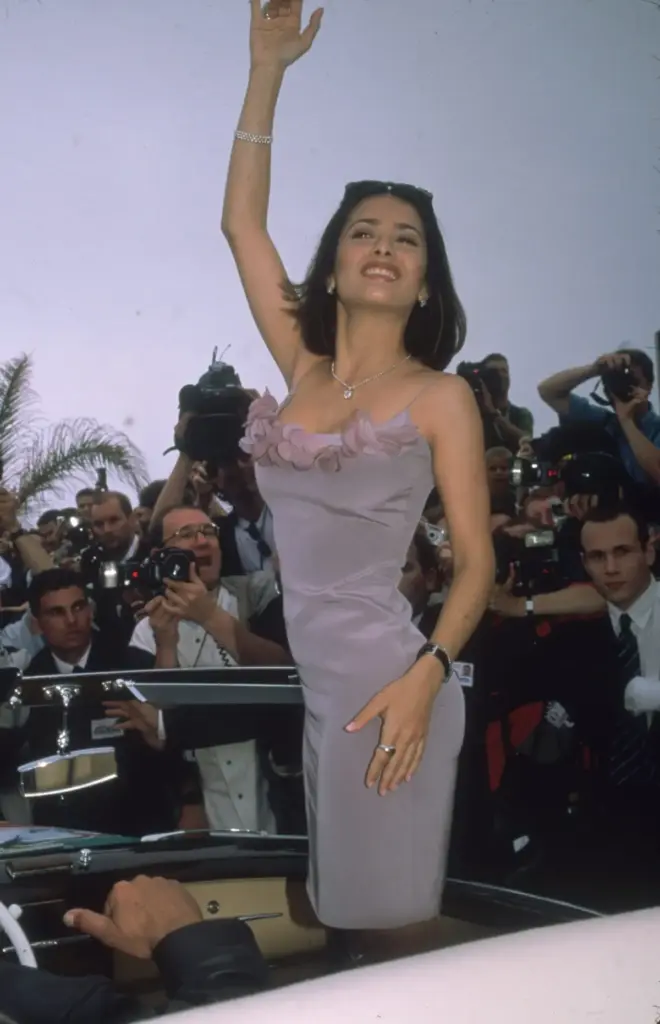
As the historical archives revisit her earliest, sun-drenched throwback photos and breakout starlet moments, the true takeaway is not merely her undeniable physical allure. It is the unyielding intellect, ironclad willpower, and artistic genius of a woman who looked at a closed Hollywood door, kicked it off its hinges, and forever altered the cinematic landscape for generations of storytellers to come.