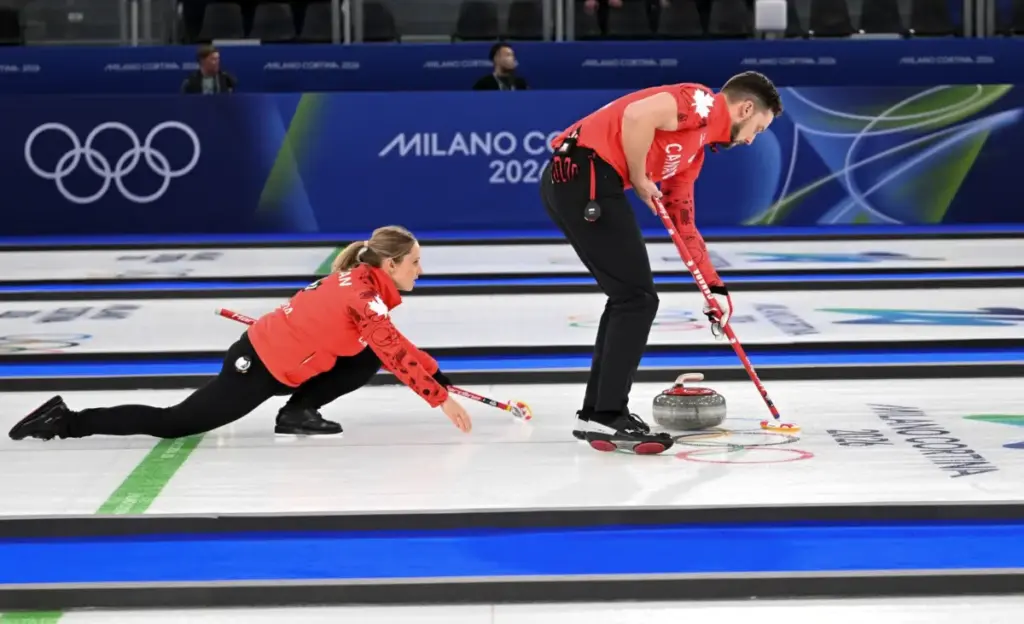
Executive Overview
The 2026 Milano Cortina Winter Olympic Games have delivered the usual array of high-octane spectacle: gravity-defying aerials in freestyle skiing, breakneck speeds down the bobsled track, and razor-thin margins on the figure skating ice. Yet, amid the thunderous applause echoing through the Italian alpine arenas, an unexpected storm has materialized in one of the Winter Games’ most traditionally serene environments: the curling sheet.
Long celebrated as a bastion of gentlemanly (and gentlewomanly) conduct, strict self-policing, and post-match camaraderie—where winning skips routinely buy their opponents a round of drinks—the curling world has been plunged into turmoil. At the heart of this unprecedented tempest are swirling allegations of cheating leveled against Canada’s powerhouse men’s and women’s teams.
What began as a tense, localized dispute during a high-stakes round-robin match between Canada and Sweden has rapidly metastasized into a full-scale international controversy. Viral video footage, conflicting interpretations of technical rule enforcement, and public defenses from curling royalty have brought the nuanced sport under a fierce global spotlight. For casual observers tuning in for the quadrennial craze, the drama has transformed a game frequently mistaken for aggressive housecleaning into compulsive, high-stakes viewing.
This deep-dive investigative report examines the anatomy of the Milano Cortina curling scandal, unpacking the physics of the sport, the specific rules at the center of the debate, the reactions from international bodies, and what this means for the integrity of the "Roaring Game" moving forward.
Detailed Chronology: How the Controversy Unfolded
The Flashpoint: Canada vs. Sweden Men’s Match
The ice was pristine inside the venue when the tension boiled over during a heavyweight men’s round-robin clash between curling superpowers Canada and Sweden. The matchup, anticipated as a tactical masterclass between two strategic titans, quickly devolved into an officiating flashpoint that would dominate sports broadcasts worldwide.
The controversy centers on Canadian veteran curler Marc Kennedy. As Kennedy delivered a crucial stone down the sheet, Swedish players immediately raised objections, claiming that Kennedy’s finger maintained unauthorized contact with the granite after the official release point.
In curling, even the most microscopic, split-second touch after the hog line can subtly alter the rotation, trajectory, or deceleration of a 44-pound stone. While human eyes struggle to catch such fractions of a second in real-time, the Swedish team was adamant. High-definition video clips circulating rapidly across social media platforms appeared to capture Kennedy’s digit brushing the rock post-release.
However, on-ice officials failed to call a violation during the live play. The lack of an immediate penalty triggered a frosty, highly visible on-ice exchange between the rinks. While Kennedy firmly denied any intentional wrongdoing—attributing the incident to the natural mechanics of a high-speed delivery—the seed of suspicion had been planted.
The Women’s Tournament Escalates
If the men’s incident could be dismissed by some as an isolated optical illusion or an inadvertent brush, the women’s tournament provided a direct institutional counter-punch later that very same day.
During a critical session, Canadian skip Rachel Homan—widely regarded as one of the most prolific and skilled players in the history of the sport—found herself on the receiving end of a strict enforcement call. An umpire intervened, removing one of Canada’s stones from play after ruling that a similar post-release touch had occurred.
The decision stunned the Canadian bench. Homan and her teammates vehemently disagreed with the interpretation, arguing that the enforcement was inconsistent and uncharacteristic of how the rule had historically been applied during major international competitions. Rather than smoothing over the morning’s friction, the umpire’s intervention in the women’s match poured gasoline on an already raging fire, transforming a player-to-player dispute into a systemic debate over officiating standards at the 2026 Winter Games.
Supporting Context & Metrics: The Anatomy of Curling
To truly grasp the gravity of the cheating allegations, one must first understand the hyper-technical nature of curling. Far from a leisurely pastime, modern elite curling is a high-precision kinetic discipline governed by physics, millimeter-level execution, and centuries of tradition.
History and Evolution of the Sport
Originating in the frozen lochs of 16th-century Scotland—with historical artifacts like the Stirling Stone bearing dates as early as 1511—curling is one of the oldest continuous team sports in the modern world. It made its Olympic debut at the inaugural Winter Games in Chamonix, France, in 1924. However, after a lengthy hiatus, it did not return as an official medal event until the 1998 Nagano Winter Olympics, where the women’s competition made its debut. Mixed doubles was subsequently added at the 2018 PyeongChang Games, continually expanding the sport’s global footprint.

Equipment, Physics, and Terminology
A standard curling match features two opposing teams of four players (or two in mixed doubles) competing on a sheet of pebble-encrusted ice approximately 150 feet long and 15 feet wide.
- The Stone: Fashioned from specific granites (such as Ailsa Craig common green and Blue Trefor) sourced from select quarries, each stone weighs precisely 44 pounds (19.1 kg) and is fitted with a handle.
- The House: The target at each end of the sheet, consisting of three concentric circles (the 4-foot, 8-foot, and 12-foot rings) surrounding the "button" at the exact center.
- The Curl: As the stone travels down the sheet, the rotation imparted by the thrower causes it to deviate or "curl" along a curved path. Understanding and predicting this arc is the core challenge of the sport.
- Sweeping: Players use specialized brushes to sweep the ice ahead of the moving stone. Vigorous sweeping accomplishes two things: it removes microscopic debris that could impede the rock, and the friction-generated heat slightly melts the ice micro-layer, allowing the stone to travel farther and straighter.
Scoring and Strategy
Curling is typically played over 10 ends (rounds), with each team delivering eight stones per end. Points are awarded at the conclusion of each end based on which team has stones closest to the center of the house.
The strategic complexity rivals chess. Teams deploy various shot types:
- Draws: Designed to slide neatly into the house.
- Guards: Placed intentionally to block opponents from accessing scoring stones.
- Takeouts: High-impact throws meant to violently knock opposing stones out of play.
- The Hammer: The final stone of an end. Possessing the hammer grants a massive tactical advantage, often dictating whether a team plays aggressively for multiple points or defensively cedes a point to retain the hammer for the next end.
Official Statements and Institutional Reactions
As the Milano Cortina curling venue transformed into a crucible of controversy, international governing bodies and national federations were forced to address the fallout publicly.
World Curling Federation (WCF) officials issued statements emphasizing the integrity of the officiating staff while acknowledging the intense scrutiny brought on by modern broadcast technology. "Elite sport relies on the adherence to established rules and the good faith of its competitors," a WCF spokesperson noted. "Our umpires are trained to apply the rules of delivery impartially. We are reviewing all technical protocols to ensure consistency across both men’s and women’s draws."
Meanwhile, Curling Canada rallied behind its athletes. National coaches and federation representatives pushed back against the narrative of intentional cheating, characterizing the incidents as misinterpretations blown out of proportion by viral social media algorithms.
Marc Kennedy addressed the media following the Sweden match, defending his character. "I’ve played this game with integrity for decades at the highest levels," Kennedy stated. "We respect our opponents, and we respect the rules. When you’re throwing stones at game speed with the intensity of an Olympic medal on the line, margins are razor-thin, but there was never any intent to circumvent the rules."
Rachel Homan echoed similar sentiments regarding the women’s tournament, calling for clearer technological guidelines if officiating bodies intend to penalize millimeter-level infractions retroactively or via broadcast review.
Future Outlook: Protecting the "Roaring Game"
The Milano Cortina 2026 curling scandal has triggered a profound identity crisis within the sport. As the Winter Games push toward their climax, the conversation has shifted from pure athletic achievement to a broader evaluation of how curling is refereed, broadcast, and perceived.
The Technological Dilemma
Modern sports broadcasting has evolved to feature ultra-high-definition slow-motion cameras capable of capturing minute physical anomalies that were invisible to past generations of officials. Curling now faces the same reckoning that befell soccer (with VAR) and American football (with instant replay): when technology reveals microscopic rule infractions, how should human umpires respond?
If the WCF and the International Olympic Committee (IOC) maintain a zero-tolerance policy on post-release touches, officiating must adapt to be proactive rather than reactive. Relying on opposing teams to police each other—a cornerstone of curling’s traditional sportsmanship code—breaks down when national pride and Olympic medals are on the line. Moving forward, the sport may need to implement automated line sensors similar to those used in tennis to definitively determine release violations without relying on human eye-tests or social media uproar.
Preserving the Spirit of Curling
Despite the turbulence in Milano Cortina, the core appeal of curling remains intact. The intensity of the competition has proven that the sport is far from a sleepy pastime; it is a cutthroat tactical battleground where emotional stakes run exceptionally high.
Whether Team USA, Canada, Sweden, or any other nation ultimately claims the gold medals on Italian ice, the 2026 Winter Olympics will forever be remembered as the moment curling entered a modern era of hyper-scrutiny. For the athletes, the challenge will be reconciling the fierce competitive drive of the Olympic stage with the timeless, gentlemanly ethos that has defined the "Roaring Game" for over five centuries.