Paris is a sensory metropolis, yet it is rarely remembered through the strict lens of color. Visitors recall the brilliant, clockwork illumination of the Eiffel Tower slicing through the evening fog, or the cacophony of international languages drifting from café terraces lining the historic boulevards. But color—specifically, the fleeting, in-between chromatic poetry of the twilight sky—often escapes immediate notice.
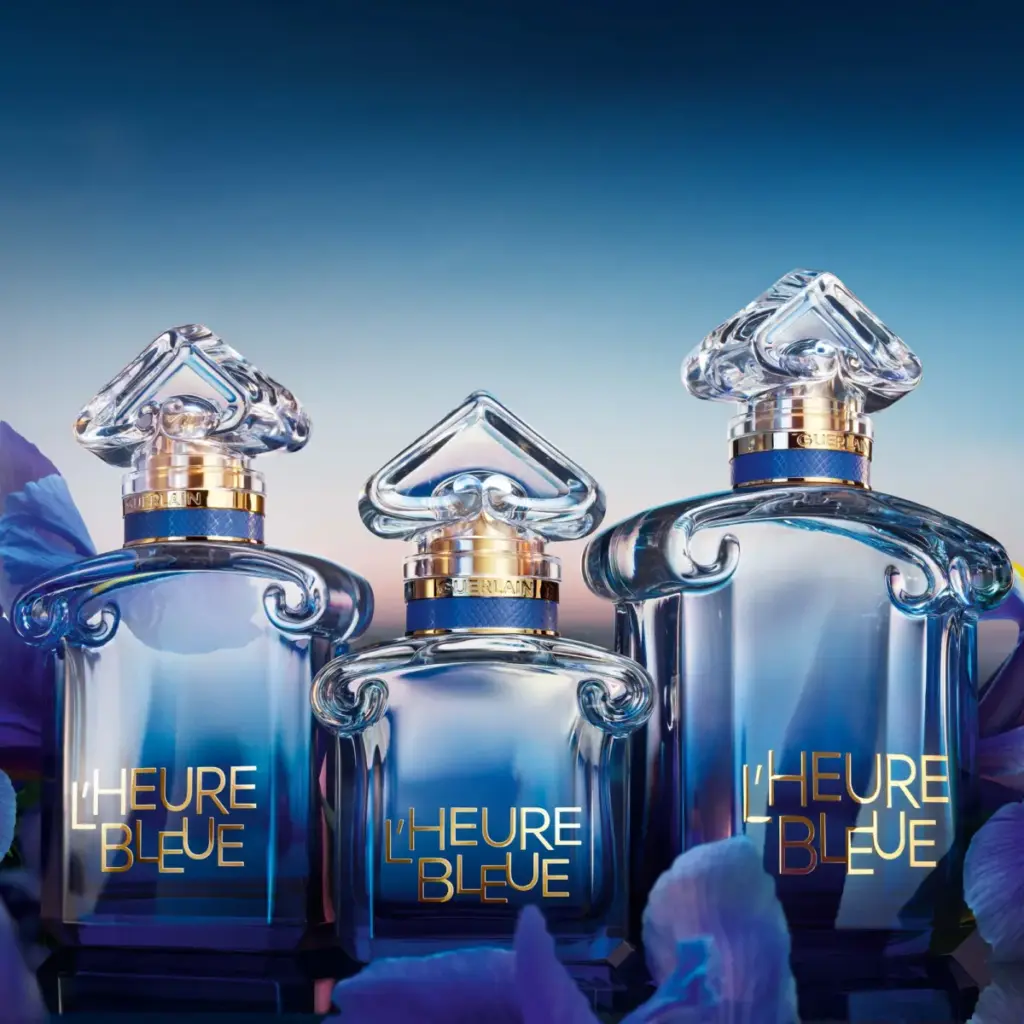
It was this ephemeral phenomenon that French perfumer Jacques Guerlain captured over a century ago. Walking along the banks of the Seine in 1912 as the fading orange glare of the sun collided with the encroaching indigo of night, he sought to bottle l’heure bleue—the blue hour. The result was the legendary fragrance L’Heure Bleue, an olfactory monument of the early 20th century.
Now, more than one hundred years later, Delphine Jelk, perfumer and director of perfume creation at Guerlain, has returned to that exact twilight. Her mission was not merely to archive or mechanically replicate the 1912 icon, but to reinvent its essence. Jelk’s modern interpretation honors its historical roots while championing an entirely new spirit. Most notably, this release marks Guerlain’s first truly feminine-focused fragrance in a decade—a departure from the brand’s historically unisex legends, such as Shalimar and Mitsouko.
By reimagining the color blue not as a masculine code, but as a sophisticated vehicle for female strength, intimacy, and modern autonomy, Jelk has crafted a provocative new chapter for one of the world’s oldest beauty houses.
Detailed Chronology: From 1912 Impressionism to Modern Alchemy
To understand the weight of Jelk’s recent achievement, one must trace the historical lineage of the House of Guerlain, an institution rapidly approaching its bicentennial anniversary. Founded on principles of bold experimentation, the house has consistently defied the conservative trends of its era.
The Birth of an Icon (1912)
When Jacques Guerlain introduced L’Heure Bleue in 1912, Europe stood on the precipice of massive social and political upheaval. The artistic landscape was dominated by Impressionism—a movement defined by blurred lines, soft transitions, and an obsession with natural light. Jacques Guerlain translated this impressionistic haze into a scent, capturing the melancholic, romantic pause between day and night. The original formulation relied heavily on a rich dry-down of orange flower, iris, and vanilla, which yielded an unexpectedly avant-garde, marshmallow-like sweetness. It was a monumental achievement of bold, emotional perfumery.
The Three-Year Modernization Process
Fast-forward over a century to the inception of Jelk’s modern project. The creative process spanned three intense years of internal reflection, material experimentation, and visual storytelling. Jelk approached the task with a deeply personal, intuitive philosophy.
"I have to say, it was totally intuitive and, in a way, selfish. I really kept what I love," Jelk explains. "When you create, you are obliged to put a lot of yourself into it because that’s how it will be emotional. You have to create with your heart."
Rather than tinkering with the top notes, Jelk focused her attention on the legendary dry-down—the sophisticated "marshmallow" accord of iris, orange flower, and vanilla that had fascinated her about the original formulation. However, to bring the fragrance into the 21st century, she integrated advanced raw materials that were entirely unavailable to Jacques Guerlain in 1912.
Chief among these is a newly engineered iris tincture. While traditional Guerlain formulations rely on iris butter—a precious, labor-intensive material derived from iris flowers requiring three years in the ground and an additional three years of drying—Jelk elected to create a powder-and-alcohol tincture. This innovation sheds the heavy, powdery connotations of a "grandma" iris, transforming it into something remarkably fresh, clean, and modern.
To complete the atmospheric illusion of the evening sky, Jelk introduced Cascalone, an aquatic-ozone note that evokes the crisp expanse of the open atmosphere, paired with ambroxan to anchor the scent with a warm, skin-like sensuality.
Supporting Context & Metrics: The Anatomy of Modern Femininity
Jelk’s creative process was driven by a rich, multi-disciplinary mood board. Moving far beyond traditional olfactive references, she assembled a visual taxonomy of modern womanhood:
Visual Textures: Blue velvet and organza ribbons symbolizing softness, transparency, and fluidity.
Artistic Influences: Impressionist masterworks, Parisian streetscapes, and the contemporary brushwork of painter Inès Longevial.
Everyday Sensibility: Oversized blue poplin shirts worn fresh out of the laundry, evoking an effortless, unpretentious intimacy.
This mood board directly informed the rejection of traditional marketing tropes. In an industry historically dominated by pink packaging, floral clichés, and hyper-sexualized messaging, Jelk’s L’Heure Bleue champions what she defines as "blue femininity."
"I love this idea of being a woman, creating for women, and true femininity, not a pink femininity. I think blue for women means that, and we don’t need to shout our femininity. We can feel very feminine in a boyfriend blue poplin shirt."
This perspective highlights a fundamental philosophical divergence between male perfumers designing for women—who historically lean into externalized, male-gaze fantasies of seduction—and a female perfumer designing for the psychological well-being of the wearer. For Jelk, perfume is not an instrument of pursuit; it is a wearable form of psychological armor.
Official Statements & Insights from Delphine Jelk
In an exclusive interview, Delphine Jelk expounds on the technical realities of formulating a masterpiece, the legacy of Guerlain, and the emotional resonance of the blue hour.
On the Definition of a Great Perfume
When asked what separates a fleeting trend from an enduring classic, Jelk points to four non-negotiable pillars:
"A good perfume is a recognizable perfume, and one that you want to go back to. When you wear it, you’re like, ‘I want to smell it again and again.’ And a good perfume is one that has a nice sillage—it creates an aura around you. It has to be long-lasting. Recognizable, long-lasting, good sillage, and addictive."
On Guerlain’s Bicentennial Legacy
As the storied house approaches its 200-year anniversary, Jelk reflects on what keeps the brand relevant across centuries:
"I think it shows that Guerlain is a creative brand because you wouldn’t be here after 200 years if you hadn’t been bold and audacious. When you see the iconic perfumes like Guerlain Shalimar, Mitsouko, L’Heure Bleue, those are perfumes that were so new at the time; it really shows how the brand was a leader in the fragrance field."
On Preserving Heritage Without Dustiness
Revitalizing a 112-year-old heritage formulation requires a delicate dance between preservation and progressive disruption. Jelk was careful not to let the brand’s illustrious history become an anchor:
"I really wanted to create a perfume for today, inspired by this beautiful idea of l’heure bleue, keeping the soul of what Jacques Guerlain did before and adding what I find very interesting. I don’t want the patrimony to be heavy or dusty. I wanted to keep the soul of the brand audacious and creative, using the most beautiful ingredients."
On Perfume as Personal Armor
Rather than focusing purely on top-note attraction, Jelk emphasizes the intimate, protective qualities of a fragrance worn close to the skin:
"Perfume doesn’t just give you confidence, but it protects you. I love the gesture in the morning when you put your perfume on. It’s armor. It’s going to protect me and envelop me."
Future Outlook: The Evolution of Luxury Fragrance
The launch of this reimagined icon signals a broader paradigm shift within the global luxury fragrance market. For decades, legacy houses relied heavily on safe, crowd-pleasing floral-fruity profiles designed to appeal to the widest possible demographic. However, consumer demand has evolved rapidly. Today’s sophisticated buyers—particularly women purchasing for themselves rather than for external validation—are actively seeking emotional resonance, historical narrative, and radical authenticity.
Guerlain’s strategic pivot back to deeply narrative-driven, gender-redefined iterations of its patrimony proves that heritage houses do not need to abandon their roots to capture modern relevance. By empowering master perfumers like Delphine Jelk to infuse their personal artistic visions, historical palettes, and contemporary sociological insights into archival formulas, the brand successfully bridges the gap between 1912 and the modern era.
As the fragrance settles into its long-lasting, woody, skin-like dry-down of vanilla and ambroxan, it leaves behind an unmistakable message: the night is arriving, the day’s duties are finished, and for those willing to embrace their autonomy, everything is possible.