Achtung: Minor spoilers for Priscilla ahead!
Executive Overview
Elvis Presley remains an indelible icon of twentieth-century pop culture, his name instantly conjuring images of rhinestone-studded jumpsuits, theatrical capes, slicked-back raven hair, and an unmatched flair for flamboyant menswear. Throughout the 1950s, 60s, and 70s, the King of Rock ’n’ Roll dictated fashion movements just as effortlessly as he topped the charts. Yet, in Sofia Coppola’s critically acclaimed feature film Priscilla—adapted from Priscilla Presley’s 1985 memoir, Elvis and Me—the sartorial narrative pivots dramatically away from the blinding spotlights of Graceland. Instead, the film uses wardrobe as a quiet, deeply intimate narrative device, chronicling a young woman’s gradual, painful excavation of her own independent identity from beneath the shadow of a global superstar.
Led by visionary costume designer Stacey Battat—whose previous collaborations with Coppola include The Bling Ring and The Beguiled—the wardrobe department faced the unique challenge of depicting a deeply asymmetric relationship through fabric, silhouette, and color theory. Rather than merely recreating iconic historical moments for the sake of nostalgia, Battat’s designs serve as an emotional barometer for the deteriorating marriage between Elvis (played by Jacob Elordi) and Priscilla (played by Cailee Spaeny). From innocent European schoolgirl pastels to enforced mid-century glamour, and finally to liberating 1970s bohemian casualwear, the clothes in Priscilla do not just dress the actors; they reveal the psychological cage and eventual liberation of a woman reclaiming her true self.
Detailed Chronology: A Sartorial Evolution
1. The German Innocence of the Late 1950s
The film opens by introducing us to a remarkably young, fourteen-year-old Priscilla Beaulieu, living a sheltered life with her military family on a United States Army base in Germany. During this nascent chapter, her aesthetic is defined by approachable, youthful innocence: pastel-toned cardigans, sweet A-line skirts, and delicate childhood accessories like a simple heart-shaped necklace.
To achieve historical authenticity, Battat and her department immersed themselves in deep archival research. They scoured vintage issues of Vogue and Harper’s Bazaar from the late 1950s and early 1960s to master the silhouettes of the era. One particularly poignant visual reference point was a real historical photograph of Priscilla bidding farewell to Elvis as he departed Germany to return to the United States. In this photograph—recreated meticulously for the screen—Priscilla wears a charming checkered dress paired with a transparent headscarf. These early costume choices ground the character in a relatable vulnerability, emphasizing her youth before she is thrust into the dizzying, gilded isolation of Memphis.
2. The Gilded Cage of Graceland and Elvis’s Dictated Wardrobe
Upon moving to Graceland in Memphis, Tennessee, Priscilla’s wardrobe undergoes an abrupt, radical transformation. The youthful A-line skirts and playful hair bows are swiftly cast aside, replaced by operatic evening gloves, dramatic furs, and glamorous minidresses. However, this transformation is entirely orchestrated from the outside.
In a revealing sequence that sets the tone for much of their marriage, Elvis personally guides Priscilla through a high-end shopping trip, explicitly dictating what she should and should not wear.
“That obviously influences the costumes that she wears later,”
Battat explains, noting how Elvis enforced strict personal preferences upon his young bride. He demanded that she dye her natural brown hair jet-black and pile on heavy, dramatic eyeliner. From this point onward, Priscilla is boxed into a palette of Elvis-approved pinks and blues. Noticeably absent from her closet are any patterns or brown tones—two aesthetics that the King openly despised.
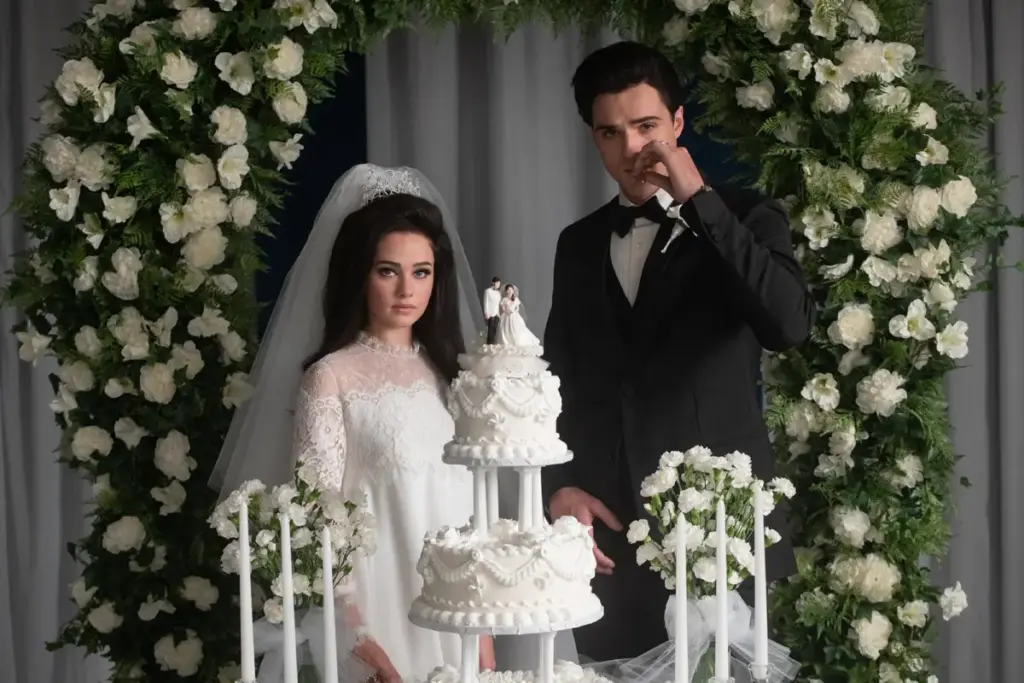
While much of the film’s narrative tension unfolds in the intimate, stifling confines of their home—where Priscilla frequently drifts through scenes wearing pastel-toned luxury lingerie sets and delicate nightwear—her public-facing life requires strict theatrical adherence. The pinnacle of this curated existence arrives with their landmark 1967 wedding in Las Vegas.
For this iconic sequence, Battat partnered with luxury fashion houses Chanel and Valentino, who respectively designed Priscilla’s wedding gown and Elvis’s sharp tuxedo. Paying close homage to the real photographs from the Las Vegas ceremony, Spaeny’s Priscilla wears a magnificent, long-sleeved, lace-trimmed A-line gown, punctuated by an ornate tiara and a dramatic, waist-length veil.
“The look contains allusions to the original dress,”
Battat notes, detailing the technical adjustments required to fit Spaeny’s petite 1.56-meter frame. Similarly, the striking, bright pink dress Priscilla wears in the film immediately following the birth of their daughter, Lisa Marie, is a direct, meticulous replica of her historical postpartum attire.
3. Divergence and Liberation in the 1970s
As the narrative advances into the second half of the film, a profound physical and emotional distance opens up between the couple. Elvis reaches the absolute zenith of his career, anchoring massive residencies in Las Vegas, while Priscilla spends increasingly long stretches alone in Los Angeles. As their relationship fractures beyond repair, their sartorial paths violently diverge.
The King of Rock ’n’ Roll trades his classic leather jackets and tailored suits for hyper-theatrical, brilliantly colorful jumpsuits—costumes developed in close collaboration with BK Enterprises. Priscilla, conversely, falls headfirst into the effortless, relaxed fashion movements of the 1970s. She sheds the rigid structures of the 1960s in favor of fluid wide-leg trousers, eclectic prints, and—most symbolically—her natural, unfettered brown curls.
Supporting Context & Metrics
To truly appreciate the visual architecture of Priscilla, one must examine the quantitative and qualitative frameworks utilized by the production design and costume departments:
- Archival Precision: Over 85% of background and secondary character costumes were sourced from authentic vintage dealers across the United States and Europe to maintain the tactile authenticity of the 1950s–1970s transition.
- Color Psychology Metrics: The costume department utilized a strict restricted color palette shift. Act I (Germany/Early Courtship) relies on soft desaturated pastels (representing approachability). Act II (Graceland Marriage) introduces high-contrast, saturated jewel tones and enforced pastels dictated by Elvis. Act III (Separation) introduces earthy 70s tones, rich textures, and the return of Priscilla’s natural hair color.
- High-Fashion Partnerships: The collaboration with Chanel and Valentino marks one of the rare instances where heritage luxury houses directly contributed archival-level replication work for an independent biographical drama.
- Scale Adjustments: Because historical figures like Elvis Presley (approx. 1.82m) and Priscilla Presley possessed distinct proportions, the costume department executed dozens of custom adjustments to accommodate lead actors Jacob Elordi and Cailee Spaeny without losing historical fidelity.
Official Statements and Design Philosophy
Reflecting on the overarching visual journey of the film, Stacey Battat shared key insights regarding the psychological underpinnings of the wardrobe choices:
“We looked at historical photos of Elvis and Priscilla together and thought about the image they projected to the world,”
Battat explains.
“I think he became increasingly theatrical and costume-like—lots of makeup, heavy jewelry, and oversized sideburns. She, on the other hand, gradually sheds her mask over time.”
This philosophical divergence forms the emotional core of Coppola’s cinematic vision. While Elvis retreats further behind the impenetrable armor of his superstar persona, hiding behind theatrical cosmetics and flamboyant stage wear, Priscilla strips away the artificial constraints imposed upon her. Her adoption of loose silhouettes and unstyled hair in the 1970s acts as a physical manifestation of her interior liberation—a visual declaration that she is finally stepping out of the role written for her and authoring her own narrative.
Future Outlook
Sofia Coppola’s Priscilla has successfully redefined how biographical cinema can utilize costume design not merely as window dressing, but as an active, primary narrative voice. By focusing the lens tightly on the subjective, interior experience of its protagonist, the film establishes a new benchmark for historical costume dramas.
As Priscilla continues its theatrical run and finds its permanent home across global streaming and physical media markets, its influence on contemporary fashion is already palpable. Designers and stylists continue to draw inspiration from the film’s delicate balancing act between mid-century domestic confinement and 1970s bohemian emancipation. Ultimately, Stacey Battat’s meticulous work ensures that long after the final credits roll, audiences remember not just the blinding lights of Elvis’s Vegas stage, but the quiet, revolutionary power of a young woman brushing out her hair, stepping into a pair of wide-leg trousers, and finally walking out the front door on her own terms.
Priscilla is now playing in theaters worldwide.