In the fast-evolving landscape of high-end fashion and lifestyle branding, the playbook for athletic sponsorships has undergone a seismic shift. No longer content with merely outfitting on-court officials or slapping logos onto stadium banners, premier luxury labels are re-engineering major sporting events into comprehensive, multi-month retail and cultural seasons.
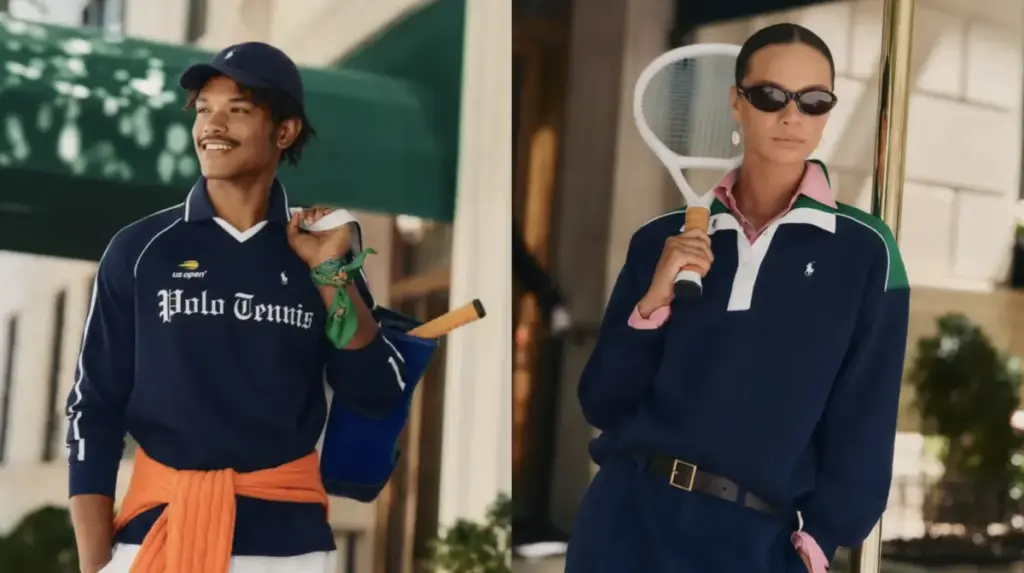
At the vanguard of this movement is Ralph Lauren. As its marketing investment reaches an all-time high of 8.2% of total sales—up significantly from 7.5% a year prior and a modest 3.5% during earlier phases of its brand-elevation strategy—the iconic American prep house is turning the U.S. Open into an extended, 360-degree commercial ecosystem. Spanning a six-week retail takeover at Nordstrom’s New York flagship, expansive hospitality suites at Arthur Ashe Stadium, localized product personalization labs, and the debut of a certified vintage archival program, Ralph Lauren’s strategy exemplifies how modern luxury brands capture consumer mindshare.
Simultaneously, the broader luxury market is experiencing a philosophical divergence. While heritage houses double down on experiential, physical touchpoints like tennis activations, they are simultaneously grappling with digital identity in the age of generative artificial intelligence. Faced with an avalanche of slick, algorithmic imagery that threatens to homogenize the digital sphere, luxury powerhouses such as Dior Beauty and Hermès are championing handcrafted animation, pen-and-ink illustrations, and visibly human artistry.
This deep-dive analysis examines Ralph Lauren’s strategic evolution at the U.S. Open, explores the wider commercial intersections between luxury fashion and tennis culture, and investigates the anti-AI counter-movement sweeping creative studios worldwide.
Detailed Chronology: The Six-Week U.S. Open Takeover
The temporal boundaries of sports marketing have officially been shattered. While the U.S. Open tournament itself kicks off on a Sunday and runs for approximately three weeks, Ralph Lauren’s active operational footprint began nearly three weeks prior to the first serve.
The Runway Leading to the Match
- August 4: Ralph Lauren initiates a high-profile takeover of The Corner at Nordstrom’s New York flagship store. Designed as an immersive consumer touchpoint, the installation is slated to remain open through September 20—a full week after the tournament’s conclusion.
- Mid-August: The brand rolls out its expanded Create Your Own product personalization stations, integrating live-action patch application, custom printing, and embroidery for attendees directly at the tournament grounds.
- Tournament Window (Late August – Mid-September): Over 800 individuals are outfitted by Ralph Lauren, including 300 ball-crew members, 215 on-court officials, and 285 court attendants (a curated group featuring high-profile VIPs, celebrities, and select athletes with existing brand affiliations).
- Post-Tournament Extension (Through September 20): The Nordstrom flagship activation and digital touchpoints continue to capture post-event momentum, effectively stretching a two-week sporting match into a six-week commercial season.
This extended window demonstrates a fundamental shift in how the brand leverages its two-decade tenure as the official outfitter of the U.S. Open. Rather than relying on fleeting visibility during televised matches, Ralph Lauren has constructed a runway of events that captures both pre-tournament anticipation and post-event retail demand.
Supporting Context & Metrics: Financials and Retail Mechanics
The aggressive expansion of Ralph Lauren’s tournament activations is not a standalone marketing experiment; it is the physical manifestation of a rigorous financial and brand elevation strategy championed by executive leadership.
Fueling Growth Through Marketing Investment
In the first quarter of fiscal 2027, Ralph Lauren’s marketing expenditure climbed to 8.2% of total sales. This figure represents a deliberate acceleration from the 7.5% recorded in the corresponding period last year, and marks a dramatic departure from the roughly 3.5% allocation maintained during earlier phases of the brand’s turnaround.
Skeptics of aggressive marketing spend often worry about margin erosion or diminished pricing power. However, Ralph Lauren’s financial health metrics defy these concerns:
- Revenue Growth: Quarterly revenue surged by 13% in constant currency, reaching $1.96 billion.
- Pricing Power: Average unit retail (AUR) climbed by 15%, proving that increased marketing is driving brand equity and consumer willingness to pay higher price points rather than forcing margin-diluting discounting.
- Customer Acquisition: The brand successfully recruited 1.5 million new direct-to-consumer (DTC) customers during the single quarter.
Diversifying the Retail Assortment
Beyond traditional commemorative tournament merchandise, Ralph Lauren has diversified its U.S. Open product ecosystem to capture distinct consumer segments:
- Certified Vintage Program: In a first for its U.S. Open activation, Ralph Lauren introduced its certified vintage program—originally launched in September 2024—to the tournament space. Offering authenticated archival pieces priced between $150 and $3,500, the initiative capitalizes on the burgeoning secondary market. By placing rare, archival items alongside customizable tournament merch, the brand captures resale demand while reinforcing its heritage credentials.
- Immersive Hospitality Suites: The expanded hospitality presence inside Arthur Ashe Stadium has been architected as a multi-functional space. Divided into dedicated viewing, dining, and gathering zones, the suite is entirely furnished by Ralph Lauren Home. It functions simultaneously as a private VIP enclave and an experiential showroom for the company’s broader luxury lifestyle vision.
- Cross-Category Retail Integration: The Nordstrom takeover and on-site boutiques feature a complete lifestyle curation spanning men’s, women’s, children’s, and home products, supported by experiential touchpoints such as bespoke cocktails, private styling appointments, and interactive personalization labs.
Official Statements and Industry Insights
The transformation of athletic tournaments into cultural pop-culture festivals has rewritten the rules of sports marketing. Industry veterans point out that traditional sponsorships are no longer sufficient for brands seeking meaningful return on investment.
Leadership Perspectives
Reflecting on the quarterly results during an August earnings call, Ralph Lauren CEO Patrice Louvet emphasized the compounding returns of their marketing strategy:
"Our marketing teams are really doing a fantastic job around the world, building brand desirability, recruiting new customers… We are generating really good returns from our increased marketing investment."
In official press materials shared with trade publications, the company reiterated its mandate to push the boundaries of sports partnerships:
"Ralph Lauren is taking this year’s U.S. Open activation beyond the court through retail, consumer activations, and hospitality, cementing a lifestyle proposition that resonates long after the final match."
The "Front Porch" of Pop Culture
According to sports-marketing consultant and former USTA executive Joe Favorito, the U.S. Open has evolved far beyond a mere tennis tournament:
"The U.S. Open is a pop-culture happening. It becomes the front porch for the right brands to engage — not just for two weeks, but for life."
Favorito notes that brands can no longer afford a passive approach to sports sponsorships:
"You can’t just buy visibility and hope that you win. The event must be integrated across retail and marketing channels, with specific commercial and customer-acquisition goals."
The Broader Tennis Retail Boom
The commercial viability of aligning with tennis culture extends well beyond apparel giants. Fine-jewelry brand Aurate reports that its tennis bracelet and necklace category now accounts for approximately 50% of the New York brand’s annual sales, having expanded by more than 60% year-over-year since its inception in 2021.
Aurate Marketing Director Zoé Macias notes that September—anchored by the U.S. Open—serves as the brand’s third-strongest selling month for tennis jewelry, trailing only the holiday season and Mother’s Day, with a consistent 10% sales bump during the tournament window. Furthermore, Aurate’s accessible-to-luxury pricing architecture—ranging from a $198 lab-grown white-sapphire piece in stainless steel to natural-diamond 14-karat gold designs starting at $2,588—illustrates how brands utilize the tennis aesthetic to bridge entry-level accessibility with high-end luxury aspirations.
Future Outlook: The Anti-AI Counter-Movement in Luxury Animation
While physical activations like Ralph Lauren’s U.S. Open takeover dominate the experiential landscape, a parallel revolution is taking place in the digital domain. As generative artificial intelligence democratizes the creation of slick, hyper-polished campaign imagery, luxury brands are actively pivoting toward deliberately human, handcrafted artistry to preserve their aura of exclusivity and authenticity.
The Hand-Painted Rebellions of Dior and Hermès
Recent weeks have underscored this philosophical pivot:
- Dior Beauty released a hand-painted animated film chronicling the poetic narrative of Miss Dior.
- Hermès populated its digital channels and website with surreal pen-and-ink sea creatures crafted by artist Linda Merad.
This creative direction is a direct response to consumer fatigue over algorithmic uniformity. Hana Shimizu, managing partner of creative studio Hornet—which has collaborated with premier luxury houses including Tiffany & Co., La Mer, Longchamp, and Loewe—diagnoses the industry’s current anxiety:
"The fear for any brand is now about feeling generic, feeling AI, or feeling like it is without a soul."
Craftsmanship, Authorship, and Asset Longevity
Once dismissed by luxury executives as overly playful or suited only for top-of-funnel social media add-ons, animation—particularly stop-motion, feltcraft, and hand-drawn illustration—has been elevated to a core pillar of luxury storytelling. According to Shimizu, these mediums serve as tactile proof points for core brand pillars:
"Craftsmanship, authorship, and authenticity are what luxury sells. Showing behind-the-scenes footage of an artist’s process has become essential; it serves as a proof point that it was done for real."
Moreover, luxury brands are demanding greater commercial utility from these artistic commissions. Rather than commissioning one-off digital shorts, marketing directors are building expansive visual universes. These hand-crafted assets are engineered for maximum versatility—deployed across flagship retail environments, e-commerce platforms, social channels, and out-of-home billboards. The modern luxury metric of success has shifted away from superficial vanity metrics like views and clicks toward asset longevity, cross-channel reuse, retail adaptability, consistency, and long-term brand recall.
Conclusion
As the boundaries between sport, culture, commerce, and digital expression continue to blur, luxury brands face a dual imperative. On the physical front, exemplified by Ralph Lauren’s masterclass at the U.S. Open, brands must transform fleeting events into enduring lifestyle seasons backed by robust marketing investments and diversified retail offerings. Simultaneously, in the digital realm, they must reject the cold efficiency of artificial intelligence in favor of tangible human craftsmanship. By mastering both physical immersion and authentic artistic storytelling, the leaders of the luxury sector are successfully securing their dominance for the next generation of consumers.