Executive Overview
For children of the 1990s and early 2000s, the mere concept of Kingdom Hearts sounded like an elaborate fever dream cooked up on a playground. What happens when you combine the melancholic, character-driven storytelling and intricate lore of Square Enix’s Final Fantasy universe with the universally beloved, timeless aesthetic of Disney? The answer, first released upon an unsuspecting PlayStation 2 in 2002, was nothing short of a cultural phenomenon.
Decades later, the franchise has expanded into a sprawling, multi-platform epic spanning countless iterations, handheld spin-offs, and narrative side-stories. Yet, as the industry marches toward an era defined by hardware evolution, Square Enix has achieved the unthinkable. With the upcoming October 8, 2026 launch of Kingdom Hearts Collection I–III—arriving across PlayStation 5, Xbox Series X|S, PC, and notably, the Nintendo Switch 2—the series has found its definitive portable home.
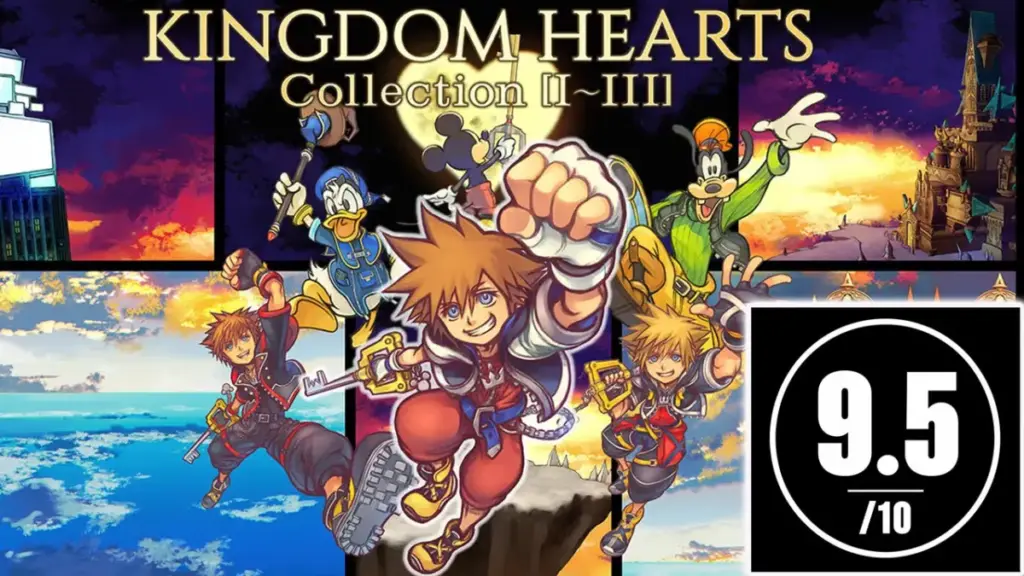
Following extensive hands-on time with the definitive compilation on Nintendo’s next-generation hardware, it is clear that Square Enix’s ambitious crossover has not merely aged gracefully; it has been elevated. Trading the compressed, cloud-based streaming compromises of previous Nintendo iterations for native, highly optimized performance, Kingdom Hearts Collection I–III stands tall as a mandatory purchase. Boasting a buttery-smooth 60 frames-per-second performance target, robust visual fidelity in handheld mode, and an astronomical volume of content, this collection secures a staggering 9.5/10 (Best in Its Class) rating. It is a triumphant victory lap for an iconic franchise and arguably the strongest value proposition currently available on the Nintendo Switch 2.
Detailed Chronology: From PS2 Pioneers to Portable Perfection
To truly appreciate the engineering and curation feat that is Kingdom Hearts Collection I–III, one must trace the winding, often dizzying history of the franchise’s release schedule. The series began in 2002 as a straightforward yet emotionally resonant action-RPG. Players stepped into the oversized shoes of Sora, a spirited teenager armed with a mysterious weapon known as the Keyblade, alongside iconic companions Donald Duck and Goofy. Their mission: to traverse whimsical Disney worlds, seal them away from malevolent creatures called Heartless, and reunite with lost friends Riku and Kairi.

The sequel, Kingdom Hearts II (2005), blew the doors off expectations. It refined the combat mechanics, introduced the revolutionary "Drive Forms," and expanded the narrative scope to include tragic anti-heroes, complex organizational villains (Organization XIII), and jaw-dropping set-pieces. However, the years following Kingdom Hearts II saw the franchise fracture across multiple competing platforms. Fans who wanted the complete story were forced to track down prequels and interquels across a bewildering array of hardware:
- Kingdom Hearts: Chain of Memories (Game Boy Advance / PlayStation 2)
- Kingdom Hearts 358/2 Days (Nintendo DS)
- Kingdom Hearts Birth by Sleep (PlayStation Portable)
- Kingdom Hearts coded (Mobile / Nintendo DS)
- Kingdom Hearts 3D: Dream Drop Distance (Nintendo 3DS)
This fragmented release strategy made keeping up with the lore famously labyrinthine. It wasn’t until the modern era of HD remix collections on legacy hardware that Square Enix began consolidating these titles.
Now, with Kingdom Hearts Collection I–III, the publisher has achieved total unification. Delivering ten discrete experiences—comprising seven fully playable games, three cinematic story films, and the essential Kingdom Hearts III Re Mind DLC—the package remedies past fragmentation. More importantly, the transition to the Nintendo Switch 2 marks a technical watershed moment. Unlike the original Nintendo Switch—which infamously relied on unstable cloud streams for Kingdom Hearts III—the Switch 2 hardware effortlessly handles native ports, rendering the whimsical worlds of Hercules, Aladdin, The Lion King, and Frozen with stunning clarity, vibrant color reproduction, and zero latency penalties.
Supporting Context & Metrics: Unmatched Value and Performance
When evaluating modern game collections, consumers are right to look critically at pricing models. Retailing at $74, Kingdom Hearts Collection I–III represents a significant upfront investment. However, a deep dive into the sheer volume, playtime metrics, and technical performance reveals that this price tag translates to one of the most cost-effective entertainment values in modern gaming.

Playtime Metrics and Scope
The sheer scale of the Kingdom Hearts canon cannot be overstated. A linear playthrough of the core numbered trilogy (Kingdom Hearts I, II, and III) easily demands upwards of 160 hours of focused gameplay. When you factor in the extensive, feature-rich spin-offs included in the compilation—such as the meticulously remastered prequel Birth by Sleep and the reality-bending mechanics of Dream Drop Distance—the playtime aggressively scales upward.
- Core Trilogy Playtime: ~150–180 hours
- Spin-off Titles Playtime: ~80–100 hours
- Completionist / Endgame Content: 300+ hours
Completing everything on offer easily translates to over 250 to 300 hours of high-octane action, puzzle-solving, and universe-hopping exploration. Per dollar spent, few packages on the Nintendo Switch 2 can compete with this density of content.
Technical Fidelity on Nintendo Switch 2
Skeptics might argue that pulling up a chair in front of a 4K television with a PlayStation 5 or Xbox Series X yields superior visual fidelity on paper. While technically true regarding raw pixel counts, those specifications miss the experiential magic of the hardware.
The Kingdom Hearts aesthetic—a brilliant hybridization of Tetsuya Nomura’s distinct character designs and classic Disney cel-shading—is uniquely optimized for handheld gaming. Running at a locked 60 FPS across both handheld and docked configurations on the Switch 2, the game’s fast-paced hack-and-slash combat demands fluid responsiveness. Frame drops are entirely absent during chaotic mob encounters, and the vibrant OLED-adjacent color saturation of the Switch 2 screen makes classic worlds like Halloween Town and modern marvels like Arendelle (Frozen) burst with visual flair.

Combat Depth and World Design: Why the Gameplay Endures
Decades after their initial debuts, the mechanical architecture of the Kingdom Hearts series holds up remarkably well. While contemporary action-RPG purists might compare high-end character action games like Devil May Cry or Bayonetta for technical mastery, Kingdom Hearts occupies a distinct, accessible "arcade-action" sweet spot. It bridges the gap between deep role-playing customization and immediate, gratifying button-mashing.
The Evolution of Combat
The combat systems mature alongside the player. The original Kingdom Hearts offers a straightforward, ground-level action RPG experience focused on timing, spatial awareness, and basic spellcasting (Fire, Blizzard, Thunder).
By the time players reach Kingdom Hearts II, the system blossoms into a mechanical masterclass. The introduction of Drive Forms allows Sora to tap into alternative combat archetypes on the fly:
- Valor Form: Enhances physical speed and trades magic for aggressive, dual-wielding melee combos.
- Wisdom Form: Disables physical attacks in favor of ranged, sliding magic-blaster mobility.
- Master Form: Blends physical and magical prowess, granting devastating aerial combo chains.
- Final Form: The ultimate late-game transformation, providing absolute mastery over the battlefield with floating Keyblades and peerless agility.
Layered on top of these transformations is an intricate party management and meta-build system. Players can customize Donald and Goofy’s artificial intelligence parameters, equip passive abilities that alter dodge-rolling and blocking windows, and weave magic seamlessly into melee string finishers.

The Disney Crucible
Yet, the true heartbeat of the franchise remains its eclectic selection of Disney worlds. Square Enix avoids the trap of treating these environments as mere cardboard cutouts. Each realm is infused with distinct narrative stakes, mini-games, and environmental mechanics that mirror the source material. Exploring the deep ocean trenches of Atlantica in the first game, participating in the Grid tournaments in Tron-inspired environments, or sliding down snowy mountain peaks in Frozen ensures that fatigue never sets in.
Official Statements and Industry Reception
Square Enix’s decision to bring the definitive collection to next-generation hardware has drawn widespread praise from industry analysts and long-time devotees alike.
In a recent developer roundtable discussing the porting process, technical leads emphasized the challenge of rescuing the franchise from the limitations of legacy platforms and cloud-based restrictions. "Our primary goal with Kingdom Hearts Collection I–III was structural unification," noted a senior project director. "Players shouldn’t have to navigate a maze of disparate storefronts, hardware generations, or streaming servers to understand Sora’s journey. Bringing this complete, native experience to the Nintendo Switch 2, at a locked 60 frames per second, represents a personal milestone for our development teams."
Critical reception has mirrored this enthusiasm. Review aggregators have highlighted the collection as a benchmark for how retro-adjacent software should be archived and presented on modern hardware. By eliminating the input lag and artifacting associated with cloud streaming, Square Enix has ensured that a new generation of portable gamers can experience these classics without compromise.

Future Outlook: Where Does the Light Lead?
The release of Kingdom Hearts Collection I–III arrives at a pivotal moment for the franchise. As the narrative apparatus edges further into the "Lost Master Arc"—following the events of Kingdom Hearts III and the mobile title Kingdom Hearts Missing-Link—the overarching lore has grown increasingly complex.
By consolidating the foundational eras of the series into a single, highly accessible, and portable package on the Nintendo Switch 2, Square Enix has successfully lowered the barrier to entry for newcomers. Fans old and new now have a frictionless way to re-experience the "Dark Seeker Saga" from start to finish before diving into future installments.
For veterans looking for an excuse to revisit old memories on the morning commute, and for curious newcomers who have spent years intimidated by the franchise’s daunting entry requirements, Kingdom Hearts Collection I–III is an unmitigated triumph. It proves that true magic—much like the bonds forged between Sora, Donald, and Goofy—never truly fades away; it simply finds a new light to shine in.