Executive Overview
The modern fitness landscape presents a stark cultural dichotomy. On one side, the traditional weight room reigns supreme, echoing with the clanking of iron plates, the thud of heavy dumbbells hitting rubber flooring, and the primal grunts of heavy lifters chasing personal records. For the uninitiated, this environment can feel deeply intimidating—a landscape cluttered with expensive machinery and dominated by a subculture that often feels exclusive.
On the other side of the fitness spectrum lies the minimalist, highly accessible world of calisthenics and bodyweight training. Armed with little more than gravity, floor space, and your own physical mass, moves like air squats, push-ups, and planks promise an egalitarian path to physical fitness. You can perform them in a hotel room, a quiet living room, or a sunlit park, entirely free of gym memberships or equipment costs.
Yet, this democratization of fitness raises a fundamental, highly debated question among exercise physiologists and strength coaches alike: Can you truly build muscle and develop functional strength using bodyweight exercises alone, or are dumbbells, barbells, and resistance machines an absolute prerequisite for physical transformation?
To uncover the truth, we must look beyond fitness marketing and examine peer-reviewed science, the mechanics of muscular hypertrophy, and insights from leading experts in kinesiology and functional strength. While bodyweight training offers unmatched convenience and serves as an exceptional entry point for beginners, its limitations become apparent as fitness levels advance. Understanding how muscles respond to tension, what "muscular failure" truly means, and how to apply progressive overload will determine whether your bodyweight routine is building a powerhouse physique or simply spinning its wheels.
Detailed Chronology: The Evolution of Resistance Training Paradigms
To understand where bodyweight training fits into contemporary fitness, it is helpful to trace how humanity has built strength across historical eras and how the science of muscle growth has evolved.
Antiquity and the Birth of Calisthenics
Long before the invention of the cast-iron dumbbell or the adjustable barbell, ancient civilizations relied entirely on bodyweight conditioning. The ancient Greeks, renowned for their pursuit of physical perfection and athletic prowess, built their foundational training around gymnastics, running, wrestling, and calisthenics (derived from the Greek words kalos, meaning beauty, and sthenos, meaning strength). Warriors in ancient Sparta and Rome conditioned themselves through rigorous calisthenic drills, weapon-handling, and body-dragging exercises, proving that immense functional strength could be forged without modern machinery.
The 20th Century: The Rise of Iron
The landscape shifted dramatically during the late 19th and 20th centuries with the industrialization of fitness. The invention of the barbell, adjustable plates, and pulley systems shifted the paradigm toward external loading. Bodybuilding pioneers like Eugen Sandow and later Golden Era icons popularized the gym floor, establishing the dogma that true muscle hypertrophy required heavy external resistance. Bodyweight training was largely relegated to the realm of martial artists, gymnasts, and military basic training—viewed as a baseline for conditioning rather than a premier tool for packing on serious muscle mass.
The Modern Renaissance: Convenience Meets Science
As the 21st century progressed, the rise of desk-bound occupations, remote work, and fast-paced lifestyles created a massive demand for efficient, home-based fitness solutions. Concurrently, exercise scientists began deploying advanced diagnostic tools—such as muscle biopsies, magnetic resonance imaging (MRI), and electromyography (EMG)—to study cellular responses to mechanical tension. Researchers sought to answer a critical question: Does muscle tissue recognize the difference between a 50-pound dumbbell and 50 pounds of distributed body mass?
The consensus that emerged from these decades of research changed how trainers view bodyweight training. Science revealed that muscle fibers do not care what creates the tension; they only care about how much tension is generated and whether that tension brings the muscle close to fatigue. This realization sparked a modern renaissance in calisthenics, turning bodyweight training from a makeshift alternative into a respected, scientifically validated discipline.
Supporting Context & Metrics: The Mechanics of Bodyweight Load
Not all bodyweight exercises are created equal. The human body is a complex system of levers, pulleys, and unequal mass distributions, meaning that moving your body through space places drastically different demands on different muscle groups.
The Anatomy of Load Distribution
Consider an upper-body isolation movement like a bodyweight bicep curl. Because you cannot isolate your biceps using only the weight of your forearm and hand, there is virtually no meaningful resistance placed on the muscle fibers. In stark contrast, a standard push-up requires the upper body to support and push a significant percentage of total body mass.
According to a seminal study published in the Journal of Strength and Conditioning Research, the percentage of body weight lifted during a standard push-up can reach up to 75% of a person’s total mass. For a 150-pound individual, that translates to pressing roughly 112.5 pounds on every single repetition—explaining why push-ups feel intensely challenging even without external weight plates stacked on your back.
The Lower-Body Dilemma
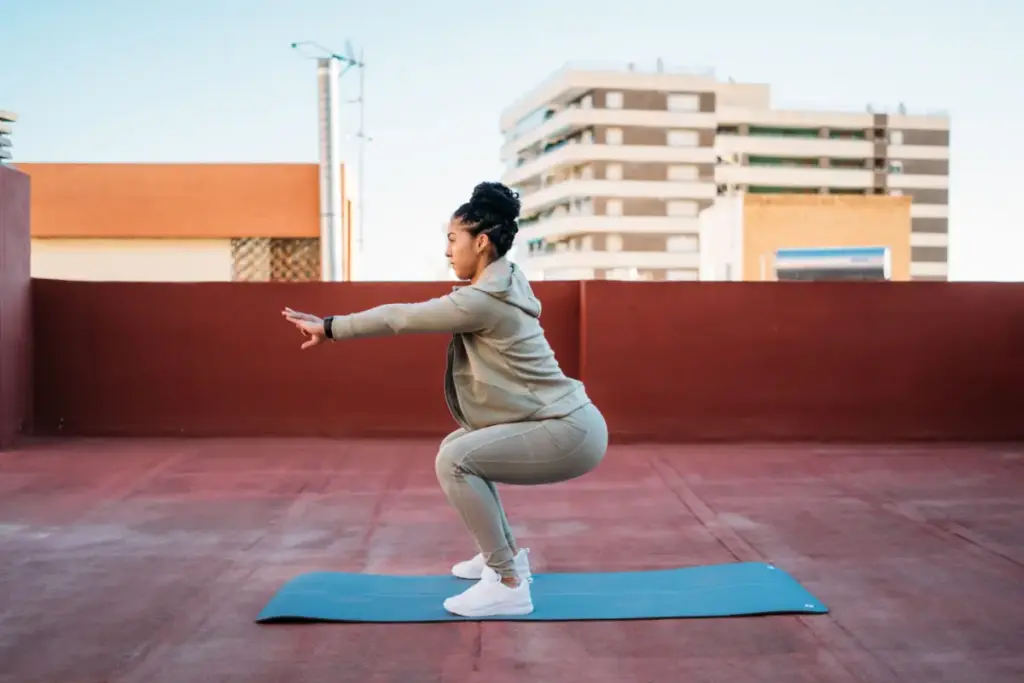
When we shift our focus to the lower body, the biomechanical reality changes again. Lower-body movements like air squats and lunges engage some of the largest, strongest muscle groups in the human body: the glutes, quadriceps, and hamstrings. Because these muscles are designed to carry our entire body weight all day long during walking, running, and climbing stairs, a standard air squat offers very little relative challenge for an experienced individual.
"For the average person, bodyweight squats are not going to be enough," explains Meredith Witte, MS, CSCS, founder of the functional strength platform The Playground. "Our legs are very strong, and so they’re going to feel challenged by body weight, but it’s still really not going to be enough to sufficiently build muscle, unless you truly have not worked out before, or you are an older adult who has not been working out."
Official Statements & Expert Insights: The Science of Muscle Hypertrophy
To determine whether bodyweight routines can stimulate true muscle growth (hypertrophy), we turn to world-renowned researchers and elite strength conditioning specialists.
The Magic Word: Proximity to Failure
According to Dr. Stuart Phillips, a prominent kinesiology professor at McMaster University in Ontario who has extensively researched muscle protein synthesis, the primary driver of hypertrophy is mechanical tension coupled with proximity to muscular failure.
Dr. Phillips notes that research conducted by his team demonstrates that muscle growth occurs whether you lift heavy weights, light weights, or use no external weight at all—provided that you generate enough tension to bring the muscle close to the point of failure. Muscular failure is defined as the physiological point during a set where you feel completely incapable of completing another concentric repetition with proper form.
Meredith Witte describes the visceral sensation of reaching this threshold as "trudging through mud." During your final repetitions, movement speed slows drastically, and finishing the rep feels nearly impossible.
Who Benefits Most from Bodyweight Training?
While advanced athletes must employ extreme calisthenic variations (such as one-arm push-ups, pistol squats, or handstand push-ups) to reach failure, beginners and sedentary individuals experience profound physiological adaptations from basic movements.
"The biggest improvements in strength and muscle are going to happen in people who are pretty inactive to start with," Dr. Phillips explains.
For novices, or individuals returning to exercise post-injury or surgery, low-intensity bodyweight exercises are more than enough to cause micro-tears in muscle fibers and trigger repair mechanisms. Furthermore, these movements play a critical role in neuromuscular adaptation.
Kristie Larson, CSCS, founder of Tension, a strength training studio for women in Brooklyn, emphasizes the neurological benefits: "Bodyweight is a great, free option that can be done anywhere… You can teach your brain to recruit the muscle fibers that you maybe aren’t utilizing." By mastering basic bodyweight patterns, exercisers forge a robust brain-body connection, improving coordination, balance, and core stability before ever stepping near a barbell.
Future Outlook: How to Progress and When to Introduce Weights
If you choose to stick exclusively with bodyweight training, you cannot remain stagnant. The foundational rule of physical progression is progressive overload—the systematic increase of stress placed on the body over time to force continuous adaptation.
While traditional weightlifters achieve progressive overload by adding heavier plates to a barbell, bodyweight practitioners must manipulate other variables.
Advanced Strategies for Bodyweight Progression
- Leverage and Variations: Changing the biomechanics of a movement can dramatically increase its difficulty. Transitioning from a standard double-leg squat to a single-leg pistol squat, or elevating your feet during a push-up, drastically alters the load placed on the target muscles.
- Tempo Manipulation: Slowing down the eccentric (lowering) phase of a movement increases time under tension, forcing muscle fibers to work harder without adding external load.
- Form Refinement: Utilizing strict, flawless technique eliminates momentum and prevents stronger, compensatory muscles from taking over for the target muscle group.
- Volume Management: Increasing repetitions and sets can drive progress up to a point. However, exercise scientists caution that once you can comfortably perform 30 or more repetitions without muscular failure, you cross the threshold from resistance training into muscular endurance training. At that stage, muscle growth stalls.
The Inevitable Ceiling
What happens if you never introduce external weights into your routine? Eventually, you will hit a physiological plateau.
"Bodyweight exercises just can’t provide enough stimulus for the average person for very long," Witte notes. "Pretty quickly, your body is simply going to need more to build muscle."
However, context matters. If your primary goal is not to maximize muscle mass or win powerlifting competitions, but rather to maintain functional independence, robust bone density, joint mobility, and longevity as you age, bodyweight training can be sufficient indefinitely. "If someone wants to just maintain muscle, then bodyweight could be appropriate indefinitely," Larson concludes.
Conclusion: Finding Your Balance
Ultimately, the choice between bodyweight training and weighted resistance is not an "either-or" proposition. Bodyweight exercises offer unmatched accessibility, foundational movement literacy, and a gateway to lifelong mobility. Yet, for those chasing aggressive muscle growth and continuous strength gains, incorporating dumbbells, kettlebells, or barbells becomes an eventual necessity. By understanding your personal fitness goals, respecting the science of muscular failure, and progressively challenging your body, you can design a regimen that keeps you strong, capable, and resilient for decades to come.