Executive Overview
The narrative of the American labor movement is frequently taught as a chronicle of burly, adult male industrial workers clashing with corporate titans in the late 19th and early 20th centuries. Yet, this foundational historical perspective overlooks the true architects of working-class rebellion in the United States: young women, teenage girls, and children.
From the very first factory strike in American history—initiated by young female textile workers in Pawtucket, Rhode Island, in 1824—to modern, youth-led organizing campaigns at major contemporary corporations, youth have consistently formed the militant vanguard of economic justice. Confronting grueling 14-hour workdays, rampant industrial hazards, and starvation wages, these young workers did not merely protest; they invented the modern strike, reshaped national labor laws, and laid the structural blueprint for two centuries of collective bargaining.
This deep dive examines the historical trajectory of youth-led labor militancy, tracking its evolution from early New England textile mills to the sprawling modern service economy, and highlighting the enduring principle that systems designed to exploit labor can be dismantled by the collective will of those who sustain them.
Detailed Chronology of Youth-Led Labor Militancy
1824: The Birth of the "Turn-Out" in Pawtucket
On May 26, 1824, the American industrial landscape experienced a seismic shift. The New England factory system was still in its infancy, yet its mills were already notorious for grueling conditions, perilous machinery, and systemic exploitation. When mill owners in Pawtucket, Rhode Island, colluded to slash weavers’ wages while unilaterally tacking an extra hour onto an already punishing 14-hour workday, the workforce reached its breaking point.
One hundred and two workers—consisting entirely of women and teenage girls, some as young as 15—walked off the job. The concept of a coordinated labor stoppage was so unprecedented that the participants had not yet settled on a standard term for it, initially calling it a "turn-out."
The movement quickly escalated beyond a passive walkout. Supported by the broader community, the strikers barricaded mill entrances, marched to the homes of the mill bosses, and pelted their residences with rocks. On June 1, an incendiary device was thrown into Walcott’s Mill, panicking the ownership class into negotiations. By June 3, a compromise was reached, proving that direct action could yield tangible concessions from entrenched capital.
1899–1907: Newsies, Breaker Boys, and the Garment Industry
As the Industrial Revolution matured, child and youth labor became a pervasive structural pillar of the American economy. Children and teenagers were systematically integrated into heavy industry, cotton mills, and subterranean coal mines.
Rather than succumbing to exploitation, these young workers organized. In the coal fields of Pennsylvania, preteen and teenage "breaker boys" participated extensively in militant miners’ strikes, protesting brutal hours and harsh conditions. In 1899, the iconic "newsies" of New York City launched a historic strike against newspaper magnates William Randolph Hearst and Joseph Pulitzer, successfully forcing a restructuring of their pay rates and inspiring future generations of organizers.
Youth leadership was particularly pronounced in the garment sector, where the workforce was overwhelmingly composed of young female immigrants. In 1902, 21-year-old Agnes Nestor led a successful strike for union recognition at the Eisendrath Glove Company in Chicago. Five years later, in 1907, 16-year-old Lithuanian immigrant Pauline Newman leveraged her position as a young garment worker to orchestrate a massive Lower East Side rent strike, mobilizing over 10,000 families against predatory landlords.
1909: The Uprising of the 20,000
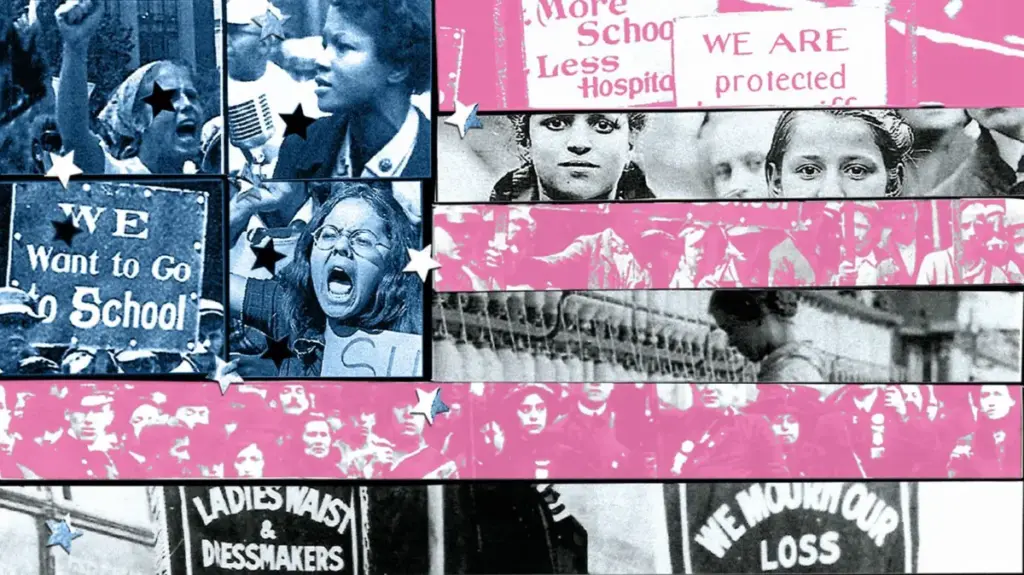
The winter of 1909 marked a watershed moment in labor history. Clara Lemlich, a 23-year-old Ukrainian refugee and garment worker, took the stage at a massive Cooper Union meeting in New York City. Frustrated by endless rhetoric from established union leadership, Lemlich interrupted the proceedings in Yiddish:
"I am a working girl, one of those who are on strike against intolerable conditions. I am tired of listening to speakers who talk in general terms. What we are here for is to decide whether we shall strike or shall not strike. I offer a resolution that a general strike be declared—now!"
The crowd erupted in agreement. The following morning, upwards of 20,000 garment workers—predominantly young Jewish and Italian immigrant women—poured into the streets. The ensuing mass strike lasted two months, ultimately securing union contracts across nearly the entire industry.
Tragically, one of the few holdout shops, the Triangle Shirtwaist Factory, became the site of an unspeakable catastrophe two years later. On March 25, 1911, a fire tore through the top floors of the building, killing 146 workers—123 of whom were young women and teenage girls—due to locked exit doors and flagrant owner negligence. The disaster underscored the prescient demands of the 1909 strikers, who had fought desperately for the very safety regulations that could have prevented the tragedy.
1912–1938: Radical Youth and Industrial Unionism
The 1910s and 1930s witnessed the emergence of radical youth organizers who viewed labor struggles through a broader socio-political lens. Elizabeth Gurley Flynn delivered her first public speech on socialism and women’s rights at age 15, and by 17, she was a full-time organizer for the Industrial Workers of the World (IWW). Flynn played an instrumental role in the historic 1912 "Bread and Roses" strike in Lawrence, Massachusetts, and the grueling five-month Paterson silk strike of 1913.
During the Great Depression, this militant tradition continued to expand across racial and ethnic lines. In 1933, 18-year-old Carrie Smith led 2,000 Black women out of the Funsten nut processing factory in St. Louis. Wielding a Bible in one hand and a brick in the other, Smith galvanized her peers with the cry, "Girls, we can’t lose!" Eight days later, management capitulated to the workers’ demands.
Similarly, in 1938, 21-year-old Emma Tenayuca helped lead 12,000 Mexican and Chicana pecan shellers in San Antonio, Texas, in what remains one of the largest strikes in the city’s history.
Supporting Context & Metrics
The historical prevalence of youth and women in the American labor force is supported by extensive economic and sociological data:
- Demographics of Early Industry: During the height of the New England textile boom in the mid-19th century, young women aged 15 to 30 comprised upwards of 80% of the workforce in mills such as those in Lowell and Pawtucket.
- The Scale of the 1909 Uprising: The "Uprising of the 20,000" involved approximately 75% women, the majority of whom were under the age of 25. The strike successfully unionized over 300 shops in New York City’s shirtwaist industry.
- Legal and Safety Impacts: The persistence of youth-led strikes directly pressured federal and state legislatures to enact child labor laws, culminating in the passage of the Fair Labor Standards Act (FLSA) in 1938, which restricted oppressive child labor practices and established baseline minimum wage and maximum hour standards.
- Modern Service Sector Shifts: According to recent data from the Bureau of Labor Statistics and labor research institutes, workers under the age of 30 currently form the backbone of unionization drives in the service, retail, and tech sectors, reflecting a generational return to militant organizing models.
Official Statements and Contemporary Perspectives
The ideological continuity between historical labor organizers and modern youth activists remains exceptionally strong. Today’s young organizers explicitly draw upon the strategies of their predecessors to challenge contemporary corporate hegemony.
DeArmon, a 23-year-old member-organizer with the Union of Southern Service Workers (USSW), emphasized the constructed nature of modern economic precarity in a statement to Teen Vogue:
"I want workers to realize, it’s a system that was made by people. We can unmake it. It’s possible to make huge changes, but we have to come together. It’s never going to change unless workers organize and demand it."
Echoing this sentiment, 25-year-old USSW organizer Jamila Allen highlighted the historical lineage and regional resilience of modern labor campaigns:
"A lot of people never learn this history. Our union is going to be like those workers before us who weren’t afraid to fight."
These statements underscore a collective realization among contemporary young workers: that overcoming modern economic inequality requires the same uncompromising solidarity and direct-action tactics deployed by the "mill girls" and immigrant garment workers of previous centuries.
Future Outlook
As the American economy undergoes a structural transition from traditional manufacturing toward service, platform, and gig-economy models, the landscape of labor organizing is experiencing its most significant revitalization in nearly a century.
Youth-led labor initiatives—typified by campaigns at Starbucks, Amazon, and various southern service industries, alongside union drives among graduate student workers—demonstrate that the spirit of the 1824 Pawtucket "turn-out" is far from dormant. Gen Z and millennial workers are increasingly rejecting atomized labor conditions, utilizing digital networks alongside traditional picket-line tactics to challenge corporate impunity.
The historical trajectory charted from the textile mills of Rhode Island to the modern service sector yields an undeniable conclusion: whenever capital has sought to extract excessive labor at the expense of human dignity, young workers have consistently emerged to challenge the status quo. As contemporary youth unions continue to build momentum, they carry forward a 200-year legacy proving that systemic exploitation is not an immutable law of nature, but a barrier meant to be dismantled.