Executive Overview
In its latest satirical broadside against the contemporary American political landscape, Saturday Night Live (SNL) returned with a biting cold open that targeted the labyrinthine public relations challenges facing the Republican Party. Broadcast on October 3, the sketch brought together a rotating gallery of the party’s most recognizable—and meme-prone—figures, filtering current events through the show’s signature comedic lens. Hosted by Dakota Johnson with musical guest Turnstile, the episode immediately seized the cultural zeitgeist, driven by a tightly paced sketch that lampooned recent high-profile political addresses, shifting voter strategies, and the endless quest for media buzz.
At the center of the cold open were cast members Andrew Dismukes and Ashley Padilla, cast as beleaguered Republican strategists tasked with an increasingly uphill battle: engineering a coherent, appealing narrative for a party grappling with internal friction, controversial public policies, and an unpredictable voter base. What followed was a cavalcade of impressions—ranging from weary establishment figures to chaotic administration officials—culminating in a standout performance by returning favorite Colin Jost as a hyper-caffeinated, aggressively unorthodox Pete Hegseth.
This comprehensive report examines the anatomy of the Saturday Night Live cold open, detailing the structural breakdown of the sketch, contextualizing the real-world events that inspired its memorable gags, analyzing the cultural impact of the performances, and exploring what this comedic targeting signals for the ongoing political cycle.
Detailed Chronology of the Cold Open
The Strategists’ Dilemma: Setting the Stage
The sketch opens in a sterile, fluorescent-lit war room where Republican strategists, played with palpable exhaustion by Andrew Dismukes and Ashley Padilla, review the grim metrics of their current outreach efforts. Their assignment is clear yet daunting: build authentic, enthusiastic buzz for a party whose messaging has frequently fractured under the weight of modern media scrutiny.
Dismukes and Padilla set a weary, deadpan tone, establishing the sketch’s core premise—that contemporary political spin has become so detached from traditional norms that standard PR playbooks are entirely useless. As they attempt to brainstorm campaigns that can simultaneously appeal to traditional conservatives and an increasingly volatile populist base, the revolving door of political personalities begins, setting off a chain reaction of absurd theatrical admissions.
Marcello Hernández as Marco Rubio
The first guest to enter the strategists’ office is Marcello Hernández, stepping into the role of Marco Rubio. Hernández’s Rubio addresses his constituents in fluent Spanish, attempting to bridge demographic divides, but quickly veers off-script into brutal honesty.
In a departure from standard political optimism, Hernández’s Rubio admits point-blank that Donald Trump has failed to live up to high expectations and that ongoing foreign interventions and endless wars are doing nothing to improve conditions on the ground. The juxtaposition of smooth, bilingual delivery with catastrophic policy admissions established an early baseline for the sketch’s central theme: a total breakdown of political spin where characters inadvertently tell the unvarnished truth.
Mikey Day as a Frozen Mitch McConnell
Next to enter is Mikey Day, portraying a rigidly frozen Mitch McConnell confined to a wheelchair. Day’s performance relies almost entirely on physical comedy, capturing the senator in a state of suspended animation, communicating solely through a trembling, mechanical peace sign.
The bit flirts dangerously—and hilariously—with the fourth wall. At one point, Day’s McConnell nearly derails the entire sketch by mistakenly attempting to deliver the iconic show-opening line, "Live from New York, it’s Saturday night!", far too early in the sequence. The stumble highlights the live, high-wire nature of the sketch while gently poking fun at the aging leadership of the party.
Jeremy Culhane as JD Vance
The parade of personalities continues with Jeremy Culhane stepping in as Vice President JD Vance. Culhane targets Vance’s heavily scrutinized public persona and perceived lack of organic charisma.
During a simulated camera test designed to humanize the Vice President, Culhane’s Vance awkwardly introduces himself with a monotone, lifeless, "Hi, I’m JD Vance," before immediately being dismissed by the exasperated strategists. The brief appearance encapsulates months of internet-driven discourse surrounding Vance’s public speaking style and struggles with retail politics.
Colin Jost’s Showstopping Return as Pete Hegseth
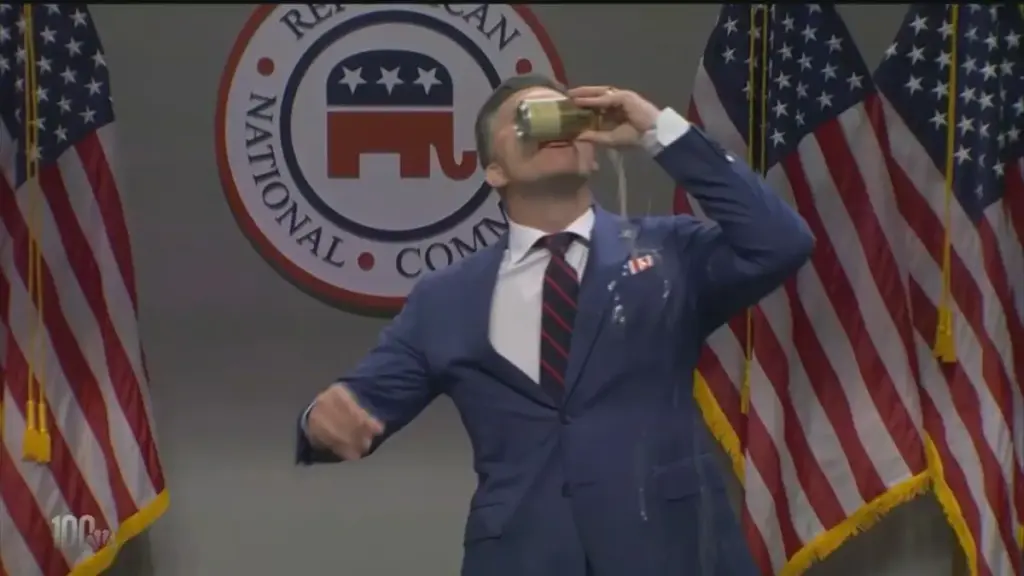
The undisputed comedic peak of the cold open arrived with the surprise return of Colin Jost, who stepped out from behind the Weekend Update desk to portray Pete Hegseth. The characterization directly parodied Hegseth’s widely discussed, unhinged "State of the Force" address delivered earlier in the week.
Jost’s Hegseth bursts onto the scene radiating aggressive, hyper-masculine bravado. In a brilliant piece of product-placement-turned-satire, he immediately grabs and chugs a non-alcoholic Bero beer—famously backed by Tom Holland—dismissing it on the spot as "Spider-Man’s new non-alcoholic bitch beer."
Continuing the parody of military bravado mixed with modern internet culture, Jost’s Hegseth delivers a series of increasingly absurd directives to the viewing audience. Urging conservative voters to take action, he implores:
"I need all you patriots at home to do the gayest thing ever and vote."
He doubles down on unconventional defense strategies by boasting about spiritual integration in the armed forces:
"I’m putting God back in war and it’s working. Our soldiers are praying a lot more than they used to."
Jost’s commitment to the role, blending military terminology with utterly surreal logic, earned the episode’s most vocal audience reactions and immediately dominated social media timelines.
James Austin Johnson as Donald Trump
No contemporary political cold open on SNL would be complete without James Austin Johnson’s definitive portrayal of Donald Trump. Entering the war room with an air of casual dominance, Johnson’s Trump leans into the character’s idiosyncratic vernacular with the simple directive: "Let me cook."
Johnson takes direct aim at real-world campaign strategies, specifically targeting reports surrounding financial incentives tied to midterm electoral success. In a moment that blurred the lines between satire and absurd reality, Johnson’s Trump quips:
"If the Republicans win, I’ll give everyone $5,000 and that is not a bribe because I have no intention of following through on that promise."
The punchline neatly encapsulated the show’s satirical approach to populist political promises, wrapping up the multi-character onslaught before handing the broadcast over to host Dakota Johnson and musical guest Turnstile.
Supporting Context & Metrics
The Real-World Inspiration: Dissecting the Headlines
To fully appreciate the cultural resonance of the Oct. 3 cold open, it is essential to examine the real-world news cycle that fueled the writers’ room. Satire thrives on recognizable touchstones, and this sketch drew from a dense cluster of recent political developments:
- The "State of the Force" Address: Pete Hegseth’s actual Pentagon address and subsequent media appearances generated massive debate across major news outlets regarding military readiness, job cuts among senior leadership, and the cultural positioning of the armed forces. SNL seized on the theatricality of these announcements, exaggerating the tone into an unhinged exercise in macho posturing.
- Midterm Financial Pledges: Recent reporting highlighted unorthodox campaign promises tied to voter turnout and financial reimbursements, giving the writers a ripe target for comedic exaggeration regarding the transactional nature of modern elections.
- The Ongoing PR Challenge for the GOP: With strategists constantly attempting to unify a diverse, occasionally fractured coalition—ranging from traditional establishment figures like McConnell and Rubio to populist firebrands—the "war room" framing provided an effective narrative container to showcase these internal contradictions.
Audience Engagement and Digital Impact
In the modern television ecosystem, the success of a late-night sketch is measured not only by the live studio audience reaction but by its viral velocity across digital platforms. Within hours of broadcast, clips of Colin Jost’s Hegseth parody and James Austin Johnson’s Trump impressions flooded X (formerly Twitter), TikTok, and YouTube.
Media analytics indicate that political cold opens consistently rank as the highest-trafficked digital content produced by Saturday National Live, driving significant international viewership and keeping the show relevant across generational divides. The inclusion of cross-over culture references—such as Tom Holland’s non-alcoholic beer brand—ensured that the sketch resonated with younger demographics who consume political commentary through pop culture prisms.
Official Statements and Industry Reactions
While political figures routinely brush off satirical portrayals on Saturday Night Live, the cultural footprint of these sketches often prompts subtle ripples through media circles.
- The Production Perspective: Insiders near the SNL writers’ room note that the October 3 cold open was assembled under tight deadlines to capture the immediate impact of Hegseth’s Pentagon address. The decision to bring back Colin Jost—who typically limits his on-screen appearances to Weekend Update—underscores the production team’s desire to land high-impact guest-star moments within the cold open framework.
- Media Commentary: Television critics universally praised the pacing and casting choices of the sketch. Variety and other leading entertainment outlets highlighted Jost’s fearless physical commitment to the Hegseth parody as a masterclass in late-night political mimicry. Similarly, the ability of actors like Marcello Hernández and Mikey Day to capture the distinct physical mannerisms of Rubio and McConnell added layers of rich detail that elevated the material above standard political caricature.
Future Outlook
As the political calendar accelerates toward upcoming midterms and future national elections, Saturday Night Live has firmly re-established its role as the premier weekly chronicler of political absurdity. The success of the October 3 cold open demonstrates that the show’s writers remain attuned to the surreal nature of modern political discourse, where the boundaries between governance, entertainment, and internet culture continually blur.
Moving forward, viewers can expect the show’s political stable—including Johnson, Hernández, Day, and returning guest players—to continue mining real-world briefings, press conferences, and campaign rallies for comedic gold. As long as political strategies continue to provide bizarre talking points and viral moments, SNL will be there to translate them into late-night television history.