The intersection of celebrity identity, aesthetic reinvention, and professional evolution has long served as a cultural barometer for contemporary entertainment. Few artists navigate this dynamic with the deliberate precision of Grammy-winning singer-songwriter Billie Eilish. Throughout her meteoric rise to international stardom, Eilish has consistently utilized her physical presentation not merely as a passive component of fame, but as an active tool for boundary-setting, artistic demarcation, and character immersion.
In her latest aesthetic shift, Eilish debuted her lightest hair transformation in years via an October Instagram photo dump, trading the long, dark brown locks she had maintained since February for a shoulder-length, strawberry blonde look. Characterized by golden hues, choppy layers, and a casual side part, this new style marks her first return to blonde tones since her transformative Happier Than Ever era in 2021.
Beyond its immediate visual impact, this hair change coincides with a broader professional transition. Eilish is stepping deeper into the world of acting, recently undergoing an almost unrecognizable 1950s style transformation to film her movie debut in an adaptation of Sylvia Plath’s classic novel, The Bell Jar. This dual evolution—spanning personal reclamation of public space and an expanding artistic portfolio—highlights an artist continually redefining what it means to be a modern cultural icon. This report explores the chronological context of Eilish’s aesthetic journey, the sociological implications of public perception, her transition into dramatic acting, and the broader landscape of celebrity image transformations.
Detailed Chronology: From Acid Green to Strawberry Blonde
To fully appreciate Billie Eilish’s current aesthetic shift, one must examine the chronological markers of her visual evolution, each chapter of which has directly corresponded to a specific phase of her personal and professional life.
The Signature Era: Acid Green and Black Roots (2019–2021)
Eilish entered the global consciousness with a distinct visual signature: neon acid-green roots paired with inky black lengths. This striking color palette became synonymous with her debut studio album, When We All Fall Asleep, Where Do We Go?. During this period, the hyper-recognizable look served as both a branding triumph and a personal shield. However, as Eilish later revealed, the sheer recognizability of the style eventually became an untenable burden. The neon green made public outings virtually impossible without immediate identification, restricting her freedom and heightening security concerns.
The Platinum Liberation: Happier Than Ever (2021)
In March 2021, Eilish shocked the music industry by debuting a platinum blonde, retro-layered shag. The transformation signaled the arrival of her sophomore album, Happier Than Ever. In subsequent interviews with outlets like Elle, Eilish opened up about the psychological motivations behind the drastic change. Seeking anonymity, she hoped the softer, classic Hollywood color would allow her to blend into crowds.
[2019-2021: Acid Green] ──> [2021: Platinum Blonde] ──> [2022-2025: Brunette Chapters] ──> [October 2026: Strawberry Blonde / The Bell Jar Era]Yet, the experiment yielded complex sociological insights. While it successfully provided a temporary veil of anonymity during initial outings, Eilish soon realized that society’s treatment of her shifted dramatically based on her hair color and wardrobe choices. The platinum blonde era forced her to confront the ways in which the public and media gaze commodify femininity, laying the groundwork for her later reflections on respect, modesty, and personal autonomy.
The Brunette Interludes (2022–Early 2026)
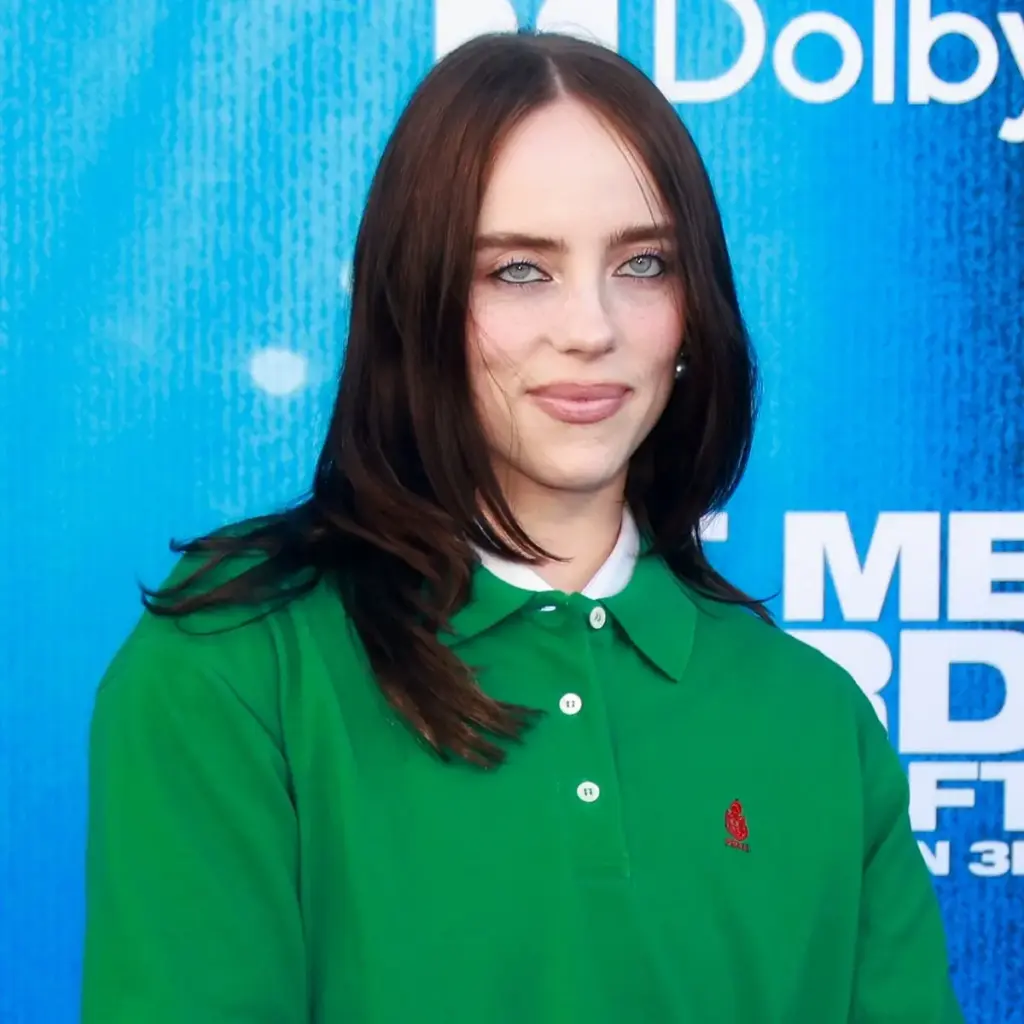
Following her platinum phase, Eilish oscillated through various shades of rich chocolates and deep espressos, leaning into darker, more grounded looks that accompanied her third studio album cycle. These choices aligned with her preference for oversized silhouettes and streetwear, maintaining a visual continuity that prioritized comfort and self-protection over conventional Hollywood glamor.
The Strawberry Blonde Reveal and The Bell Jar (Late 2026)
The current chapter began taking shape in August 2026, when Eilish was spotted on the set of The Bell Jar, sporting meticulous 1950s period attire that rendered her nearly unrecognizable. The cinematic transformation set the stage for her October 5 social media reveal. Trading her long dark tresses for golden, shoulder-length locks with choppy layers and a side part, Eilish completed her transition into strawberry blonde. Paired casually with a navy blue pullover, khaki pants, white DC Shoes socks, and black Celine sneakers, the look bridges her signature nonchalant streetwear aesthetic with a polished, mature edge.
Supporting Context & Metrics: The Sociology of Celebrity Appearance
The discourse surrounding Billie Eilish’s hair transformations extends far beyond pop-culture gossip; it touches upon core themes of gender dynamics, public surveillance, and the psychological toll of hyper-visibility.
The Burden of Recognition and Paparazzi Anxiety
During her 2021 Elle interview, Eilish detailed the claustrophobia of fame tied to a singular visual marker. "I couldn’t go anywhere with that hair because it was so obviously me. I wanted anonymity," she explained. Recounting an incident at a public park where she remained trapped under a hood out of fear, Eilish highlighted the literal safety hazards posed by stalkers and aggressive paparazzi. For artists who achieve astronomical success at a young age, aesthetic alterations often function as self-preservation tactics—attempts to reclaim bodily autonomy in public spaces.
The Dual Standard of Public Demeanor
Perhaps the most revealing aspect of Eilish’s reflections on her physical presentation is her critique of how public perception fluctuates based on aesthetic cues. Reflecting on her time as a blonde in an interview with Highsnobiety, Eilish offered a candid assessment:
"I didn’t feel sexy for one second of being blonde… When I was blonde, people treated me differently. People completely changed their demeanor."
Eilish further articulated a profound critique of industry and societal misogyny, noting that her career longevity and the baseline respect she commanded were heavily bolstered by her choice of looser, more masculine clothing. She surmised that adopting a traditionally feminine or hyper-sexualized presentation early on would have left her vulnerable to diminished respect from the public and media. By deliberately manipulating her image—sliding between baggy streetwear and retro period pieces, or dark brunettes and strawberry blondes—Eilish exposes the superficiality of cultural assumptions tied to feminine presentation.
Official Statements & Industry Perspectives
Eilish’s approach to her career is defined by an absolute refusal to be siloed into a single identity. While global audiences know her primarily as a generational vocal talent, the artist herself maintains a much more fluid definition of her professional scope.
Redefining Identity Beyond Music
In a revealing 2024 profile with Vogue, Eilish dismantled the notion that music production constitutes the entirety of her self-concept:
"I never felt like a singer. I’ve never had that as my identity."
Instead, she expressed a burgeoning passion for dramatic performance, admitting of acting, "I really secretly love it."
This philosophy explains the gravity of her transformation for The Bell Jar. Stepping into a cinematic adaptation of Sylvia Plath’s seminal 1963 semi-autobiographical novel requires more than a superficial costume change; it demands a psychological shedding of the "Billie Eilish" pop persona. By immersing herself in 1950s attire and altering her physical silhouette, Eilish is systematically building credibility as a multi-hyphenate performer capable of carrying complex dramatic weight.
Industry Context: The Great Celebrity Reinvention Wave
Eilish’s aesthetic pivot is part of a broader industry-wide wave of high-profile image shifts documented across entertainment in 2025 and 2026. From Sebastian Stan shaving his iconic MCU locks for *Thunderbolts*, to Kylie Jenner cycling back to her "King Kylie" platinum bob era, and Connor Storrie swapping hockey curls for a buzz cut during Heated Rivalry* season two, public figures increasingly utilize hair and makeup as narrative devices. These transformations signal transitions between artistic eras, character embodiment, or intentional personal milestones. Yet, few execute these shifts with the self-aware commentary that Eilish consistently brings to the table.
Future Outlook
As Billie Eilish steps into this new era defined by her strawberry blonde transformation and her impending cinematic debut in The Bell Jar, the trajectory of her career points toward sustained cross-disciplinary reinvention.
- The Acting Frontier: With her admission of a secret love for acting and her immersion in high-profile literary adaptations, industry analysts anticipate Eilish making a permanent mark in narrative film and television. Her willingness to undergo radical physical transformations for the screen signals that she approaches acting with the seriousness of a seasoned method performer rather than a dabbling pop star.
- Musical Evolution: Historically, Eilish’s visual rebrandings have served as heralds for new sonic explorations. While her current strawberry blonde look honors a desire for personal versatility rather than a strict conceptual album rollout, it positions her to experiment freely with her musical output moving forward.
- Cultural Commentary: As she matures in the public eye, Eilish remains a vital voice regarding the psychological realities of fame. Her willingness to transparently discuss the mechanics of how society treats women based on their hair color, clothing choices, and demeanor ensures she will continue to shape cultural conversations surrounding bodily autonomy and modern celebrity.
Ultimately, whether she is commanding stadium stages with haunting vocal performances or disappearing beneath 1950s period garments on a film set, Billie Eilish proves that her greatest artistic medium is her own relentless evolution.