Executive Overview
In the season-three premiere of HBO’s Euphoria, an exhausted Rue—played by Zendaya—finds herself on a remote southwestern ranch, staring into a bucket of raw cow’s milk. After scooping out a mug and taking a long, desperate slurp, she proclaims, “That’s the best f*cking milk I’ve ever had.” The moment is transformative. The taste is so overwhelmingly comforting that Rue instantly romanticizes the rural, hyper-traditional life of the ranchers. She bypasses their overt social politics, the absence of internet connectivity, and the stringent tradwife aesthetics of the women, seduced entirely by the immediate strength, solace, and false nostalgia a simple glass of cold milk provides.
This scene is more than just a piece of television world-building; it is a hyper-concentrated cultural mirror. Today, the concept of milk has broken out of the refrigerator and colonized the entire lifestyle sector. From the exponential boom of "milky" skincare toners and hydrating mists to a massive proliferation of lactonic, cozy fragrances crowding shelves at Sephora, Ulta, and global boutiques, milk has transformed from a dietary staple into a multi-sensory concept.
Simultaneously, this obsession is unfolding alongside an unprecedented convergence of economic, political, and wellness trends. We are living through the era of "proteinmaxxing," the widespread adoption of GLP-1 weight-loss medications, the cultural resurgence of the traditional homemaker aesthetic, and a booming U.S. dairy industry experiencing its first significant whole-milk consumption bump in decades.
Why is a substance defined by infancy and basic nutrition suddenly serving as the ultimate olfactory security blanket and wellness status symbol? To understand the milk-perfume phenomenon is to examine a complex intersection of macroeconomic forces, psychological yearning for safety, and an industry-wide pivot toward tactile, genderless luxury.
Detailed Chronology: The Rise of the Milky Aesthetic
The infiltration of milk into the contemporary beauty and wellness lexicon did not happen overnight. It evolved through distinct, calculated waves over the past decade, moving steadily from functional skincare to abstract emotional branding.
2016–2019: The Skincare Foundation
The modern obsession truly took root in the mid-2010s. In 2016, brands like Glossier and Milk Makeup launched with foundational products that explicitly leaned into the aesthetic and textural properties of milk—most notably Glossier’s cult-favorite Milky Jelly Cleanser. Consumers were introduced to the idea that skincare should feel cushiony, gentle, and non-stripping. During this period, "milk" was utilized primarily as a descriptor for emulsions: lightweight yet nourishing hybrids situated somewhere between a watery toner and a heavy cream.
.jpg)
2020–2022: The Pandemic Fragrance Boom
When the COVID-19 pandemic swept the globe, consumer habits shifted dramatically. As documented by industry analysts, traditional cosmetics like lipstick plummeted in sales while skincare and fragrance skyrocketed. Confined to their homes and grappling with collective anxiety, consumers treated perfume not as an accessory for the public eye, but as an intimate, self-care ritual.
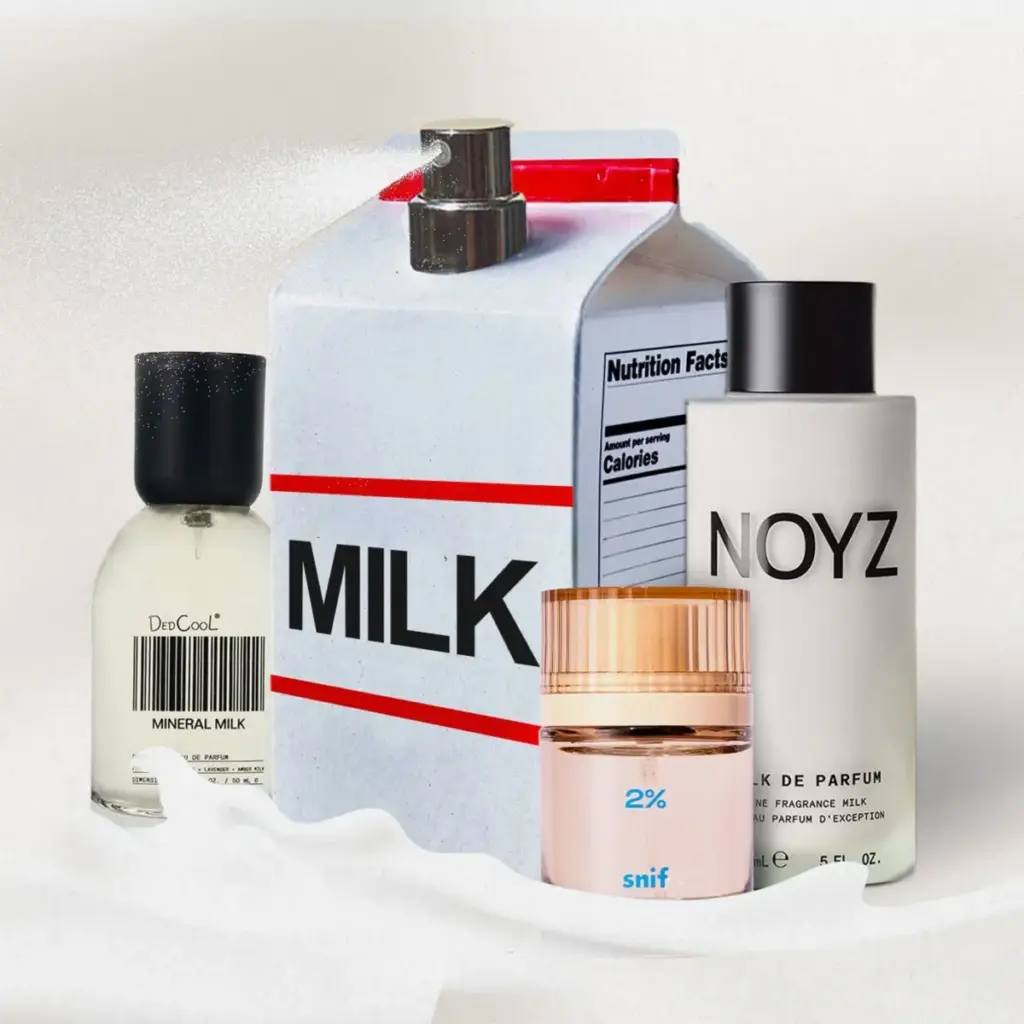
It was in this climate—specifically in 2020—that DedCool launched its signature "Milk" fragrance. Designed to melt into the wearer’s skin and create a personalized, barely-there aura, it hit the market precisely when consumers were craving sensory escapism and comfort.
2023–Present: The Olfactory Deluge and the Cereal-Milk Craze
Following DedCool’s success, the fragrance market experienced a gold rush of lactonic scents. Commodity introduced its multi-tiered Milk and Milk Orchid lines; The Nue Co. dropped First Milk in late 2025; and indie labels like Noyz introduced Mylk de Parfum formulations packaged like high-end skincare toners.
By early 2026, the trend had evolved from abstract skin-musks into hyper-literal comfort items. Snif debuted 2%’, an eau de toilette smelling unapologetically of sweet cereal milk, accompanied by body mists evoking nostalgic breakfast loops. What began as a subtle textural descriptor in skincare had officially evolved into a full-blown cultural obsession with edible, youth-adjacent comfort.
Supporting Context & Metrics: The Macro-Forces Behind the Milk Movement
To view the milk-fragrance boom in isolation is to miss the broader macroeconomic and political currents sustaining it. The cultural ascent of milk is propped up by three distinct pillars: the wellness industry’s hyper-fixation on protein, the rise of GLP-1 medications, and a deep-seated political and social craving for "simpler times."
The Proteinmaxxing and GLP-1 Factor
In the modern wellness sphere, "proteinmaxxing"—shorthand for maximizing protein intake while minimizing caloric overhead—has become the dominant dietary philosophy. Simultaneously, the proliferation of GLP-1 receptor agonists has altered how millions of consumers approach food. With approximately 12% of U.S. adults utilizing GLP-1 medications for weight management or diabetes, medical professionals frequently recommend high-protein diets alongside essential fats and fibers to preserve muscle mass and optimize drug efficacy.

Dairy has proven to be a primary beneficiary of this shift. According to data highlighted by the New York Times, 2024 marked the first increase in whole-milk consumption in years—and only the second increase recorded since the 1970s. While traditional dairy farms continue to consolidate, total cow numbers and milk yields are rising to meet renewed consumer demand for bioavailable, real-food nutrition.
The Political and Social Romance of "Realness"
Beyond macronutrients, milk occupies a potent symbolic space in contemporary political and social discourse. The romanticization of unpasteurized "raw milk" has surged concurrently with the hyper-visibility of the "tradwife" social media movement and the MAHA (Make America Healthy Again) political alignment. High-profile figures, including health officials, have publicly championed raw milk as a nutritional elixir, driving a 17.6% surge in raw milk sales in 2024 despite FDA and CDC warnings regarding foodborne pathogens.
Even as viral figures like the matriarchs of Ballerina Farm temporarily paused raw milk production due to health test failures, the underlying cultural yearning remains: consumers are desperately seeking products they perceive as "real," unadulterated, and untainted by ultra-processing.
When applied to the beauty space, this desire translates into products that promise a return to innocence, purity, and the foundational comfort of youth.
Official Statements and Industry Insights
Industry veterans, perfumers, and agricultural leaders offer a unified perspective: milk in fragrance is not about replicating the chemical composition of dairy, but about capturing a psychological state of being.
Lorna McKay, a veteran perfumer and co-founder of the Perfume Society, emphasizes that milk is fundamentally a conceptual framework rather than a raw material:

"Milky is not a material or an ingredient; it’s a concept and a feeling. You’ll get things like tonka, vanilla, sandalwood, and all these softening elements that will make the milky fragrance in the end. But a perfumer will make a milky fragrance—they’ll call it lactonic or all sorts of things—and there’s not a milky ingredient. It’s the feeling that people get when they wear these ingredients."
This sentiment is echoed by Kara Kowalski, director of fragrance and formula development at Snif, who links the trend directly to macroeconomic stress and a collective need for psychological safety:
"When the world is uncertain and we don’t know what to do, we want to go back to our creature comforts. I know in perfumery, we say that’s why gourmands are trending, because they’re comfortable. I think, in some way, milk does that too."
From the agricultural sector, Rachel Kyllo, Chief Marketing Officer for Dairy Brands at Dairy Farmers of America, notes that consumers are consciously seeking beverages and lifestyle products that evoke a pre-digital, farm-to-table simplicity:
"I think as people are looking for a beverage that harkens back to a simpler time, and also a product that isn’t ultra-processed, it just takes them to milk. It’s just a simple, real, farm-to-table nostalgic kind of beverage, and then you couple that with the nutrition that folks are looking for today."
Carina Chaz, founder and CEO of the vegan fragrance house DedCool, points out that the modern consumer embraces milk precisely because it defies rigid categorization. It is soft, universal, and inherently inclusive:

"It was a noninvasive, everyone-likes-this scent profile. It changes on everyone’s skin… We’re seeing a lot of milk, and it’s not only in fragrance; it’s in so many different categories in beauty. I think it makes sense. It’s something you can interpret in any way."
Future Outlook: The Longevity of Lactonic Luxury
As we look toward the future of the beauty and wellness markets, the milk trend shows no signs of curdling. It has successfully anchored itself at the intersection of three massive, enduring fragrance movements: the unending vanilla obsession, the dominance of intimate "skin scents," and the art of custom scent-layering.
Furthermore, the democratization of micro-luxuries points toward a lasting cultural shift. As Malena Higuera, CEO of Noyz, notes, modern consumers—particularly younger demographics and multicultural buyers—are redefining self-care through accessible, high-sensory experiences that validate internal emotional well-being through external rituals.
Whether the trend is fueled by proteinmaxxing, a nostalgic yearning for childhood mornings watching Matilda, or an escapist fantasy of ranch-life simplicity depicted on prestige television, milk perfumes have secured their place in the modern vanity. They offer a rare olfactory promise: in an increasingly loud, fragmented, and uncertain world, they allow the wearer to smell soft, feel grounded, and return, if only for a moment, to the absolute safest place they have ever known.