In the modern landscape of celebrity culture, the traditional PR circuit has evolved far beyond the standard press junket and late-night couch interview. Today, a star’s promotional run is marked by an elite, highly specific series of global modern rites of passage: ascending the Metropolitan Museum of Art’s iconic steps on the first Monday in May, enduring the existential, palate-scorching interrogation of Sean Evans on Hot Ones, walking the immaculate marble steps of the Vogue Beauty Secrets bathroom, and—increasingly—taking a seat on Quotidien, the preeminent French news and cultural nightly program broadcast on TMC.
Hosted by Yann Barthès, Quotidien has transcended its origins as a sharp-witted European current-affairs talk show to acquire an unexpected, wildly lucrative second life as a viral phenomenon across TikTok, Instagram, and X (formerly Twitter). The catalyst for this digital renaissance is not a controversial interview question or a viral political debate, but something far more superficial yet universally magnetic: the studio’s almost preternaturally flattering, cinematic lighting.
Over the past year, clips of Hollywood royalty—ranging from Margot Robbie and Zendaya to Sabrina Carpenter and Timothée Chalamet—sitting beneath the studio’s warm, diffuse glow have ricocheted across global social media feeds. Viewers are perpetually transfixed by the ethereal, poreless, and hyper-luminous way every guest emerges on camera. The phenomena have transformed the TMC plateau into an unofficial, highly coveted beauty filter come to life.
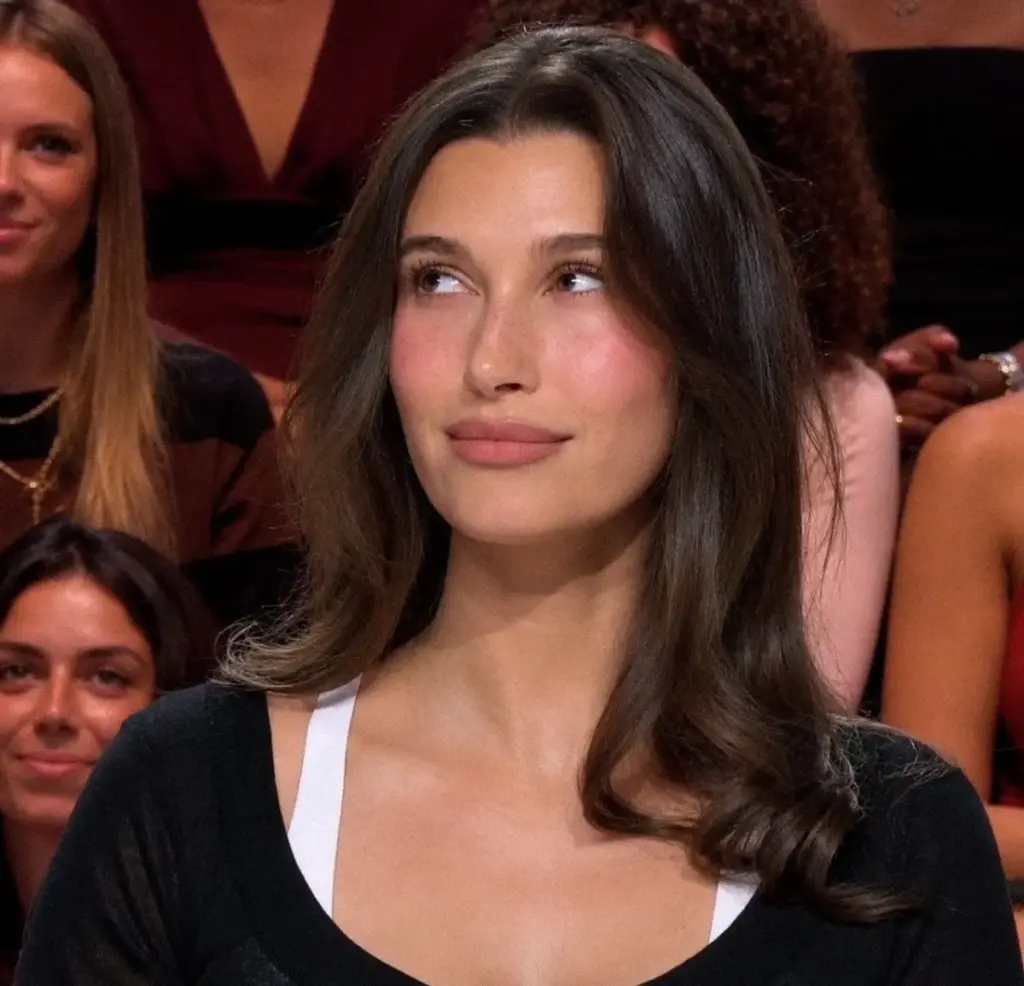
Cultural figures have taken notice. Pop sensation Zara Larsson has openly and publicly campaigned for an invitation solely to bask in the illumination, while rising artist Sombr cheekily leaned into the program’s new digital moniker during his guest appearance. Most recently, beauty mogul and style icon Hailey Bieber entered the chat. Appearing on the program during a high-profile Parisian excursion to spearhead Rhode’s European retail expansion via Sephora, Bieber’s appearance felt less like a standard promotional stop and more like a cosmic convergence: the internet’s undisputed high priestess of glow meeting the internet’s favorite purveyor of perfect light.
Detailed Chronology: From Parisian News Program to Global Digital Phenomenon
The Evolution of Quotidien
Launched in 2016 and spearheaded by veteran television journalist Yann Barthès, Quotidien carved out a dominant niche in the French media ecosystem. Blending hard news, political analysis, pop culture, and international interviews, the program quickly established itself as a must-visit destination for global stars promoting major cinematic releases, global music tours, and luxury fashion houses during Paris Fashion Week.
For years, the production functioned as a standard, high-production-value European television broadcast. Guests would sit across from Barthès in a sleek, modern studio environment, engaging in witty bilingual or translated banter. However, the intersection of high-definition digital streaming and hyper-curated social media consumption catalyzed a structural shift in how audiences consumed these interviews.
The TikTok Algorithm Meets Studio Lighting
By late 2023 and into 2024, digital media analysts began noticing an anomalous trend on TikTok: short-form edits of international celebrities on Quotidien were outperforming native US talk show clips by margins of millions of views. Comment sections were uniformly fixated on a single, recurring observation: Everyone looks unreal.
Unlike the harsh overhead fluorescent setups typical of American network television, or the hyper-saturated digital lighting arrays of late-night YouTube setups, Quotidien’s visual design creates an optical illusion of perfection. Skin textures appear smoothed without looking blurred; bone structures are accentuated without aggressive contouring; and eyes catch a distinct, captivating sparkle.
As clips of Zendaya looking like an illuminated neoclassical deity and Margot Robbie radiating old-Hollywood glamour flooded feeds, the show transcended its regional broadcasting boundaries. It became a meme, a cultural touchstone, and, crucially, a gold-standard PR placement for celebrities eager to project flawless, effortless elegance.
Hailey Bieber’s Parisian Showcase
The cultural apex of this lighting phenomenon arrived when Hailey Bieber stepped onto the TMC plateau. In town to oversee the aggressive European rollout of her skincare empire, Rhode, via high-profile partnerships with retail giant Sephora, Bieber’s appearance was strategically timed.
Bieber arrived bearing the hallmarks of her signature beauty vocabulary, which was immediately magnified by the studio’s optical environment. Sporting her newly darkened, chocolatey brunette hair—styled in a precise center part with blown-smooth, face-framing layers curling inward—she presented a masterclass in modern minimalist styling. Her makeup ethos, characterized by brushed-up laminated brows, softly defined lashes, a sheer nude-pink lip, and a high-swept rosy flush, caught the studio’s ambient warm tones with surgical precision.
Rather than merely participating in an interview, Bieber utilized the global broadcast as a live-action runway to tease an upcoming product launch: a heavily anticipated new cheek formulation slated for a November release timed to coincide with her milestone 30th birthday. By strategically pairing her Quotidien appearance with real-time social media updates regarding her road-tested cosmetics, Bieber demonstrated how contemporary celebrity founders harness traditional broadcast media to fuel direct-to-consumer digital ecosystems.
Supporting Context & Metrics: The Science of the Quotidien Glow
To understand why a French current-affairs program has become a focal point of the global beauty conversation, one must examine the rigorous, deliberate technical design behind the broadcast.
The Architectural and Lighting Blueprint
According to the show’s lighting director, Frédéric Dorieux, the visual success of Quotidien is no accident. It is the result of meticulous spatial and photometric engineering designed to combat the unforgiving nature of modern high-definition broadcast cameras.
The Circular Set Design: Unlike linear, adversarial interview layouts where guests face a wall of lights and a single camera, Quotidien utilizes an immersive, open circular set architecture. Guests are seated at the center of the plateau, surrounded by a live studio audience and multi-angle camera tracking.
Omnidirectional Diffusion: Rather than relying on hard key lights that cast deep shadows under the eyes and nose, Dorieux and his technical team employ a sophisticated matrix of soft, diffused lighting sources. These sources envelop the subject from multiple perspectives, effectively filling in natural facial depressions and creating an even, shadowless luminance.
Color Temperature Management: The palette is deliberately calibrated toward warm, golden-hour Kelvin temperatures. This specific color grading neutralizes the sallow undertones often exacerbated by standard studio environments, imparting a healthy, oxygenated flush to the skin.
Eye-Light Optimization: Strategic placement of low-intensity fill lights directly opposite the guest’s eye line creates a distinct "catchlight"—a tiny, luminous reflection in the pupil that signals vitality, alertness, and engagement to the viewer at home.
The Economics of the "Glow Economy"
The mania surrounding Quotidien aligns seamlessly with the broader cultural obsession with the "glow-up economy," a multi-billion-dollar wellness and beauty sector driven by consumer demand for hyper-dewy, healthy, and accessible aesthetics.
Metric / Indicator
Traditional Late-Night TV
Quotidien (TMC Broadcast)
Primary Lighting Approach
Directional, high-contrast keys
Omnidirectional, diffuse warmth
Global Digital Reach
Primarily domestic / regional syndication
Viral TikTok/Instagram cross-border distribution
Audience Demographic
Linear television loyalists (skewing older)
Gen Z & Millennial digital natives
Beauty Brand Synergy
Low direct correlation
High synergy (direct product teases & viral moments)
Bieber’s brand, Rhode, was built precisely on this visual philosophy. The "glazed-donut" complexion—characterized by high-gloss hydration, minimalist skin-first preparation, and strategic use of lightweight balms and blushes—defined a massive beauty cycle across social media. When the undisputed architect of the dewy aesthetic stepped directly into the internet’s favorite lighting rig, the resulting digital engagement metrics provided an immediate masterclass in modern viral marketing.
Official Statements & Industry Perspectives
While studio lighting directors and network executives traditionally operate behind the scenes, the unprecedented viral fame of Quotidien’s visual aesthetic has forced a pivot toward public acknowledgement.
Frédéric Dorieux, speaking on the technical philosophy of the show, noted in past production insights that the primary objective has always been humanization. "Television can be a harsh medium," Dorieux remarked. "Our goal is to strip away the clinical coldness of broadcast technology and create an environment where individuals feel—and consequently look—like the absolute best versions of themselves, bridging the psychological gap between the audience at home and the person in the chair."
Publicists and celebrity stylists have similarly updated their internal booking rubrics. Speaking on condition of anonymity, a prominent Los Angeles-based celebrity talent manager admitted that Quotidien has shifted up in priority during European promotional cycles.
"It used to be about ratings share in the French domestic market," the publicist noted. "Now? It’s about the asset lifecycle. We know that if a client sits in Yann’s chair, the lighting does 90% of the heavy lifting. We are guaranteed a piece of content that will perform autonomously across TikTok and Instagram for weeks after the broadcast airs. It’s essentially a free, high-end digital filter backed by professional television production."
Artists themselves have enthusiastically embraced the narrative. Swedish pop star Zara Larsson made headlines across European entertainment columns when she publicly tweeted her desire to appear on the program simply to verify the lighting rumors firsthand. When rising alt-pop artist Sombr took his seat on the plateau, he opened his interview by winking at the digital lore, acknowledging that he was there for both the conversation and the complexion boost.
Future Outlook: The Future of Celebrity PR and Studio Aesthetics
As media consumption continues its inexorable migration away from linear television toward fragmented, algorithm-driven social video platforms, the production values of traditional broadcast media are undergoing a radical reevaluation.
The phenomenon of Quotidien offers a compelling blueprint for the future of television production in an age dominated by digital aesthetics. Shows that fail to account for how their frames translate into vertical, algorithmic video formats risk losing cultural relevance among younger, digital-first demographics. Conversely, studios that deliberately design their physical spaces to double as flattering, real-time photo studios will increasingly capture the attention of high-profile talent and global brands.
For the beauty industry, this cross-pollination between talk-show broadcasting and cosmetics marketing is only just beginning. As founders like Hailey Bieber continue to leverage international media circuits to road-test unreleased inventory—transforming a standard chat-show appearance into a live-action product drop—the boundaries between editorial journalism, entertainment broadcasting, and e-commerce will continue to blur.
Ultimately, the viral success of Quotidien serves as a comforting reminder in an increasingly digital, filter-heavy world: sometimes, all it takes to capture the world’s attention is a brilliantly calibrated bulb, a warm Parisian studio, and a subject who knows exactly how to catch the light.