Model, muse, silver-screen siren, Bond girl, stage actress, and eternal style icon—Monica Bellucci has done it all, continuously redefining the boundaries of cinematic and cultural longevity. Born in the rolling green hills of Umbria, Italy, Bellucci’s journey from a small-town teenager sitting for local photographers to an international powerhouse is a masterclass in artistic reinvention. Over a career spanning more than three decades, she has defied the reductive tropes often assigned to breathtaking beauty, emerging instead as a linguistic polyglot, a critical darling, and a cinematic chameleon.
As the world marks her 62nd birthday, this retrospective offers more than a nostalgic trip down memory lane; it serves as a rigorous examination of how Bellucci transitioned from the high-stakes runways of Milan and Paris to the glittering heights of Hollywood, European art-house cinema, and the global stage. By examining her early breakthroughs, her linguistic versatility, her critically acclaimed performances, and her enduring influence on modern fashion, this profile captures the multifaceted essence of an artist who kept the entertainment industry perpetually on its toes.
Bellucci’s trajectory challenges the historical Hollywood paradigm that frequently pigeonholes foreign-born models into fleeting, superficial roles. Instead, through strategic artistic choices, fierce independence, and an undeniable magnetism, she carved out a singular niche. Today, she stands not merely as an Italian legend, but as a global benchmark of sophistication, proving that true style and substantive talent are entirely timeless.
Detailed Chronology: From Umbrian Beginnings to Global Stardom
The Formative Years: Umbria and the Early Modeling Hustle
Long before her visage graced international billboards and the covers of premier fashion glossies, Monica Anna Maria Bellucci was born on September 30, 1964, in Città di Castello, a quiet Renaissance town in the Umbria region of central Italy. Raised in an environment far removed from the frenetic energy of European fashion capitals, Bellucci was a studious and ambitious youth. Initially, her ambitions lay in the realm of law; she enrolled at the University of Perugia with the intention of pursuing a legal career.
However, fate—and an undeniable, striking physical presence—had other plans. To help pay for her university tuition, Bellucci began working as a model during her late teens, posing for local photographers. What started as a pragmatic financial solution quickly blossomed into something far more significant. By her late teens, her portfolio caught the attention of major agency scouts, prompting a high-stakes balancing act: she commuted between her demanding academic studies in Italy and the burgeoning fashion hubs of Milan and Paris.
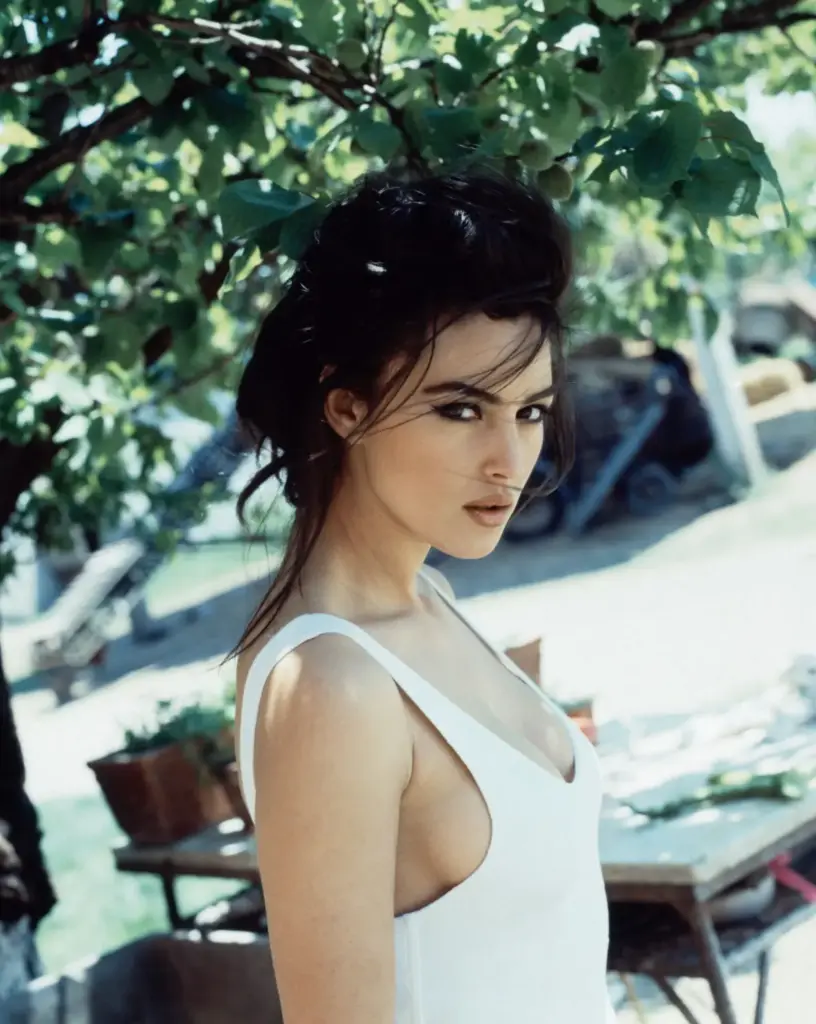
By the late 1980s, Bellucci made the definitive leap into full-time modeling. In 1988, she moved to Milan, signing with the prestigious Elite Model Management. Almost overnight, she became a fixture of the European fashion scene. She captured the lens of legendary photographers and walked the runways for top-tier design houses, most notably forging a symbiotic, lifelong relationship with Dolce & Gabbana. This era of Italian high fashion, defined by unapologetic Mediterranean sensuality and dramatic tailoring, found its ultimate living embodiment in Bellucci. Yet, even as she achieved elite status in the modeling world, she viewed the runway not as a final destination, but as a fertile launchpad for her true artistic ambition: acting.
The Transition to Acting: Television Debuts and Gothic Masterpieces
The shift from model to actress is notoriously treacherous. Historically, the entertainment industry has viewed crossover attempts with deep skepticism, frequently relegating high-fashion muses to ornamental, dialogue-free cameos. Bellucci, however, approached her cinematic apprenticeship with characteristic grit and patience.
Her acting debut arrived in 1990 with the Italian television miniseries Vita coi figli (Life with Sons), directed by Dino Risi. Though a modest television role, it provided Bellucci with invaluable exposure to on-set dynamics and allowed her to test her dramatic chops outside the controlled environment of a photo studio. More than a decade of minor television and film roles followed, during which she quietly honed her craft, taking acting classes and immersing herself in the mechanics of performance.
The critical turning point in her international film career arrived in 1992 when visionary director Francis Ford Coppola cast her in his gothic horror epic, Bram Stoker’s Dracula. Playing one of the three bloodthirsty brides of the titular vampire, Bellucci shared the screen with an ensemble cast that included Winona Ryder, Gary Oldman, and Keanu Reeves. Though her screen time was relatively brief, her striking visual impact and visceral presence in the vampire’s lair left an indelible impression on global audiences. It signaled to Hollywood and European casting directors alike that Bellucci possessed an otherworldly screen presence capable of anchoring dark, mythic narratives.
Critical Acclaim and the European Breakthrough
Following her exposure in Dracula, Bellucci returned to Europe to forge a string of daring, complex cinematic choices that firmly established her as a serious thespian. In 1996, she delivered a critically lauded performance in Gilles Mimouni’s psychological romance thriller, L’Appartement.
In L’Appartement, Bellucci played Lisa, the enigmatic and haunting object of obsession for the protagonist. Her nuanced portrayal showcased a profound emotional depth, moving effortlessly between vulnerability and haunting allure. The role earned her a prestigious César Award nomination for Most Promising Actress—France’s highest cinematic honor. This recognition was a watershed moment; it silenced industry critics who had prematurely dismissed her as merely a vampish pin-up, proving that she possessed both dramatic range and critical viability.
Throughout the late 1990s and early 2000s, Bellucci maintained a relentless international shooting schedule, effortlessly traversing linguistic and cultural boundaries. She starred in Giuseppe Tornatore’s poignant Italian drama Malèna (2000), a film that cemented her status as a global icon of beauty and tragedy. Playing a lonely wartime woman targeted by the vicious gossip of a small Sicilian town, Bellucci delivered a virtually silent masterclass in physical acting and emotional resilience. The film was a critical and commercial triumph, securing international distribution and solidifying her status as a formidable dramatic force.
Hollywood Blockbusters and Global Omnipresence
With her European bona fides firmly established, Hollywood came calling in earnest. In 2003, Bellucci achieved unprecedented global visibility by securing roles in two of the most anticipated sci-fi blockbusters of the decade: The Matrix Reloaded and The Matrix Revolutions. Portraying Persephone, the seductive and disillusioned consort of the Merovingian, Bellucci brought a palpable sense of operatic gravity to the Wachowskis’ cyberpunk universe.
Her ability to stand shoulder-to-shoulder with Keanu Reeves, Laurence Fishburne, and Hugo Weaving in complex, high-concept action sequences further expanded her demographic reach. She was no longer just an European art-house darling; she was a bonafide global box-office draw.
This momentum continued with her fearless—and deeply controversial—turn in Mel Gibson’s theological epic The Passion of the Christ (2004), where she portrayed Mary Magdalene. Stripped of her usual high-fashion glamour, Bellucci delivered a grounded, emotionally resonant performance that anchored the film’s most poignant human moments. Whether navigating the avant-garde complexities of Gaspar Noé’s harrowing Irréversible (2002)—notoriously famous for its unbroken narrative told in reverse and its unflinching confrontation with trauma—or stepping into the legendary shoes of a Bond girl in Sam Mendes’s Spectre (2015) at age 50, Bellucci continually subverted expectations, proving that her career trajectory was entirely self-determined.
Supporting Context & Metrics: The Mechanics of a Polyglot Icon
To fully comprehend the magnitude of Monica Bellucci’s career, one must look beyond the red-carpet flashes and examine the concrete metrics and cultural mechanics that have sustained her longevity.
Linguistic Versatility and International Reach
One of Bellucci’s most formidable, yet under-discussed, professional assets is her linguistic polyglotism. Fluent in five languages—Italian, French, English, Spanish, and Portuguese—Bellucci has systematically dismantled the linguistic barriers that traditionally trap foreign actors within their domestic markets.
This fluency has allowed her to work fluidly across continents without losing narrative authenticity. Consider the data of her filmography:
Italian Cinema: Collaborations with auteurs like Giuseppe Tornatore (Malèna) and Alice Rohrwacher (La chimera).
French Cinema: Critical works including L’Appartement, Irréversible, and her extensive stage work in Paris.
Hollywood/English-Language Productions: High-profile blockbusters such as The Matrix sequels, The Brothers Grimm (2005), and Spectre (2015).
Ibero-American Projects: Compelling performances in Spanish- and Portuguese-language features, showcasing her commitment to regional storytelling.
By refusing to let language dictate her casting potential, Bellucci engineered a truly international career model decades before streaming platforms globalized talent pools.
The Metrics of Style and Cultural Longevity
In the worlds of fashion and beauty, Bellucci’s metrics are equally staggering. Over a career spanning more than 35 years, she has graced the covers of virtually every major fashion publication worldwide, including Vogue (across multiple international editions), Elle, Harper’s Bazaar, Vanity Fair, and Marie Claire.
Career Milestone / Metric
Detail / Context
Active Years
35+ years (Modeling since the late 1980s; Acting since 1990)
Languages Spoken
5 (Italian, French, English, Spanish, Portuguese)
Major Nominations
César Award Nomination (L’Appartement, 1997); Nastro d’Argento wins/nominations
Franchise Appearances
The Matrix (Reloaded, Revolutions); James Bond (Spectre)
Global Brand Partnerships
Dolce & Gabbana, Cartier, Dior, L’Oréal
Her enduring partnership with Stefano Gabbana and Domenico Dolce stands as one of the longest and most fruitful muse-designer relationships in modern fashion history. Unlike fleeting Gen-Z digital influencers, Bellucci represents a masterclass in generational continuity. She transitioned effortlessly from the supermodel era of the 1990s to becoming a timeless ambassador of high luxury, demonstrating that elegance and gravitas appreciate with age.
Official Statements and Industry Perspectives
The cultural weight of Monica Bellucci’s career is best understood through the reflections of the directors, collaborators, and critics who have witnessed her creative evolution firsthand.
Reflecting on her international appeal and the deliberate choices that defined her career, Bellucci has frequently emphasized her resistance to being defined solely by physical aesthetics. In past interviews, she noted:
"Beauty is a handicap if you’re stupid, but not if you know how to use it. People think that because you look a certain way, you must be empty. But beauty without substance is nothing more than a passing facade. I have always used whatever tools I was given to tell complex, messy, and deeply human stories."
Directors who have worked with her consistently highlight her formidable work ethic and fearlessness on set. Francis Ford Coppola, discussing his casting choices for Bram Stoker’s Dracula, remarked on the instantaneous, hypnotic quality she brought to the screen:
"Monica walked into the room and the entire atmosphere shifted. She didn’t just look the part of a gothic creature of the night; she possessed an innate, classical theatricality that felt centuries old. She brought a visceral, breathing reality to a mythical archetype."
French filmmaker Gaspar Noé, who directed Bellucci through the harrowing, emotionally exhausting shoot of Irréversible, praised her unwavering courage and professional discipline:
"What people see on screen is a woman of immense physical beauty, but what directors experience is a soldier. Monica has zero vanity when it comes to the work. She dives headfirst into the psychological abyss of a character without hesitation or ego. That is why she is not just a star, but a true artist."
Industry analysts point out that Bellucci’s career strategy serves as a blueprint for contemporary actors navigating cross-cultural fame. By maintaining a home base in Europe while selectively engaging with the Hollywood machine, she avoided the burnout and typecasting that frequently plague blockbuster actors, preserving her artistic integrity across decades.
Future Outlook: The Ever-Evolving Icon
As Monica Bellucci steps into her 62nd year, the narrative surrounding her career is not one of graceful retirement, but of continuous reinvention. Far from resting on her laurels as an established global icon, she remains as active, curious, and selective as ever in her artistic pursuits.
Recent years have seen Bellucci expand her theatrical footprint, most notably taking to the stage to portray the legendary opera singer Maria Callas in the theatrical production Maria Callas: Letters and Memoirs, directed by Tom Volf. Touring internationally, the one-woman show required Bellucci to plumb the emotional depths of another legendary Mediterranean icon, reading from Callas’s private correspondence and memoirs. The production received rave reviews across Europe, proving that Bellucci’s magnetic stage presence is as potent live in a theater as it is projected on a cinema screen.
Furthermore, her personal and professional life continues to capture global headlines, demonstrating her ongoing cultural relevance. Her recent high-profile relationship with acclaimed American filmmaker Tim Burton has cemented their status as one of contemporary cinema’s most fascinating creative power couples, sparking widespread speculation about future artistic collaborations.
In film, Bellucci continues to defy demographic limitations that plague mature actresses in the industry. Rejecting the notion that a woman’s cinematic expiration date coincides with middle age, she actively seeks out independent European productions, avant-garde shorts, and international co-productions that challenge her creatively.
As we look back at the glorious throwback photos of her early modeling days in Milan and Paris, the contrast between the young Umbrian teenager and the global polyglot icon is striking. Yet, the core essence remains entirely unchanged: an unwavering commitment to beauty, intellect, and artistic independence. Monica Bellucci’s legacy is secure, yet her story is far from finished. The industry and her global audience wait with bated breath to see what masterpiece she orchestrates next.