Executive Overview
Fashion moves in cycles, but rarely does a garment stage a comeback as swift, widespread, and commercially frictionless as the rugby shirt. Characterized by its stout cotton construction, bold horizontal stripes, distinct rubber buttons, and floppy white contrast collar, the traditional athletic staple has officially broken free of the quad and the pitch. Today, it occupies a dominant position across the entire sartorial spectrum—from elite Milanese runways to mass-market digital lookbooks.
Over the past year, the rugby shirt has reached a critical mass of visibility. It has been spotted draped over the shoulders of street-style icons like Rihanna and Gigi Hadid, integrated into high-fashion presentations by Gucci and Zankov, and produced in endless iterations by heritage prep houses and fast-fashion retailers alike. Far from a fleeting novelty, the garment’s resurgence is powered by a confluence of economic caution, fatigue with the athleisure era, and a broader consumer pivot toward comforting, recognizable classicism.
According to retail analytics, search metrics, and industry leaders, the rugby shirt represents the ultimate sweet spot in contemporary retail: it offers the visual excitement of a trend without demanding that the consumer take a steep stylistic risk. As the fashion industry navigates a cautious economic landscape where shoppers scrutinize discretionary spending, the rugby shirt stands out as a masterclass in low-risk, high-reward retail strategy.
Detailed Chronology: From the Athletic Pitch to the Global Catwalk
To understand the modern ubiquity of the rugby shirt, one must trace its journey from a utilitarian sporting uniform to an emblem of counter-cultural cool and, finally, a pillar of contemporary style.
The Collegiate Roots and Subcultural Reappropriation
Originally designed for the physical demands of 19th-century English rugby union matches, the heavy-cotton shirt was engineered to withstand the rigorous pulling and tearing of the sport while remaining breathable. As the sport migrated across the Atlantic, the shirt was absorbed into Ivy League and prep-school wardrobes in the mid-20th century. Paired with chinos, penny loafers, and tweed blazers, it became a visual shorthand for collegiate leisure and youthful privilege.
However, the rugby shirt has historically possessed a rebellious streak. In decades past, subcultures—from British skinheads and indie-rock musicians to 1990s skaters and hip-hop artists—repeatedly reappropriated the garment, subverting its clean-cut image by pairing it with distressed denim, heavy boots, and oversized outerwear. This duality—simultaneously proper and slightly subversive—has given the rugby shirt an enduring flexibility that trend cycles rarely afford to other traditional garments.
The Recent Surge: From Milan to Main Street
The current renaissance began bubbling beneath the surface over the last several seasons, eventually boiling over into total saturation in recent months. High-end houses recognized the garment’s structural potential. At Milan Fashion Week, Gucci introduced tailored, elevated takes on the athletic staple, while at New York Fashion Week, avant-garde knitwear brand Zankov reinterpreted the silhouette through rich textures and unexpected color blocking.
Simultaneously, paparazzi photos of A-list celebrities—most notably Rihanna and Gigi Hadid—stepping out in classic rugby shirts sent shockwaves through digital commerce. Gift guides and trend roundups quickly flooded digital publications with headlines such as, "Rihanna and Gigi Hadid Convinced Me to Try the Cool-Girl Fall Trend That’s on Sale From $18."
This top-down validation from the luxury sector, paired with bottom-up cultural adoption by style icons, created the perfect storm. Legacy prep brands like Brooks Brothers and J. Crew—both experiencing massive contemporary revivals—placed the rugby shirt at the center of their seasonal marketing, cementing its status as the definitive garment of the season.
Supporting Context & Metrics: The Anatomy of a Retail Phenomenon
The resurgence of the rugby shirt is not merely a stylistic preference; it is backed by hard data that proves consumers are actively hunting for the garment across digital and physical retail landscapes.
The Death of Athleisure and the Search for Visual Interest
To contextualize the rugby shift, industry insiders point to consumer fatigue with the prevailing aesthetic of the past decade. David Ratmoko, a fashion photographer, model, and founder of the Swiss modeling agency Metro Models, notes a distinct shift in the industry’s photographic output and consumer demands.
"My read is that the athleisure cycle ran its course," Ratmoko explains. "People get tired of trends faster than they get tired of clothes. So after athleisure had its run, consumers looked for casual items of greater visual interest than just a plain sweatshirt. Rugby shirts tick all the right boxes here. Casual enough to wear, but with the added benefit of historical visual interest."
While hoodies and sweatpants dominated remote-work wardrobes and post-pandemic casual wear, the market eventually reached saturation. Consumers grew weary of monochromatic, textureless loungewear. The rugby shirt offers a structural upgrade: it provides the physical comfort of a heavy cotton sweatshirt but introduces architectural elements—namely, the collar, placket, and bold striping—that instantly elevate a casual outfit, making the wearer look put-together with minimal effort.
Hard Data: LTK and Search Metrics
Quantitative evidence confirms that consumer demand for rugby shirts is exploding organically. Data provided to industry trade publication Glossy by creator commerce platform LTK (from its October "Most Loved" list, which tracks user searches and clicks) illustrates a staggering surge in interest.
- Search Volume: Consumer searches for the exact phrase "rugby shirt" skyrocketed by 750% over a single month.
- Product Engagement: Clicks on American Eagle’s striped rugby shirt surged by 142% during the same timeframe, catapulting the item into the platform’s top six most-desired products for October.
This data underscores a vital retail truth: the trend is not just being forced onto consumers by luxury marketing teams; it is being aggressively pulled through the funnel by shoppers searching for accessible, stylish, and comfortable fall layering pieces.
Official Statements and Industry Insights
Behind the scenes, retail strategists, creative directors, and industry executives are carefully orchestrating how the rugby shirt fits into a broader economic and commercial strategy.
The Economics of Familiarity: Why Retailers Love the Rugby
Jackie Swanson, managing partner at Gartner Consulting, offers a sharp analysis of why the rugby shirt has become a darling of retail strategists. According to Swanson, the garment sits at the exact intersection of consumer desire and corporate risk management.
"[Rugby shirts are] recognizable enough that consumers immediately understand them, fresh enough to create a reason to buy, and versatile enough for retailers to sell them across multiple customer segments and price points," Swanson notes. From a retail strategy perspective, the interesting story is how brands are creating newness without asking consumers to take a huge fashion risk."
In an economic climate where shoppers are exercising heightened selectivity with their discretionary budgets, consumer behavior changes. When money is tight, shoppers are hesitant to invest in bizarre, unproven silhouettes that might look dated by next season. Familiarity breeds confidence.
"Rugby shirts already have established fashion codes around prep, collegiate style, and sportswear," Swanson adds. "A retailer can change the stripe, color, fabrication, fit, or styling, and create something that feels new without having to teach the customer how to wear it."
The Gateway Drug to Brand Loyalty
For heritage brands that built their empires on traditional American sportswear, the rugby shirt is more than just a seasonal bestseller—it is a powerful acquisition tool.
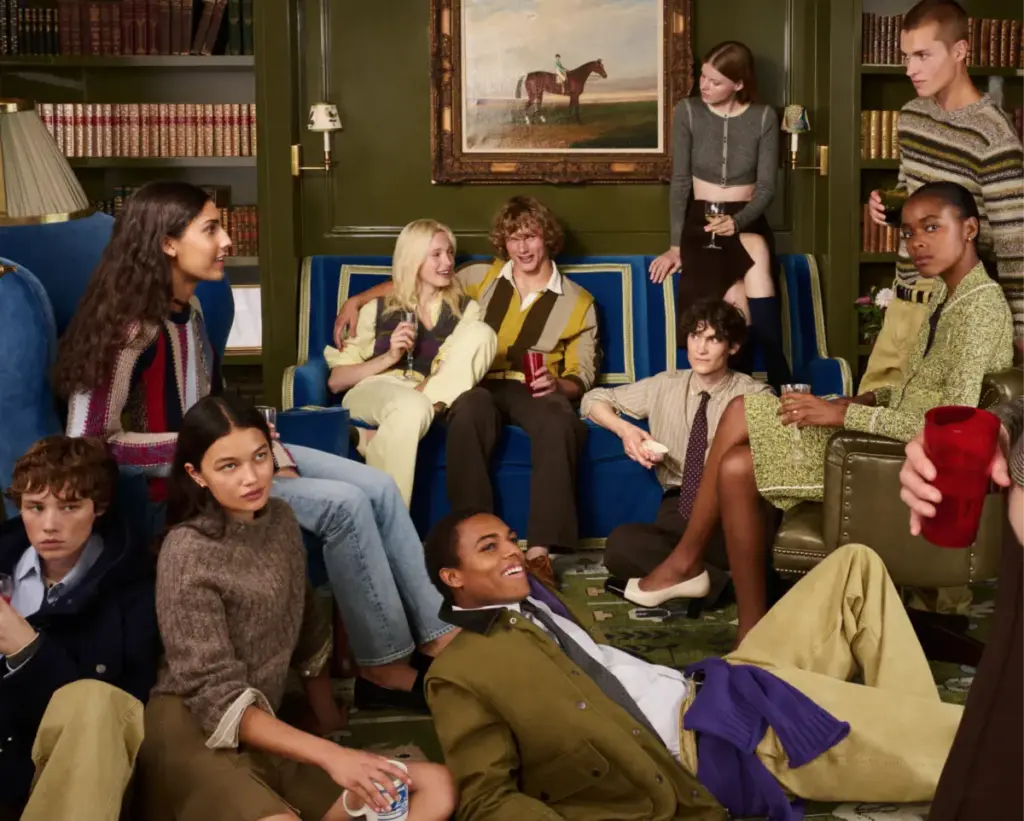
Michael Bastian, creative director of Brooks Brothers, views the rugby shirt as an ideal entry point for customers who may have previously viewed the brand as overly formal or inaccessible. As part of Brooks Brothers’ recent New York Fashion Week presentation, the brand heavily featured the rugby shirt, offering both pristine, traditional interpretations and modernized versions featuring graphic prints overlaid on classic stripes.
"A lot of times, people will start with the brand with a rugby shirt, or something else classic like a polo shirt," Bastian explains. "And then you get them as a customer. Men, in particular, are very loyal, and once they know a brand has what they like, they’ll stick with it."
Furthermore, Bastian notes that the appeal of the rugby shirt defies traditional gender lines, creating a unisex product pipeline that simplifies inventory management while broadening market reach.
"We see a lot of girls in the office wearing the men’s rugby," Bastian shares. "We’ve been making more smalls and extra smalls of the men’s rugby because we know women are buying them. Maybe we don’t even do the women’s rugby because we know she’s going to buy the men’s version anyway."
Future Outlook: The Preppy Renaissance and Beyond
The resurgence of the rugby shirt does not exist in a vacuum. It is part of a much larger, macro-level revival of preppy and heritage menswear codes that are sweeping the global fashion market.
The Broader Preppy Boom
Across the board, traditional staples are experiencing an unprecedented renaissance. Oxford cloth button-downs, crisp navy blazers, pleated trousers, and Harrington jackets are dominating retail floors. Legacy institutions like Ralph Lauren and Tommy Hilfiger are reporting soaring revenues, while direct-to-consumer newcomers and skate-adjacent brands (such as Pink Palm Puff) are adopting prep codes and infusing them with contemporary streetwear sensibilities.
This movement—often dubbed "prep revival" or "Ivy style 2.0"—succeeds because it avoids the stuffy elitism of historical prep by mixing high-low styling. Today’s consumer thinks nothing of pairing a $300 designer rugby shirt with thrifted vintage Levi’s and beat-up New Balance sneakers, or wearing an oversized men’s rugby dress as casual streetwear.
Will the Trend Have Staying Power?
While trend cycles in the modern digital age burn hotter and faster than ever before, the rugby shirt possesses structural advantages that protect it from instantaneous obsolescence. Because it is rooted in utility, durability, and classic sportswear history, it transcends the definition of a mere "micro-trend."
As long as consumers crave clothing that balances comfort with intellectual and visual heritage, the heavy cotton stripe will hold its ground. Whether worn oversized by supermodels in New York, styled sharply on the runways of Milan, or pulled off a discount rack by an everyday shopper, the rugby shirt has firmly re-established its status as an undisputed wardrobe essential.
The verdict from the runway and the retail floor is unanimous: the floppy collar is here to stay, and the heavy stripe is back on top.