Executive Overview
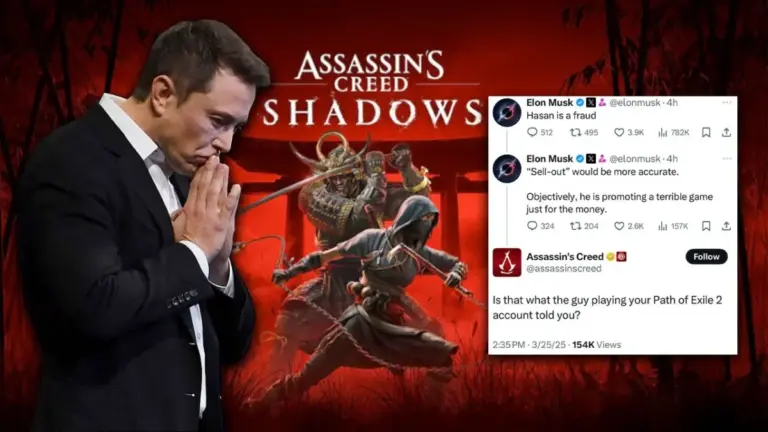
In the hyper-connected, hyper-scrutinized landscape of modern social media, few phenomena are as thoroughly devastating as a corporate account executing a "ratio" on a platform’s own billionaire owner. On a quiet afternoon that quickly devolved into a digital spectacle, the official X (formerly Twitter) account for Ubisoft’s upcoming tentpole title, Assassin’s Creed: Shadows, did just that. Target-locking Elon Musk amidst a heated online dispute regarding influencer marketing, game criticism, and authenticity, the social media manager behind @AssassinsCreed deployed a surgically precise callback to Musk’s recent gaming scandals.
The resulting digital execution—garnering upwards of 400,000 likes overnight—reignited a broader conversation regarding the billionaire’s complicated, often controversial relationship with video games. It also underscored the precarious nature of corporate-owned digital infrastructure, where the platform’s proprietor is increasingly vulnerable to grassroots mockery and institutional pushback alike. This report details the genesis of the feud, the intersecting drama involving prominent online personalities, Musk’s history of "fraudulent" gaming escapades, and the broader cultural fallout of an unforgettable internet moment.
Detailed Chronology: From Influencer Sponsorships to a Billion-Dollar Burn
The powder keg was ignited by a familiar face in anti-woke gaming commentary circles: notable video game critic and commentator @Grummz. Taking to X, Grummz leveled sharp criticism at Ubisoft, targeting the development team behind Assassin’s Creed: Shadows for their decision to sponsor prominent leftist Twitch streamer Hasan Piker (known online as HasanAbi). The sponsorship involved Piker broadcasting the game to his vast audience, a standard marketing maneuver for AAA releases that immediately drew the ire of certain factions within the online gaming community.
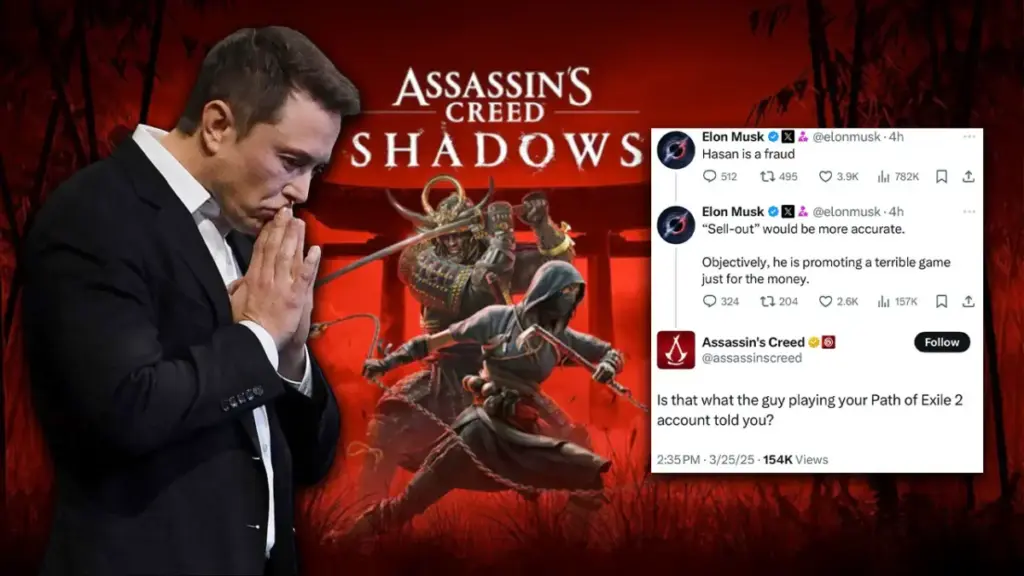
Sensing an opportunity to weigh in on a cultural flashpoint, Elon Musk stepped into the digital fray. Replying to the thread, Musk launched a direct verbal assault against Piker, labeling him a "fraud" and a "sell out." According to the tech mogul, Piker was promoting a "terrible game just for the money," invoking a common narrative among anti-Ubisoft commentators who frequently weaponize development delays and historical controversy surrounding Assassin’s Creed: Shadows to decry the project.
However, Musk severely miscalculated the room. The official @AssassinsCreed X account, monitoring the discourse surrounding their product, executed a rapid counter-offensive. Instead of addressing the critique of their marketing budget or engaging in a protracted debate over game quality, the account delivered a devastating, context-aware zinger:
"Is that what the guy playing your Path of Exile 2 account told you?"
The response was an instantaneous viral sensation. Within hours, the tweet obliterated Musk’s original post in engagement, securing over 400,000 likes and dominating gaming timelines across the globe. For internet onlookers, the burn was poetic justice, directly referencing a humiliating scandal that had plagued Musk just weeks prior.
The drama did not stop with the corporate ratio. Following the initial exchange, Hasan Piker and Elon Musk engaged in a bizarre, proxy-mediated war of words facilitated by Grummz. Piker openly challenged Musk to a "duel" in FromSoftware’s notoriously difficult action-RPG Elden Ring, testing the billionaire’s actual mettle in a high-skill gaming environment. Musk responded by calling Piker "chickens—" for allegedly blocking him on the platform, turning a critique of corporate advertising into a personal pissing match. Yet, despite the cross-fire of insults, the @AssassinsCreed ratio remained the undisputed heavyweight champion of the day’s events, reducing a billionaire’s moral grandstanding to a punchline about his inability to play his own video games.
Supporting Context & Metrics: The Anatomy of the Path of Exile 2 Scandal
To truly understand why the Assassin’s Creed jab landed with such lethal precision, one must examine the events of earlier that year when Musk was embroiled in what the internet quickly dubbed the "Fraud Gamer Controversy."
For weeks, Musk had been livestreaming his playthrough of Grinding Gear Games’ punishing action-RPG Path of Exile 2. Operating a high-rank character, Musk broadcasted his sessions to millions of followers, presenting himself as a dedicated, hardcore veteran of the genre. He spoke with authority on game mechanics, build optimization, and meta-strategies, expecting his audience to marvel at his digital prowess alongside his corporate exploits.
Instead, he ran into a wall of chronically online, eagle-eyed Path of Exile 2 veterans.
As clips of the livestream circulated across X, Reddit, and various Discord servers, actual POE players began dissecting Musk’s gameplay with forensic intensity. What they found was mortifying. The billionaire was blundering awkwardly across maps, displaying a profound lack of mechanical understanding, missing basic cues, and navigating high-level encounters with the grace and hesitation of a complete novice.
The cognitive dissonance between his character’s overpowered stats and his actual ineptitude sparked widespread mockery. Alex Alarga, a prominent community commentator, captured the prevailing sentiment on X:

"What an ego-trip… Elon Musk has been livestreaming himself playing overpowered Path Of Exile 2 character, proudly and seriously pretending that he got there himself, and actual POE veterans are laughing their asses off watching and dissecting that charade. Why Elon, why?"
The investigation didn’t stop at video analysis. Data-minded players dug into publicly available game telemetry and server data, discovering glaring inconsistencies. The data clearly indicated that Musk’s account was either "playing from Asia or using a VPN to play from Asia"—an inexplicable geographic anomaly for a resident of Texas unless the account was being actively operated by someone else in a different time zone.
Faced with mounting, undeniable proof that he had engaged in "account boosting"—hiring professional gamers or grinders to level up and gear out his character while he slept or managed Tesla and SpaceX—Musk offered a weak defense. In a post that only cemented his status as a gaming poser, he wrote: "It’s impossible to beat the players in Asia if you don’t, as they do!"
This admission transformed Musk into a permanent laughingstock within hardcore gaming spaces. Thus, when he dared to call Hasan Piker a "fraud" for accepting a corporate sponsorship, the irony was too rich for the internet—and corporate social media managers—to ignore.
Official Statements and Digital Reactions
The aftermath of the corporate ratio triggered a wave of creative expression across social media platforms, with users parsing the interaction through layers of internet irony and meme culture.
Many internet users, previously critical of Ubisoft’s recent corporate strategies and the promotional rollout of Assassin’s Creed: Shadows, experienced a rapid ideological pivot. Comment sections flooded with the popular meme, "I was unfamiliar with your game," a phrase used when an entity or individual unexpectedly proves their competence in a high-stakes situation.
X user @soundaholism encapsulated the mood of thousands by publicly vowing to purchase Assassin’s Creed: Shadows at full retail price rather than waiting for a post-launch discount, purely out of respect for the social media manager who successfully humbled the platform’s owner.
Other users seized the opportunity to mock the fundamental irony of Musk’s current corporate reality. For months, critics have pointed out the bitter comedy of Musk spending $44 billion to acquire Twitter (now X) primarily to control the digital town square, only to find himself routinely "cooked," ratioed, and publicly dismantled by corporate brands, independent streamers, and anonymous meme accounts on his own dime.
Ubisoft’s social media team remained publicly silent following the viral post, allowing the organic engagement to do the heavy lifting. However, within the broader marketing and public relations communities, the incident is already being studied as a masterclass in modern crisis deflection and brand-aligned snark. By tying their response directly to a verified, well-documented point of hypocrisy regarding Musk’s gaming habits, the Assassin’s Creed account neutralized an anti-game narrative and redirected the news cycle entirely toward the billionaire’s personal embarrassment.
Future Outlook: Corporate Snark in the Era of Musk’s X
As social media platforms continue to evolve under decentralized oversight and shifting monetization models, the dynamic between platform proprietors and corporate advertisers remains deeply fraught. Elon Musk’s active, often abrasive posting style has transformed his personal profile into a lightning rod for controversy, inviting direct confrontations with the very brands and personalities that populate his ecosystem.
The humiliation suffered by Musk at the hands of the Assassin’s Creed social media team signals a broader cultural reality: corporate entities are increasingly willing to push back against platform owners when brand safety or marketing narratives are threatened. While X relies heavily on AAA gaming publishers for ad revenue and platform engagement, instances like this prove that the barrier between corporate diplomacy and internet shitposting has permanently dissolved.
For Musk, the incident serves as yet another cautionary tale regarding the perils of online posturing. Whether it is faking high-tier status in Path of Exile 2 through outsourced grinding or hurling accusations of fraud at leftist streamers while sitting on a throne of compromised gaming credentials, the billionaire continues to discover that the internet has a long memory and an even sharper tongue.
As the release of Assassin’s Creed: Shadows approaches, Ubisoft has inadvertently secured millions of dollars in free, viral marketing—all courtesy of a billionaire who simply couldn’t resist weighing in on a game he was neither qualified to judge nor capable of playing on his own.