Achtung: Minor spoilers for Priscilla ahead!
Executive Overview
Elvis Presley remains an indelible icon of twentieth-century popular culture, heavily defined by his flamboyant stage wardrobes, gemstone-studded jumpsuits, and an uncompromising flair for theatrical fashion that dictated trends throughout the 1960s and 1970s. Yet, in Sofia Coppola’s cinematic masterpiece Priscilla—adapted from Priscilla Presley’s deeply revealing 1985 memoir Elvis and Me—the sartorial choices pivot away from the explosive bombast of the King of Rock ’n’ Roll. Instead, the wardrobe functions as a subtle, deeply intimate instrument of narrative storytelling. It charts the quiet evolution of a young woman gradually forging, suppressing, and ultimately reclaiming her own identity within the gilded cage of celebrity.
Starring Jacob Elordi as Elvis and Cailee Spaeny as Priscilla, the film strips away the blinding lights of Graceland to examine the domestic architecture of power dynamics. At the heart of this visual translation is costume designer Stacey Battat, whose previous collaborations with Coppola on The Bling Ring and The Beguiled established a shared cinematic language of interiority and emotional resonance. For Priscilla, Battat approached fashion not merely as period-accurate window dressing, but as a psychological barometer. Through meticulous historical research, high-end fashion partnerships, and a sharp focus on the shifting power balance between the couple, Battat’s costume design becomes a silent character in its own right—one that speaks volumes about control, compliance, and independence.
Detailed Chronology
1. The Innocent Beginnings: Germany and the Late 1950s
The narrative opens in West Germany, where a 14-year-old Priscilla Beaulieu lives with her family on a United States Army base. Here, Battat introduces the audience to an adolescent aesthetic characterized by innocence and youthful vulnerability. Priscilla is costumed in pastel-toned cardigans, sweet A-line skirts, and delicate accessories, such as a signature heart-shaped necklace. These pieces reflect a conventional mid-century middle-class upbringing frozen in time.
To ensure absolute authenticity, Battat and her department dove deep into archival material, scouring vintage editions of Vogue and Harper’s Bazaar from the late 1950s and early 1960s. They analyzed everyday silhouettes, textile weights, and tailoring norms of American military families stationed abroad.
One striking visual reference point comes directly from the historical record: a photograph of Priscilla bidding farewell to Elvis as he boards a plane back to the United States. In the film, Spaeny recreates this moment wearing a modest plaid dress paired with a translucent headscarf. It is an outfit defined by modesty and unpretentious charm—a stark contrast to the blinding limelight that would soon consume her existence.
2. The Gilded Cage of Graceland: Control and Conformance
Upon relocating to Memphis, Tennessee, to live within the sprawling, opulent confines of Graceland, Priscilla’s wardrobe undergoes a drastic, coercive transformation. The girlish plaid skirts and playful hair bows are abruptly cast aside, replaced by operatic evening gloves, dramatic eyeliner, and glamorous minidresses.
This shift was not organic; it was meticulously orchestrated. In a revealing scene within the film, Elvis acts as a personal stylist and strict director, dictating precisely what Priscilla is permitted to wear. He demands that she dye her natural brown hair jet-black and lean heavily into theatrical makeup trends. Battat notes how this foundational scene dictates the trajectory of Priscilla’s wardrobe for years to follow. Bound by Elvis’s rigid personal preferences—which banned earth tones and patterns he disliked—Priscilla is subsequently trapped in a curated palette of pinks, baby blues, and pristine whites.
Despite the confinement, a significant portion of the narrative intimacy occurs behind closed doors. Within the private chambers of Graceland, Priscilla frequently moves through the static environment clad in pastel-toned lingerie sets and delicate nightgowns. These garments underscore her domestic entrapment, functioning simultaneously as loungewear and the uniform of a kept muse.
3. The 1967 Las Vegas Wedding: Haute Couture and Historical Precision
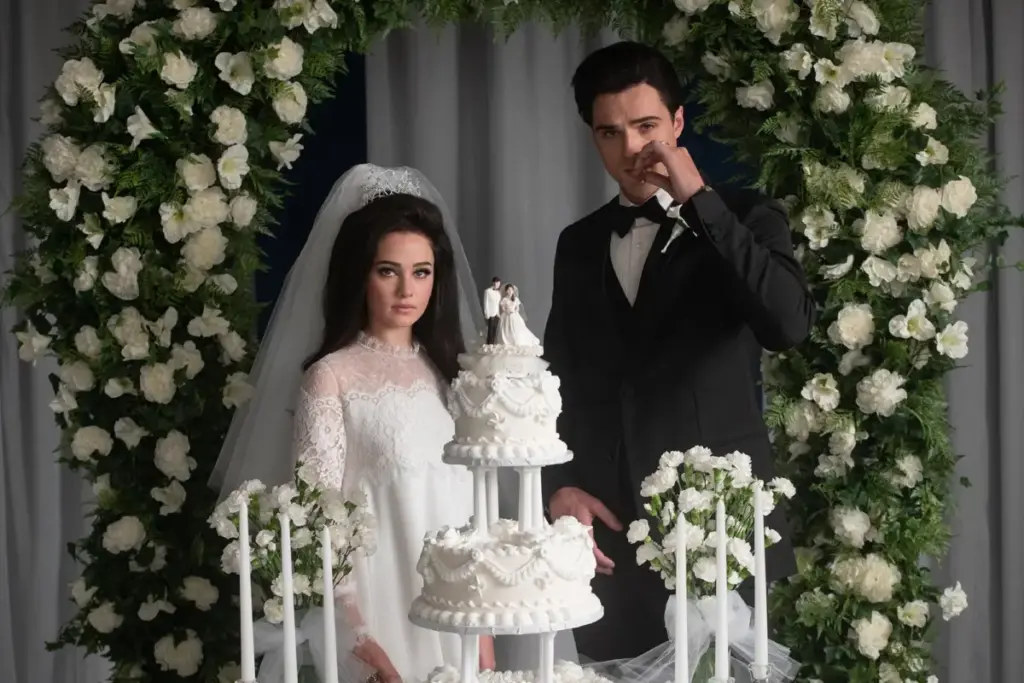
The apex of the couple’s public union is marked by their high-profile 1967 Las Vegas wedding. To recreate this historic ceremony with absolute fidelity, Battat forged exceptional partnerships with two legendary luxury fashion houses: Chanel, which designed Priscilla’s iconic wedding gown, and Valentino, which tailored Elvis’s sharp wedding suit.
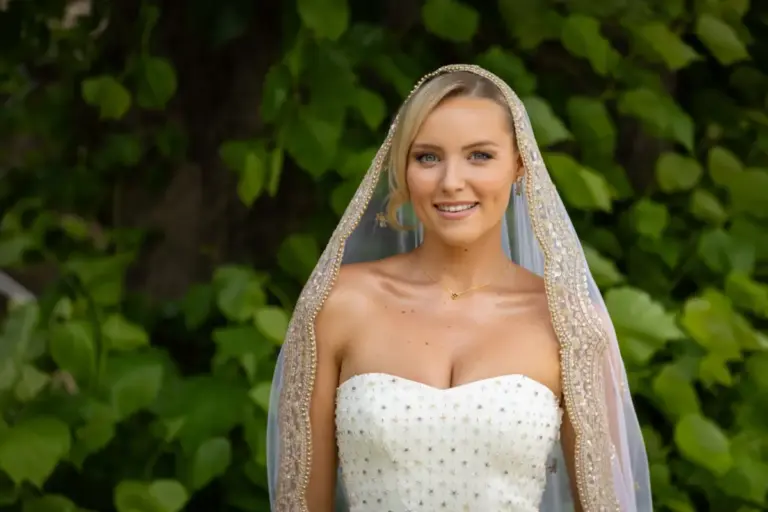
Mirroring the original archival photographs of the ceremony, the cinematic iteration of Priscilla’s dress is a long-sleeved, lace-trimmed A-line masterpiece, flawlessly complemented by a sparkling tiara and a sweeping, hip-length veil.
"The look contains subtle allusions to the original dress," Battat explains regarding the recreation process. "We had to adjust parts of it specifically to match Cailee’s physical stature [standing at 1.56 meters / 5’1"]."
This commitment to physical scale and historical silhouette extends to subsequent milestones. The outfit Priscilla wears immediately following the birth of their daughter, Lisa Marie—a vibrant, hot-pink dress—serves as a direct cinematic nod to the vivid colors documented in family photographs of the era.
4. Divergence and Liberation: Los Angeles and the 1970s
As the narrative advances into its second half, the geographical and emotional distance between Elvis and Priscilla widens dramatically. Elvis achieves the absolute zenith of his career under the blinding neon lights of Las Vegas, while Priscilla finds herself increasingly isolated in Los Angeles.
This emotional estrangement manifests directly in their clothes. The King of Rock ’n’ Roll discards his earlier understated leather jackets and traditional tailored blazers in favor of increasingly flamboyant, rhinestone-encrusted jumpsuits—costumes meticulously recreated by Battat in collaboration with BK Enterprises.
Conversely, Priscilla falls hard for the relaxed, liberated trends of the 1970s. She sheds the tight constraints of Elvis’s wardrobe mandates, adopting wide-leg trousers, eclectic patterns, and letting her natural, beautiful brown curls cascade freely once more. The visual contrast is profound: Elvis buries himself deeper beneath the armor of superstardom, while Priscilla slowly strips away her manufactured persona to find her authentic self.
Supporting Context & Metrics
To appreciate the weight of Stacey Battat’s work on Priscilla, one must evaluate the film not merely as a biopic, but as a masterclass in visual subtext. In historical film design, period accuracy is often prioritized over narrative function. However, Coppola and Battat weaponized historical accuracy to highlight emotional decay.
- Color Theory as a Narrative Tool: Throughout the first act, pastels represent youth and pliability. As the film progresses into the Graceland era, saturation increases, mirroring the claustrophobic artificiality of celebrity culture. By the final act, earth tones and relaxed textures return to Priscilla’s wardrobe, symbolizing a return to emotional grounding and autonomy.
- Scale and Proportional Contrast: Jacob Elordi stands at an imposing 1.96 meters (6’5"), while Cailee Spaeny stands at 1.56 meters (5’1"). Battat utilized this 40-centimeter height disparity deliberately within the costume design. High heels, structured minidresses, and towering hairstyles were weaponized in the early marriage scenes to artificially elevate Priscilla or emphasize her fragility next to Elvis’s overwhelming physical and cultural footprint.
- Archival Precision: Over 80% of the key looks featured in the film—from the German schoolgirl outfits to the Las Vegas wedding ensemble—were custom-built from scratch by Battat’s team after studying private photo collections, ensuring that the visual timeline mapped precisely onto the psychological trauma and growth outlined in Priscilla Presley’s memoir.
Official Statements
Reflecting on the collaborative creative process behind the film’s visual identity, costume designer Stacey Battat shared key insights regarding the inspiration that drove the project’s aesthetic direction:
"Sofia and I looked at this picture together and we both agreed that Priscilla looks like she is extremely uncomfortable there," Battat recalls, referencing a pivotal 1970 photograph of the couple that foreshadowed their ultimate separation. "I think that photo strongly mirrors how we later see the two of them interact in the film."
Elaborating on the psychological transformation encoded in the clothing, Battat contrasted the trajectories of the two central figures:
"We looked at historical photos of Elvis and Priscilla and thought about the image they presented to the world," Battat explains. "I think he became more and more theatrical and costume-like—lots of make-up, jewelry, and large sideburns. She, on the other hand, sheds her mask over time."
Future Outlook
Sofia Coppola’s Priscilla has fundamentally shifted how contemporary biographical dramas approach costume design. Rather than relying on mere nostalgia or encyclopedic replication of famous outfits, the film establishes a new benchmark for character-driven styling. By treating fashion as a psychological battlefield—where garments serve alternately as armor, prison bars, and instruments of liberation—Battat’s work has resonated deeply with critics and fashion historians alike.
As Priscilla continues its theatrical run worldwide, its impact on modern fashion trends—particularly the resurgence of 1960s mod aesthetics, soft pastel tailoring, and the re-evaluation of mid-century feminine silhouettes—proves that the visual vocabulary established on screen extends far beyond the cinema. The film reminds audiences that what we wear tells the world who we are, or, more importantly, who we are being forced to become.