Executive Overview
For the better part of a decade, the global fashion consciousness was held captive by an aesthetic of whispered opulence. Under the banner of "quiet luxury"—a cultural movement exhaustively cataloged, scrutinized, and eventually editorialized to exhaustion by style publications worldwide—the wardrobe of the modern tastemaker became a study in ascetic restraint. Dominant silhouettes featured a monochromatic sea of greige, camel, ivory, and onyx. Style icons like Kendall Jenner, Zoë Kravitz, and Hailey Bieber presided over an era where wardrobe staples were meant to last a lifetime, and color was relegated to a timid "pop"—a cherry-on-top red sweater slung casually over one’s shoulders, a muted jade-green accent bag, or a solitary pastel shoe.
However, fashion is inherently reactionary, a swinging pendulum perpetually exhausted by its own extremes. The breaking point arrived on September 26, 2025, in Milan. Against the backdrop of a volatile season characterized by unprecedented creative-director musical chairs, Versace staged a runway debut that instantly dismantled the reigning minimalist orthodoxy. Spearheaded by designer Dario Vitale, the Spring/Summer 2026 collection did not merely introduce color back into the luxury lexicon; it detonated it.
What began as a provocative exercise in 1980s maximalism paired with preppy subversion quickly catalyzed a global design panic. By the Fall/Winter 2026 collections, the industry-wide pivot was complete. From the structural ateliers of Paris to the experimental studios of New York, the runways transformed into laboratories of high-contrast juxtaposition. Color is no longer an accent piece; it is the fundamental architectural base of the modern wardrobe. As the industry casts off the shackles of good-taste minimalism, this report investigates the chronological turning points, the psychological underpinnings, the industry metrics, and the authoritative insights driving fashion’s boldest renaissance in decades.
Detailed Chronology: From the Milan Catalyst to the Global Saturation
To understand how high fashion pivoted from the monastic silence of greige to the electric shout of neon and saturated primaries, one must trace the timeline of key events that reshaped the runway between late 2025 and mid-2026.
September 26, 2025: The Versace Shock Wave in Milan
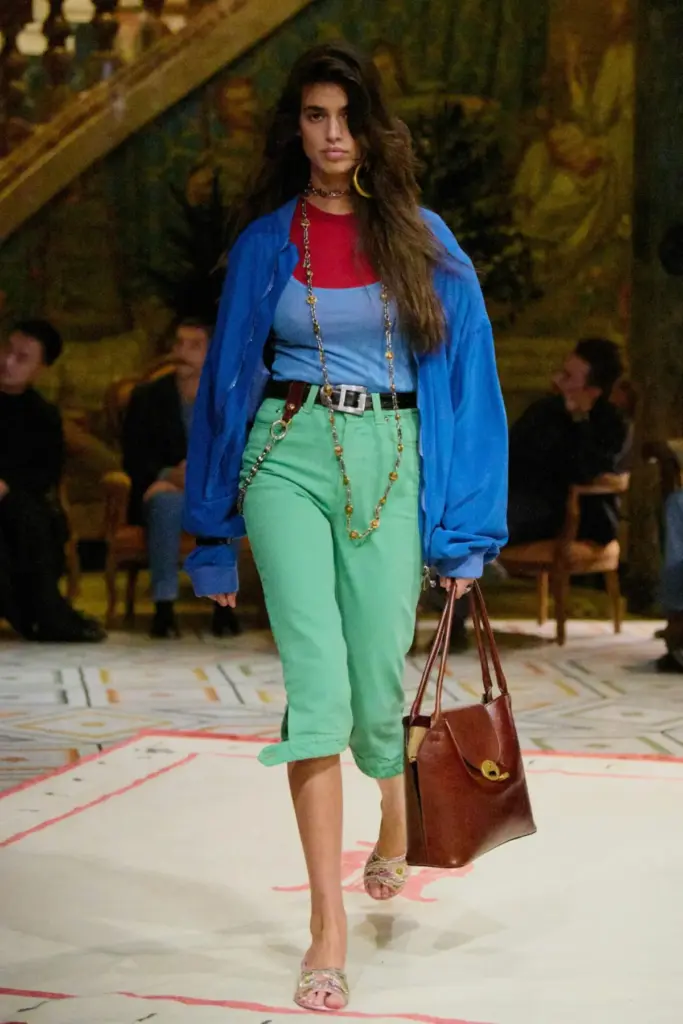
The seismic shift can be traced down to a single, much-dissected look on the Milan Fashion Week runway. Opening Versace’s Spring/Summer 2026 show, Dario Vitale sent out a model wearing a royal-blue cotton bomber jacket layered over a clashing red-and-cornflower-blue shirt-tank-top hybrid. This kaleidoscopic torso was anchored by sea-foam-green capri pants and finished with metallic peep-toe sandals.
It was an audacious collision of aesthetics: part prep school, part 1980s power-dressing maximalism, and entirely indebted to the house codes of Gianni Versace, yet thoroughly modernized. Critics were immediately polarized. The traditionalists recoiled at the jarring saturation, while forward-thinking stylists and editors recognized a watershed moment. Vitale’s thesis was clear: beauty no longer resided in safety, but in the friction of competing hues.
Fall/Winter 2026 Runways: The Color Domination
What initially looked like a provocative outlier in Milan rapidly ossified into a systemic industry standard by the time the Fall/Winter 2026 collections rolled around. Designers who had spent years refining muted palettes suddenly pivoted toward unapologetic chromatic exploration.
In Paris, the chromatic revolution was inescapable. Marie-Adam Leenaerdt and Mugler sent models down the runway clad in blazing neon hues that seemed to vibrate under the flashbulbs. Vaquera offered highlighter-yellow shift dresses that demanded spatial dominance, while Saint Laurent subverted its own dark heritage by pairing hot red and brilliant orange within the same ensemble. Perhaps most emblematic of the shift was Issey Miyake, where Satoshi Kondo debuted a suite of neon trench coats that effectively rewrote the rules of outer wear, treating coats not as shields against the elements, but as beacons of aggressive optimism.
In New York, the styling grew wonderfully chaotic. Brands like Zankov leaned into wacky, layered knits that mixed jewel tones with acidic primaries. Meanwhile, Meryll Rogge’s critically acclaimed debut for Marni featured breathtaking styling dichotomies, pairing a traffic-cone-orange slip dress with a heavy, hunter-green utility parka. The message was uniform: the fashion world had collectively developed an allergy to beige.
June 2026: Menswear and the Universal Rainbow
By the Men’s Fashion Week in June 2026, the contagion had thoroughly crossed gender lines. Auralee continued to refine its famously sophisticated color-blocking techniques, proving that subtle textures could elevate loud colors. Even Jonathan Anderson at Dior could not resist the pull, sending baby-pink trousers down the menswear runway and cementing the reality that chromatic liberation belonged to all wardrobes, regardless of gender binaries.
Supporting Context & Metrics: The Anatomy of a Rebound
The death of quiet luxury was not merely an aesthetic whim; it was a deeply quantifiable consumer and editorial reaction.
Retail Reactions and the Search for Technicolor
According to retail analysts and luxury buyers, the immediate aftermath of the Versace and subsequent Fall/Winter shows saw frantic inventory grabs. Editors and global influencers aggressively ravaged showroom racks, seeking out pieces that offered instant visual impact. Industry insiders note that consumer demand for saturated color lines was second only to the staggering retail frenzy surrounding Matthieu Blazy’s Chanel-era revival.
Data tracking luxury e-commerce platforms throughout early 2026 revealed a staggering spike in searches for terms like "neon outerwear," "color-blocked tailoring," and "monochromatic jewel tones," while searches for "quiet luxury staples" and "beige trench coats" saw their sharpest decline in five years.
Historical Precedents: The Masters of Hue
While Vitale’s collection served as the match that lit the fuse, the current color explosion stands upon the shoulders of historical giants. Dries Van Noten remains the undisputed living master of color-matching, renowned for his preternatural ability to make disparate, clashing shades—such as deep burgundy, burning hot pink, and absinthe green—feel harmonious and inevitable. Following his footsteps, successor Julian Klausner has adeptly carried the torch, ensuring the house remains a sanctuary for chromatic expression.
In the realm of pattern and structured knitwear, American designer Christopher John Rogers continues to define world-class color execution. His strategic use of taffeta, vibrant stripes, and sculptural silhouettes proves that color does not have to be chaotic to be loud; it can be engineered with architectural precision.
Mainstream Cultural Adopters
While ultra-minimalist style icons like Kendall Jenner are unlikely to adopt a full red-blue-orange ensemble overnight, the mainstream cultural zeitgeist has fully embraced the saturation. Pop culture’s most influential arbiters are driving the trend forward in real-time:
- Charli XCX: Though navigating a self-described "goth" era, the pop star famously wore a custom aqua-blue Chrome Hearts set in her "Wink Wink" video, followed by a striking, eggplant-purple cinched minidress from 7 for All Mankind—the unofficial dress of the Fall/Winter 2026 season—in her "Music" visual.
- Zara Larsson: Functioning as a living rainbow on festival stages globally, Larsson’s performance wardrobe has cycled through nearly every hue in the Pantone spectrum.
- Hailey Bieber: Known universally as a pioneer of the clean-girl aesthetic, Bieber made major fashion headlines by stepping out for dinner in a vibrant, lacy yellow vintage top—proving that even the most dedicated devotees of minimalism are craving a sudden injection of dopamine-inducing brightness.
Official Statements & Industry Insights
To truly gauge the psychological and emotional shift behind the technicolor revival, one must examine the testimonies of the designers currently shaping the commercial landscape.
Lizzie Owens, Head of Design at contemporary cult-favorite brand 6397, found herself entirely unable to resist the gravitational pull of the color revolution. Reflecting on the design process for recent collections, Owens describes an almost visceral shift in her creative process.
"Starting with Spring 2026, it became the thing I couldn’t ignore," Owens explains. "Fall/Winter 2026 worked the same way: turquoise, purple, peach announced themselves before concept, before the fabric. Something about 2026 was shouting for color."
Under her direction, 6397’s signature wide-leg denim and expertly tailored shirting suddenly bloomed with mint greens, vibrant pink panther pinks, and shocking turquoises. For Owens, choosing a color palette so far in advance of a collection hitting the sales floor requires a departure from analytical forecasting.
"Choosing a palette for something that won’t be seen for over a year is pure instinct, emotion, almost a sixth sense," she adds. "You can’t overthink it, and it’s definitely not about subscribing to color trend reports or waiting on Pantone’s color of the year. You have to tap into something beyond the usual level of consciousness to feel it before you can even name it."
Analyzing the macro-cultural forces at play, Owens diagnoses the color boom as a necessary and violent correction against years of enforced sartorial good behavior.
"I think we’re rebounding from a long ‘good taste’ era—quiet, luxurious, unapologetically wealthy," Owens notes. "The pendulum is moving toward creative expression, emotion, even messiness. And it’s not just a feeling—color theory backs it up. Our eyes and brains respond to color emotionally: butter yellow calms you down; bright canary yellow excites you."
Future Outlook: How to Navigate the Era of Hyper-Saturation
As the fashion industry consolidates its embrace of the rainbow, the methodology of getting dressed has fundamentally changed. The cardinal rules of the 2020s—such as limiting an outfit to two muted colors or relying on a single neon accessory to anchor a sea of black—are officially obsolete.
The New Rules of Engagement
- Color as Foundation: Color is no longer an accent; it is the structural foundation of the look. Outfits are built from the saturation up.
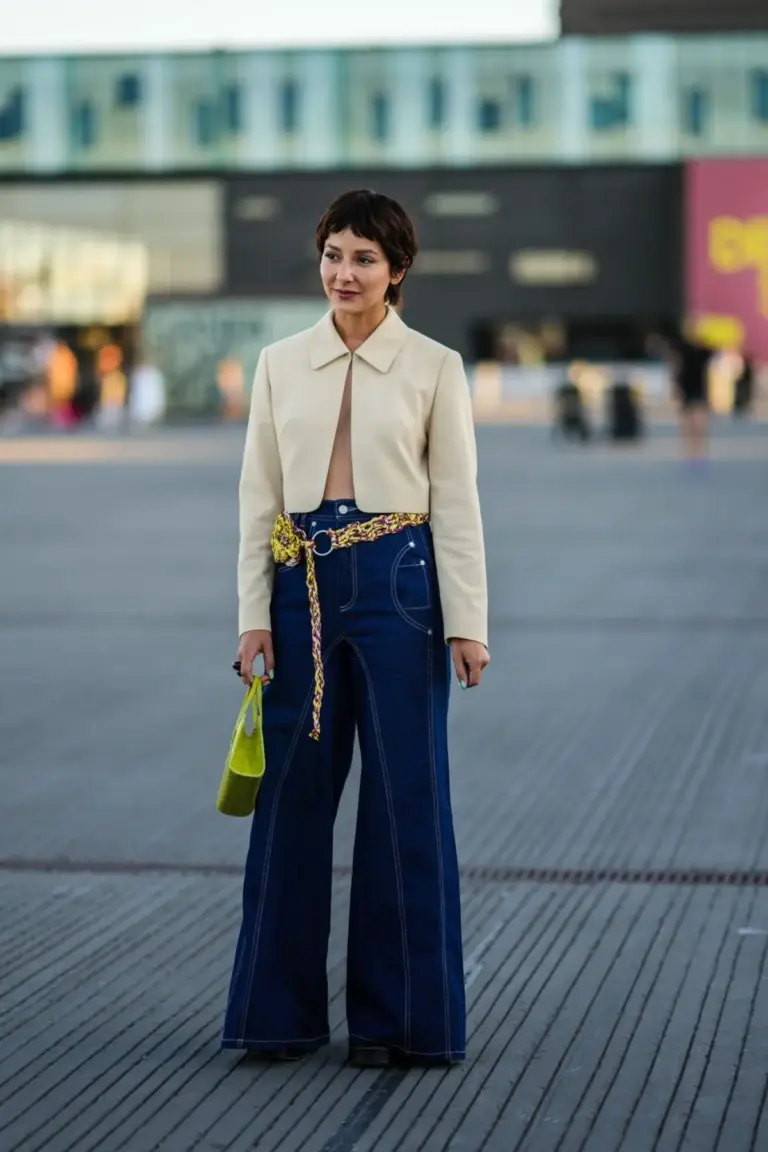
- Fearless Clashing: The modern uniform encourages mixing three or more colors that traditional style guides claimed "should never work together." Think teal paired with neon blue and lilac, or traffic-cone orange against hunter green.
- Monochromatic Day-Glo: Wearing a single, blinding shade from head to toe is the ultimate power move of the post-minimalist era.
- Texture and Hue Harmony: Balancing matte fabrics with glossy finishes allows intense shades to coexist without visually overwhelming the eye.
Why We Wear Color Now
The return to saturation is not merely aesthetic; it is deeply psychological. In an era marked by global uncertainty, political upheaval, and societal fatigue, the collective psyche is rejecting the comfort blanket of gray. Quiet luxury offered safety and control through austerity. Technicolor chaos offers something far more radical: joy, emotional release, and unbridled creative expression.
As Lizzie Owens aptly summarizes: "The world is burning, so why not spice it up?"
The era of whispered fashion is officially over. Let the screaming colors begin.