
Executive Overview
London Fashion Week has long occupied a singular position in the global style canon. Revered as the incubator of avant-garde subversion and the birthplace of boundary-pushing design houses such as Chopova Lowena and Simone Rocha, the city’s creative pulse inevitably spills off the official exhibition runways and onto the tarmac. During the most recent showcase, the street-style galleries along The Strand and outside prominent shows like Talia Byre offered a fascinating sociological and aesthetic study of contemporary dress.
This season’s sartorial narrative split dynamically into two distinct factions. On one side stood the champions of uninhibited creative expression: a maximalist approach defined by bold prints, brilliant flashes of color, and playful silhouette juxtaposition. On the other, an equally potent movement toward relaxed, lived-in dressing captured the imagination of the city’s fashion cognoscenti. Rather than relying on manicured perfection, the prevailing street-style vocabulary favored low-rise silhouettes, vintage-inflected utility wear, and an effortless, instinctive layering style.
This report provides a comprehensive, authoritative breakdown of the micro-trends and macro-shifts defining the London Fashion Week street style set. From the unexpected dominance of jewel-toned leathers and heritage accessories to the subtle resurgence of early-2000s nostalgia, we examine how the industry’s most influential editors, buyers, and creators are rewriting the rules of autumn and spring transitional dressing.
Detailed Chronology: The Evolution of London’s Street-Style Narrative
The rhythm of London Fashion Week is marked as much by the movement of attendees between venues as it is by the presentations themselves. As photographers and editors staked out key locations across the British capital, a clear chronological evolution of trends emerged across the multi-day event.

Phase One: The Rise of Utilitarian Nostalgia and Archive-Inspired Layers
The opening days of the schedule were characterized by a pragmatic yet deeply stylish approach to transitional weather. Along The Strand, oversized camouflage trousers—steeped in a lived-in, vintage aesthetic reminiscent of Nili Lotan’s utilitarian tailoring—dominated the pedestrian walkways. Rather than styling these cargo trousers with delicate counterweights, the street-style set leaned into their rugged heritage by pairing them with structured blazers and razor-sharp accessories.
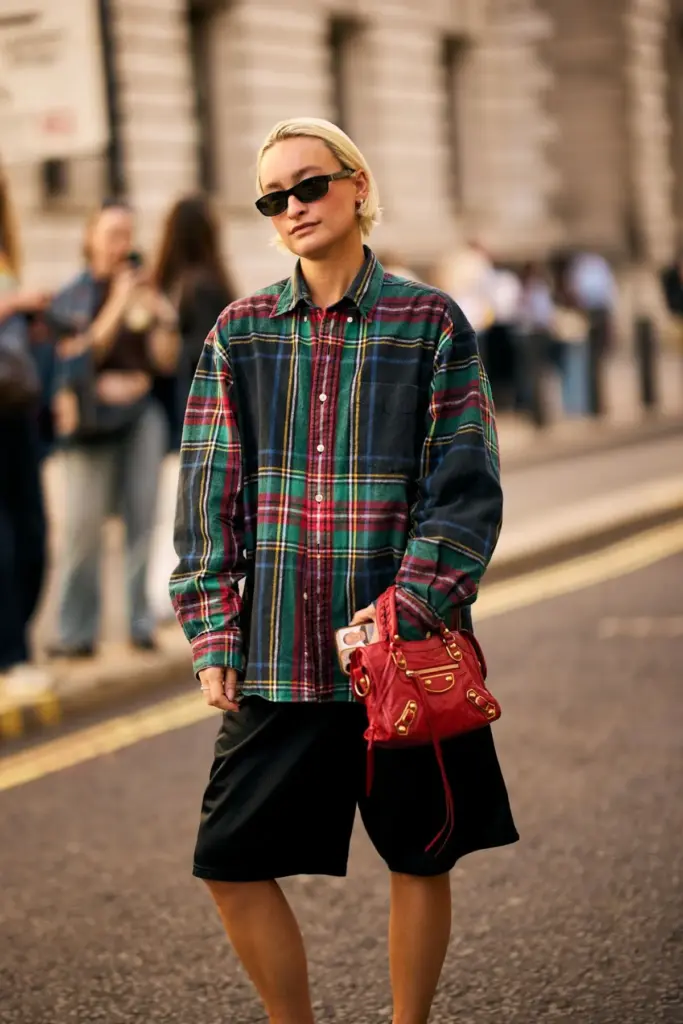
Simultaneously, early-2000s nostalgia manifested through a refined lens. Plaid and checked shirts, long championed by heritage outfitters like With Nothing Underneath alongside high-street staples from Marks & Spencer, served as the ultimate layering vehicles. Vogue Shopping’s Mia Portet captured this ethos masterfully, subverting traditional styling rules by pairing an unstudied plaid shirt with athletic basketball shorts and a high-impact, colour-pop Balenciaga City bag.
Phase Two: The Pivot to Effortless Knitwear and Tailored Proportions
As the week progressed, the temperature and the aesthetic tone shifted toward sophisticated ease. The voluminous barrel-leg jeans that commanded the spotlight in previous seasons found themselves sharing space—and occasionally losing ground—to low-rise, slimmer-cut denim slung low on the hips.
To anchor these low-slung proportions, attendees turned to the season’s breakout knitwear: structured V-neck sweaters and quarter-zip pullovers, a subtle nod to the minimalist precision seen at houses like Chanel under Matthieu Blazy. Layered over fine-gauge turtlenecks or worn directly against the skin, these pieces emphasized comfort without sacrificing structural integrity.

Footwear choices mirrored this desire for grounded practicality. Classic penny loafers paired with slouchy white cotton socks became the uniform of choice for navigating the city’s sprawling geography, frequently anchored by balloon-leg trousers or pleated midi skirts.
Phase Three: Jewel-Toned Leathers and the Triumph of Heritage Accents
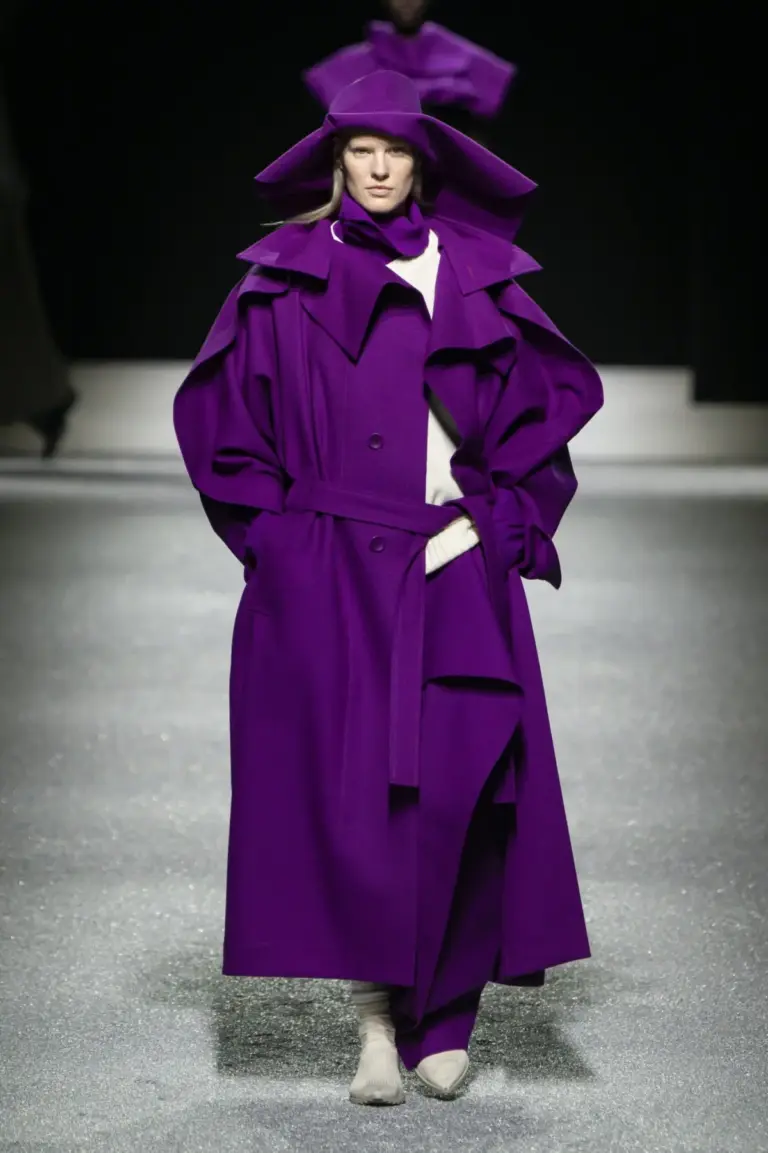
In the final stretch of Fashion Week, color emerged as the ultimate differentiator. Eschewing the predictable neutrals of autumn past, the street-style vanguard enveloped themselves in rich, unexpected hues of purple and violet. Whether manifested in supple leather trench coats, fine-gauge cashmere knits, or accessories, this jewel-toned shade proved remarkably versatile, particularly when set against contrasting pops of tomato red.
Simultaneously, the accessories market experienced a seismic shift. Following Mulberry’s high-profile ready-to-wear division relaunch under the creative direction of British fashion luminary Christopher Kane, the iconic Mulberry Bayswater bag staged an unassailable street-style comeback. Spotted everywhere from classic black and tan to high-shine amethyst leather, the heritage silhouette cemented its status as the definitive "it-bag" of the season.
Supporting Context & Metrics: Decoding the Street-Style Economy
To understand why certain items dominate the concrete runways of London while others fade into obscurity, one must analyze the intersection of retail data, editorial influence, and consumer appetite.

The Animal Print Pivot: Leopard Yields to Zebra
For several consecutive seasons, leopard print reigned supreme as the undisputed monarch of animal prints. However, street-style metrics from this season indicate a definitive changing of the guard. Zebra print—characterized by its high-contrast monochrome linearity—has rapidly usurped leopard as the pattern of choice.
Retail platforms have reported significant surges in searches for zebra-motif accessories and ready-to-wear items, ranging from Marks & Spencer’s pointed-toe kitten-heel mules to Cala De La Cruz’s crepe mini skirts. The appeal lies in zebra’s graphic versatility; unlike leopard, which carries distinct bohemian or rock-and-roll connotations, zebra acts almost as a neutral, easily paired with bold primaries or grounding blacks and navys.
The Economics of Heritage Relaunches
The omnipresence of the Mulberry Bayswater on the streets of London was no accident of serendipity. In the modern fashion ecosystem, street style acts as an advance marketing engine for brand restructurings. When a legendary British house repositions itself under a visionary creative director like Christopher Kane, the fashion press and tastemakers mobilize immediately to validate the narrative.
By integrating heritage pieces into contemporary, often incongruous outfits—such as pairing a structured high-shine leather bag with distressed camo cargos or sporty nylon zip-ups—the street-style set demonstrated the enduring adaptability of British design heritage.

Official Statements and Industry Insights
Key figures within the British fashion landscape have weighed heavily on the philosophical shift underpinning this season’s street style.
Joy Montgomery, Shopping Editor at Vogue, reflected on the instinctive nature of modern dressing:
"The best outfits we are seeing on the streets of London right now do not look labored. There is a deliberate friction—pairing sophisticated tailoring with athletic references, or classic heritage leather goods with slouchy, utility-driven separates. It’s about creating an outfit formula that looks as though it happened instinctively in three minutes, even if the curation behind it is razor-sharp."
A prominent London-based retail analyst noted the commercial ripple effect of Fashion Week street style:

"What walks down The Strand today dictates the sell-through rates on e-commerce platforms tomorrow morning. When editors and influencers consistently style low-rise denim with structured V-neck knits and loafers with white socks, they are providing consumers with an accessible, highly replicable blueprint for transitional dressing. It bridges the gap between high-concept runway shows and real-world utility."
Future Outlook: What the Street-Style Set Predicts for Next Season
As London Fashion Week draws to a close, the trends road-tested on its streets offer a clear trajectory for the seasons ahead. The overarching theme is one of pragmatic subversion—the desire to wear foundational, classic garments (like plaid shirts, V-neck knits, and heritage leather bags) but to style them with unexpected proportions, clashing textures, and high-low contrasts.
- The Continuation of Color-Blocking via Rich Leathers: Expect jewel tones—specifically amethyst purple, rich burgundies, and deep emeralds—to remain dominant as consumers seek alternatives to standard winter black and camel. The use of coloured leather outerwear and accessories will transition from an editorial risk to a mainstream capsule wardrobe staple.
- The Evolution of Denim Proportions: While barrel-leg styles will retain a loyal following for their architectural silhouette, the re-emergence of slimmer-cut, low-rise denim signals a broader pendulum swing toward 1990s and Y2K minimalism, albeit executed with modern fabric technologies and sophisticated tailoring.
- Footwear Functionalism: The pairing of structured loafers, kitten heels, and utility boots with comfort-first elements like athletic socks and relaxed trousers confirms that orthopaedic practicality and high fashion are no longer mutually exclusive.
Ultimately, London’s street style remains the industry’s most honest and exhilarating barometer. It proves that true style is born not in the sterile environment of a design studio, but in the chaotic, vibrant, and deeply individualistic daily life of the city itself.