Executive Overview
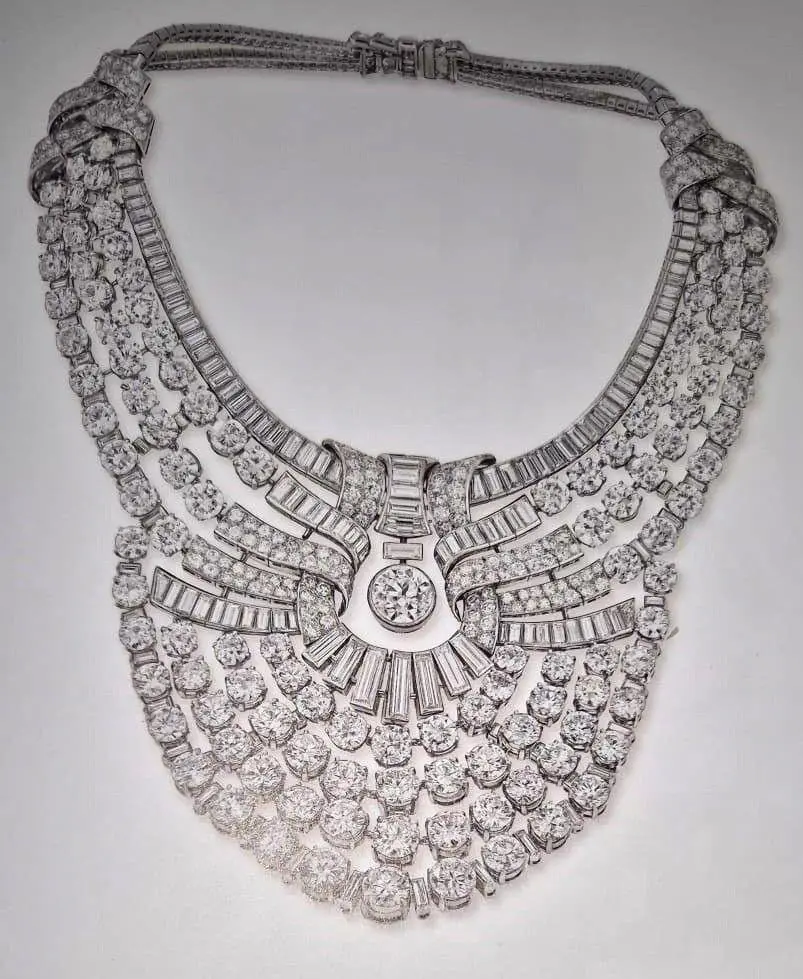
In what is rapidly becoming one of the most brazen cultural thefts of the decade, Austrian authorities have launched an international manhunt following a high-stakes daytime robbery at Vienna’s prestigious Museum of Applied Arts (MAK). Two unmasked perpetrators walked into the museum during regular visiting hours on a Thursday afternoon, shattered a fortified display case with a hammer, and escaped with a priceless 19th-century royal heirloom: a platinum-and-diamond Van Cleef & Arpels necklace encrusted with more than 600 precious stones and weighing over 200 carats.
Valued conservatively at more than £3 million (€3.5 million), the stolen artifact is not merely a masterwork of high jewelry; it is a piece of living history. Originally commissioned for the Egyptian royal family, the masterwork was famously worn by Queen Nazli of Egypt at the 1939 wedding of her daughter to the future Shah of Iran.
The theft highlights a terrifying vulnerability in Europe’s cultural institutions, echoing a string of high-profile, audacious museum raids—most notably the staggering £76 million Louvre heist in Paris just months prior. Despite cutting-edge, world-class security measures deployed in collaboration between MAK and the French jewelry house, the thieves managed to exploit the chaotic window of a targeted, armed daytime raid. As investigators pore over crystal-clear CCTV footage of the unmasked suspects, the art world is once again forced to reckon with the stark reality that premier security protocols can still be bypassed by ruthless, calculated opportunism.
Detailed Chronology: How the Daylight Robbery Unfolded
The operation was characterized by a chilling combination of audacity, speed, and calculated disregard for standard criminal tradecraft. Rather than mounting a midnight assault, slipping past perimeter alarms under the cover of darkness, or deploying complex electronic hacking tools, the two suspects treated the museum like ordinary tourists.
Phase 1: Infiltration
On Thursday afternoon, the two unidentified men purchased standard admission tickets at the MAK box office, blending seamlessly into the steady flow of afternoon visitors. Security cameras later captured the duo casually walking through the exhibition galleries, completely unmasked. Their exposed faces, now central to the nationwide manhunt released by the Vienna State Police (LPD Wien), suggest a level of supreme arrogance or a calculated bet that their identities could be concealed or discarded quickly once outside the museum’s immediate vicinity.
Phase 2: The Strike
The suspects bypassed hundreds of contemporary and historical pieces to zero in on a single, highly secure exhibition zone: the display housing the Van Cleef & Arpels collection. The retrospective exhibition, which began in June and was scheduled to run through September 27, showcased roughly 500 items celebrating the illustrious history of the French jewelry house.
Moving with practiced coordination, one of the suspects produced a heavy hammer. Despite the display case being constructed from wall-integrated bulletproof glass—a security standard specifically implemented to meet international exhibition requirements—the relentless, targeted blows shattered the structural integrity of the casing.
Phase 3: The Threat and Evacuation
As the glass fractured, exposing the priceless 673-diamond masterpiece, at least one of the thieves revealed a weapon. Recognizing the immediate threat to human life, contracted security personnel from an external firm made the critical decision to prioritize visitor safety. In strict adherence to international museum security protocols during armed incidents, staff initiated emergency evacuation procedures.

While visitors were ushered away from the danger zone, the thieves snatched the 200-carat platinum necklace. Within minutes of stepping through the museum doors as paying guests, the perpetrators vanished into the crowded streets of the Austrian capital, triggering an immediate and sprawling police lockdown and manhunt.
Supporting Context & Metrics: The Stolen Legacy and a Continent Under Siege
To understand the gravity of the theft at MAK, one must examine both the pedigree of the stolen artifact and the disturbing macro-trend of cultural heritage thefts sweeping across Europe.
The Royal Pedigree: A 200-Carat Masterpiece
The stolen Van Cleef & Arpels necklace is an artifact of extraordinary historical and gemological significance. Key specifications include:
- Gemstone Count: 673 individual diamonds.
- Total Carat Weight: Over 200 carats of high-purity diamonds set in platinum.
- Historical Provenance: Custom-designed for the royal court of Egypt.
- Iconic Moment: Famously worn by Queen Nazli of Egypt in 1939 to commemorate the marriage of her daughter, Princess Fawzia, to Mohammad Reza Pahlavi, the crown prince (and future Shah) of Iran.
The piece represents an apex of mid-20th-century jewelry design, combining immense intrinsic material value with irreplaceable historical narrative. Because of its globally recognized design and distinctive stone configurations, art crime experts note that the necklace cannot simply be sold intact on the open market. Investigators suspect the perpetrators may either be acting on commission for an unscrupulous private collector or intend to dismantle the piece, melting down the platinum setting and recutting the individual diamonds to launder their provenance.
A Continent-Wide Epidemic of Museum Heists
Thursday’s raid at MAK does not exist in a vacuum. It is part of a deeply concerning wave of brazen, high-value art and artifact thefts targeting major European cultural institutions.
Most notably, the incident immediately recalls the sensationalized Louvre robbery in Paris on October 19 of the previous year. In that daylight raid, which completely stunned French authorities and resulted in the temporary closure of the world-famous museum, a specialized gang utilized a truck-mounted furniture elevator to scale the historic building to the second floor. Using heavy industrial power tools, they smashed through reinforced windows and absconded with 19th-century gem-studded royal tiaras, necklaces, and earrings valued at an astronomical £76 million—all within a blistering four-minute window during regular operating hours.
The shift toward audacious daytime heists—leveraging the chaos of crowds, structural element manipulation, and rapid extraction—signals a new tactical evolution among organized art-theft rings. Traditional security frameworks, historically designed to counter nocturnal stealth break-ins, are increasingly being tested and broken by daylight aggressors willing to introduce direct threats of violence.
Official Statements and Institutional Response
In the wake of the robbery, museum leadership, security experts, and law enforcement agencies have faced intense public scrutiny regarding how such a high-profile target could be compromised despite modern preventive technology.

Lilli Hollein, the director of MAK, addressed the media via local reports, making no effort to downplay the severity of the crisis. "The theft of this valuable piece hits us hard," Hollein stated, acknowledging the emotional and professional blow to the institution.
However, Hollein fiercely defended the museum’s security infrastructure, emphasizing that MAK had spared no expense in preparing for the exhibition. In close partnership with Van Cleef & Arpels, the museum installed state-of-the-art security measures specifically tailored for the exhibition, anchored by wall-integrated bulletproof glass display cases.
"The security measures meet the highest standards customary for international exhibitions of jewellery," Hollein asserted. Yet, she conceded a sobering reality of modern cultural administration: "Despite world-class measures, a targeted, armed attack during ongoing exhibition operations cannot be completely ruled out."
Praising the swift and disciplined response of the museum’s frontline staff, Hollein highlighted that human safety superseded material recovery. "In such a situation, it is crucial that the established procedures function and that the staff react appropriately. This was the case here," she noted, confirming that the presence of an armed threat left security personnel with no alternative but to prioritize the immediate evacuation of innocent visitors over physical intervention.
The Austrian Interior Ministry and the Vienna State Police have since taken full command of the investigation. By releasing high-resolution CCTV captures of the unmasked suspects to the public, investigators are banking on community tips, facial recognition technologies, and international border alerts to track down the men before the dismantled stones vanish across international black markets.
Future Outlook: The Security Reckoning for Global Museums
The Vienna Museum of Applied Arts heist serves as a clarion call for curators, security directors, and cultural ministries across the globe. As criminal syndicates adapt their methodologies to exploit the inherent openness of public institutions, museums are forced into an existential dilemma: how to balance public accessibility with fortress-like protection.
Moving forward, the fallout from the MAK and Louvre incidents is expected to drive several critical paradigm shifts in museum security:
- Mandatory Biometric and AI Screening: Expect an acceleration in the adoption of AI-driven behavioral analytics and facial recognition at museum entry points, designed to flag individuals exhibiting suspicious reconnaissance patterns before they purchase tickets.
- Dynamic Hardening of Display Cases: While traditional bulletproof glass successfully delayed the thieves, the use of heavy hammers and power tools points toward a need for layered composite barriers that can withstand sustained kinetic attacks for longer durations.
- Redefined Armed Response Protocols: The reliance on passive evacuation during armed daylight raids leaves museums vulnerable to asset loss. Institutions are actively reviewing whether armed, plainclothes security details or reinforced rapid-response interior zones are necessary for ultra-high-value exhibitions.
- Enhanced International Intelligence Sharing: With stolen artifacts routinely moving across borders within hours via organized networks, Interpol and national police forces are scaling up specialized art-crime task forces to intercept stolen masterworks before they are permanently altered or destroyed.
For now, the search for the two unmasked men who walked into Vienna’s MAK and stole a piece of Egyptian and Iranian royal history continues. As detectives comb through digital footprints and forensic evidence, the £3 million Van Cleef & Arpels necklace remains a ghost—a glittering monument to a bygone era of elegance, now swallowed up by the shadowy underbelly of international art theft.