Executive Overview
As individuals cross the threshold into their fourth decade, a quiet physical shift often begins to take place. Reaching one’s 40s with the exact physiological capacity, recovery rate, and muscle mass of a 20- or 30-year-old is an increasing rarity in modern society. Cumulative minor injuries, sedentary work environments, and natural biological processes start to leave their mark on how the human body moves, bends, and lifts.
However, this trajectory of decline is neither absolute nor unalterable. According to leading fitness experts, the gradual loss of muscle mass and joint stiffness frequently associated with getting older can be actively mitigated—and in many cases, reversed—through targeted, intelligent movement.
"Losing strength and mobility isn’t an inevitable part of aging, but it is something we need to work against," explains Mark Harris, a seasoned level-four personal trainer and certified strength and conditioning coach. "After 40, we naturally begin to lose muscle mass, power, and joint mobility if we don’t continue challenging our bodies."
Dispelling the myth that combating age-related physical decline requires exhausting hours at the gym or navigating a labyrinth of complicated machines, Harris has designed an accessible, highly efficient routine. Comprising just three foundational functional movements, this routine can be executed with minimal equipment, making it ideal for busy professionals and everyday individuals seeking to preserve their independence, structural integrity, and vitality for decades to come.
Detailed Chronology: Understanding the Biological Shift After 40
To understand why a targeted fitness intervention becomes crucial in midlife, one must first examine the natural physiological timeline of human aging.
The Onset of Sarcopenia and Dynapenia
Beginning around the age of 30, humans enter a phase where natural muscle mass and function begin a slow, often imperceptible decline. This process is known medically as sarcopenia (the loss of muscle tissue) and dynapenia (the loss of muscle strength). While these changes are subtle in early adulthood, their cumulative effects typically become pronounced by the fourth decade.
Without sufficient mechanical stimulus—such as resistance training or load-bearing exercise—the body begins to break down muscle protein faster than it can synthesize it. This leads to a gradual reduction in cross-sectional muscle area. Concurrently, the nervous system undergoes alterations that reduce the recruitment efficiency of motor units, meaning the body loses not just the size of its muscles, but its ability to fire them rapidly and forcefully.
The Impact of Modern Sedentary Lifestyle
Compounding natural biological aging is the modern occupational landscape. Millions of adults spend eight to ten hours a day seated at desks. This prolonged sedentary behavior creates postural adaptations:
- Hip Flexor Shortening: Sitting continuously keeps the hip flexors in a shortened state, leading to tightness and reciprocal inhibition of the gluteal muscles (glute amnesia).
- Thoracic Kyphosis: Forward head posture and rounded shoulders weaken the upper back and rear deltoids while tightening the chest wall.
- Ankle Mobility Deficits: A lack of loaded ankle dorsiflexion reduces the range of motion required for efficient walking, squatting, and stair-climbing.
The Intervention Window
Harris emphasizes that while these degenerative shifts begin in middle age, the fourth and fifth decades represent a critical window of intervention. Establishing robust movement patterns and building a foundation of functional strength during this period acts as a biological insurance policy. It protects against structural degradation, preserves metabolic health, and ensures that the physical demands of daily life—from picking up a child to hauling groceries—remain effortless and pain-free.
Supporting Context & Metrics: The Science of Functional Movement
To combat the physiological realities of aging, fitness professionals rely heavily on functional training. Unlike isolated bodybuilding movements designed solely to aestheticize a single muscle, functional movements train the body for the activities performed in daily life. They require the coordinated action of multiple joints and muscle groups across multiple planes of motion.
Why Focus on These Three Movements?
Harris’s routine focuses on three primary pillars of physical capability: lower-body deep flexion, upper-body vertical pushing, and explosive lower-body power generation.
1. The Deep Squat (Lower Body Mobility and Stability)
The squat is arguably the most fundamental movement pattern in human existence. Every time an individual stands up from a dining chair, gets out of a car, or rises from the sofa, they are executing a squat variant.
- Muscles Recruited: Quadriceps, hamstrings, gluteus maximus, core stabilizers, and spinal erectors.
- Joints Involved: Hips, knees, and ankles.
- The Aging Benefit: Practicing deep squats—or executing sit-to-stands from a low chair without using the hands—preserves crucial range of motion through the hips and ankles. As ankles and hips stiffen with age, individuals tend to alter their gait, increasing the risk of lower back strain and falls. Maintaining deep squat capacity ensures structural longevity in the lower kinetic chain.
2. The Seated Overhead Press (Upper Body Range and Posture)
Shoulder health and thoracic mobility are notorious casualties of desk-bound lifestyles. As people age, shoulders frequently grow stiff, and posture becomes increasingly rounded.
- Muscles Recruited: Deltoids, triceps, upper trapezius, serratus anterior, and core stabilizers.
- The Aging Benefit: Regular overhead pressing forces the shoulder girdle and upper back to move through their full, natural range of motion. By strengthening these areas, individuals counteract the postural slouch associated with computer work. Furthermore, maintaining overhead strength ensures that everyday functional tasks—such as placing luggage in an overhead bin or reaching for high kitchen shelves—remain entirely manageable.
3. The Fast Step-Up (Power Generation and Fall Prevention)
While muscular strength is vital, researchers in gerontology and sports science have identified another physical quality that degrades even faster: power.
- Definition: Power is the ability to produce force rapidly ($Power = fracForce times DistanceTime$).
- The Aging Benefit: When an individual trips on an uneven pavement or a loose rug, avoiding a fall does not depend solely on absolute muscular strength; it depends on how quickly the nervous system can fire fast-twitch muscle fibers to catch oneself. Fast step-ups train these exact fast-twitch fibers, teaching the body to generate force with intent and speed, thereby serving as a critical safeguard against injurious falls in later life.
Official Guidelines: Mark Harris’s 3-Move Anti-Aging Circuit
Rather than requiring an exhaustive daily workout, Harris has structured these three movements into a streamlined, highly effective continuous circuit.
Circuit Protocol
- Execution: Perform the three exercises consecutively as a continuous circuit.
- Rest: Rest for 45 to 60 seconds upon completing all three exercises before starting the next round.
- Volume: Complete a total of 3 rounds per session.
Movement 1: The Deep Squat
[Target: Hips, Glutes, Thighs, Ankles]
[Rounds: 3 | Reps: 10-12 per round]- How to Do It:
- Stand with your feet slightly wider than shoulder-width apart, toes pointed slightly outward.
- Engage your core, keep your chest proud, and initiate the movement by pushing your hips backward as if sitting down into an imaginary chair.
- Lower your body smoothly, allowing your knees to track in line with your toes, aiming to descend until your hip crease drops below your knee level (a deep squat). If mobility is initially limited, practice using a low chair, rising without pushing off with your hands.
- Drive through your entire foot—keeping your heels firmly planted—to return to the starting upright position, squeezing your glutes at the top.
- Progression: Once bodyweight squats begin to feel effortless and fail to challenge your muscular endurance, Harris recommends holding a dumbbell or kettlebell at your chest (goblet squat style), or integrating a weighted vest to increase the load progressively.
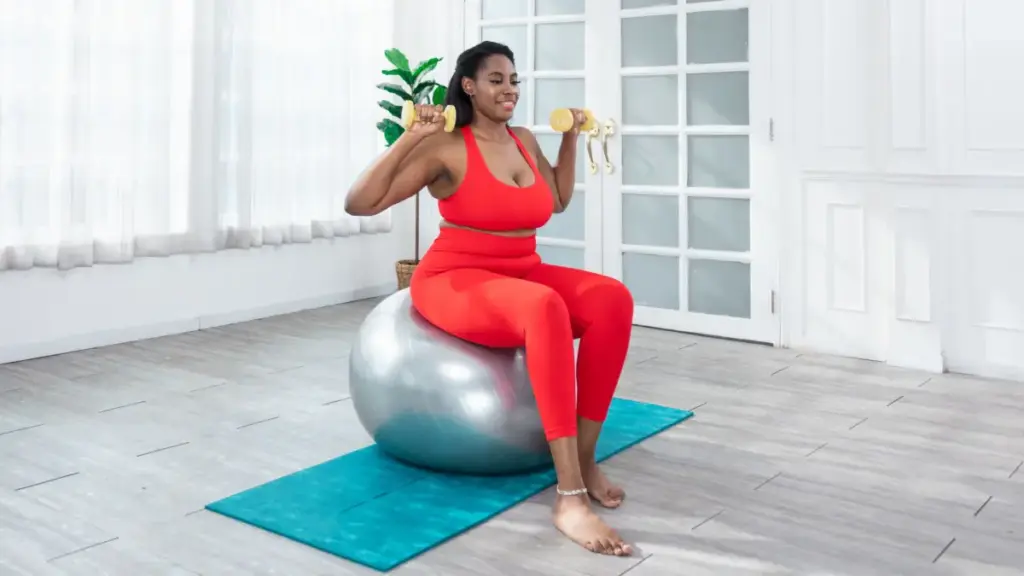
Movement 2: The Seated Overhead Press
[Target: Shoulders, Upper Back, Triceps]
[Rounds: 3 | Reps: 10-12 per round]- How to Do It:
- Sit upright on a bench or sturdy chair with a supportive backrest, planting your feet firmly flat on the floor to create a stable base.
- Hold a pair of dumbbells at shoulder height, palms facing forward or slightly inward, with your elbows tucked in at a comfortable angle below your wrists.
- Brace your abdominal core to prevent excessive arching in your lower back.
- Press the weights upward in a smooth, controlled vertical arc until your arms are fully extended overhead without locking out your elbows harshly.
- Lower the dumbbells back down to shoulder height under strict control.
- Progression: Performing this movement in a seated position isolates the upper body, minimizes momentum from the legs, and ensures that the shoulders and upper back shoulder girdle do the heavy lifting safely.
Movement 3: The Fast Step-Up
[Target: Fast-Twitch Muscle Fibers, Explosive Power, Balance]
[Rounds: 3 | Time: 20-30 seconds per side]- How to Do It:
- Stand facing a sturdy, stable box, bench, or low platform of an appropriate height (such that your knee forms roughly a 90-degree angle when placed upon it).
- Place your right foot entirely flat on top of the box.
- Drive upward explosively through your right heel, rising quickly to stand tall on the box, bringing your left knee up or simply tapping it lightly.
- Immediately lower yourself back down to the starting position under control, maintaining your balance.
- Complete all repetitions or time on one leg before switching sides.
- Coach’s Note: "The aim isn’t to jump as high as possible," Harris notes, "but to move with intent and stand up quickly before lowering under control." Focus on the speed of the ascent rather than simply piling on excessive height.
Future Outlook: Building a Sustainable Longevity Mindset
As life expectancies rise globally, the medical and fitness communities are shifting their primary paradigm away from mere lifespan—the number of years a person stays alive—toward healthspan: the number of years lived in good health, free from chronic debility, loss of independence, and functional decline.
Integrating simple, evidence-based strength and conditioning frameworks into midlife and beyond is no longer viewed as the exclusive domain of elite athletes or bodybuilders. It is recognized as an essential component of preventative healthcare.
By dedicating just a few minutes a few times a week to functional staples like deep squats, seated overhead presses, and explosive step-ups, individuals in their 40s, 50s, and beyond can fundamentally rewrite their physical future. They can preserve their metabolic health, protect their skeletal joints, retain their neurological reflexes, and ensure that they remain robust, capable, and entirely independent throughout every chapter of their lives.