In the season-three premiere of Euphoria, an exhausted Rue (played by Zendaya) accepts a mug of raw cow’s milk on a southwestern ranch, slurping it down to proclaim, “That’s the best f*cking milk I’ve ever had.” The moment encapsulates a sudden, idealized romanticism of rustic, uncomplicated life—devoid of internet connectivity and steeped in traditional comfort—compared to the modern chaos of her reality. A simple, cold glass of milk, the scene suggests, acts as a restorative elixir: a vessel of strength, solace, and manufactured nostalgia for an era one has never truly known.
This cultural fascination is no longer confined to prestige television or the dinner table. Over the past decade, milk has established a formidable footprint across the beauty and wellness landscape, evolving from a dietary staple into a dominant sensory concept. From the 2016 debuts of Glossier’s Milky Jelly Cleanser and Milk Makeup to a modern saturation of hair milks, milky toners, and viral sensations like Rhode’s Glazing Milk, the dairy-inspired aesthetic has conquered retail shelves from Ulta and Sephora to Olive Young in South Korea.
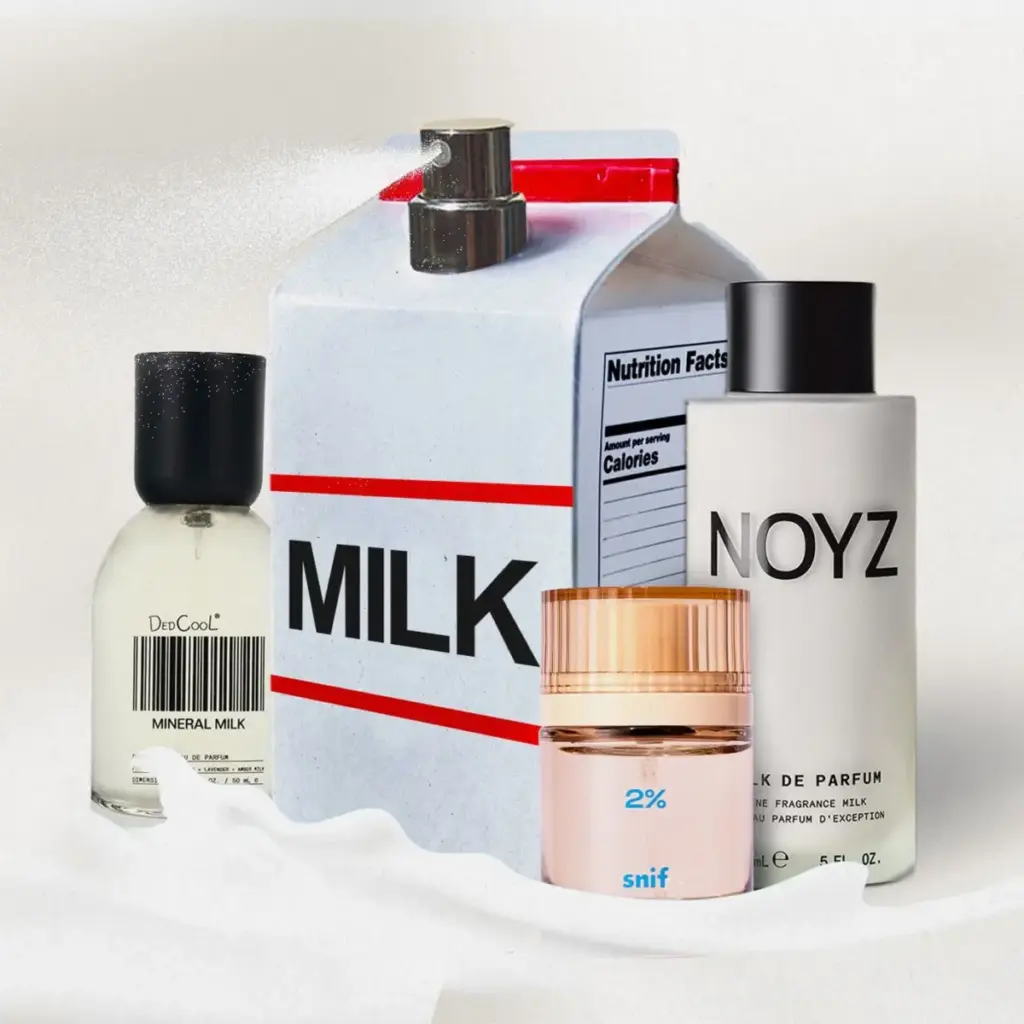
Yet, the trend’s most fascinating frontier lies in perfumery. The milk-inspired fragrance market has experienced an exponential boom, catalyzed by pandemic-era self-care habits and sustained by macroeconomic anxieties, the wellness industry’s “proteinmaxxing” craze, and shifting cultural politics. Today, brands like DedCool, Commodity, Snif, and Noyz are bottling the abstract concept of milk, offering consumers an olfactory retreat into youth, safety, and sensory luxury. This investigation explores how a fluid traditionally reserved for breakfast tables and infancy became the definitive comfort scent of the mid-2020s.
Detailed Chronology: The Evolution of the Milk Beauty and Fragrance Wave
The ascent of milk as a premier cosmetic and olfactory note did not happen overnight. Its trajectory traces a clear path through changing consumer habits, economic disruptions, and cultural reinventions over the last ten years.
-
2010–2016: The Early Seeds of Skin Scents and Minimalism
Long before "milk" became a dedicated marketing vertical, indie perfumer Carina Chaz formulated the original "Milk" scent for DedCool as a teenage passion project. Debuting quietly in an era before the skin-scent craze took hold, the fragrance was intentionally light, designed to sit close to the body. Simultaneously, the broader beauty industry began embracing gentle, non-irritating formulations. The 2016 launches of Glossier’s Milky Jelly Cleanser and the colour cosmetics brand Milk Makeup signaled an early consumer appetite for the physical and visual softness associated with dairy motifs. -
2020: The Pandemic Paradigm Shift
The COVID-19 pandemic fundamentally altered consumer spending habits. While traditional cosmetics like lipstick saw sharp declines due to global lockdowns and masking mandates, skin care and fine fragrance surged. Perfumes transformed into portable luxuries and emotional escapes. Capitalizing on this psychological shift, DedCool officially launched its signature Milk perfume in 2020. It instantly sold out, proving that consumers were actively seeking non-invasive, universally comforting scent profiles that mimicked intimacy and personal warmth..jpg)
-
2021–2024: The Proliferation of the Lactonic Category
As pandemic restrictions eased, the fragrance industry did not revert to pre-2020 norms. Instead, the "skin scent" and vanilla obsessions merged into a broader appreciation for "lactonic" notes—perfumery terms for creamy, milky accords built using tonka bean, sandalwood, and synthetic lactones. Major houses and indie disruptors alike rushed into the space. Commodity introduced its widely popular Milk expressive scent, while brands like The Nue Co. and various global houses began experimenting with milk-adjacent formulations. Concurrently, real-world dairy consumption saw a historic shift: after decades of decline in favor of plant-based milks, whole-milk consumption in the United States recorded a rare increase in 2024, bolstered by changing dietary guidelines and cultural movements. -
2025–2026: The Peak Milk Era
The trend reached a fever pitch between late 2025 and early 2026. The Nue Co. launched First Milk, formulated by master perfumer Frank Voelkl to evoke the earliest scent memory of human connection. Shortly after, Snif introduced 2%, a sweet, cereal-milk-inspired eau de toilette complete with marketing materials reminiscent of the iconic 1990s "Got Milk?" campaigns. In early 2026, LA-based indie brand Noyz debuted its Mylk de Parfum collection, merging liquid-skincare formats with high-volume, accessible luxury. Today, the market is crowded with offerings ranging from DedCool’s Mineral Milk to Bath & Body Works’ Milk line, cementing milk not merely as a passing fad, but as a permanent pillar of modern fragrance architecture.
Supporting Context & Metrics: Cultural, Economic, and Political Drivers
To understand why consumers are eager to smell like dairy, one must examine the complex web of economic uncertainty, diet culture, and political symbolism that underpins the trend.
Macroeconomic Anxiety and the Comfort Economy
The explosion of milky and gourmand fragrances coincides with a period of persistent global inflation, geopolitical friction—including fragile ceasefires in the Middle East—and domestic anxieties surrounding immigration enforcement and economic mobility. Industry experts note a direct correlation between external instability and the desire for internal comfort.
"When the world is uncertain and we don’t know what to do, we want to go back to our creature comforts," explains Kara Kowalski, director of fragrance and formula development at Snif. In perfumery, this manifests as a dominance of gourmand and lactonic notes, which chemically and psychologically signal safety, youth, and emotional warmth.
Proteinmaxxing, GLP-1s, and "Big Milk"
Simultaneously, the health and wellness sphere has undergone a radical transformation driven by two dominant forces: the rise of GLP-1 weight-loss medications (utilized by roughly 12% of U.S. adults by 2025) and "proteinmaxxing"—the obsessive pursuit of high protein intake relative to caloric consumption.

While these trends have led agricultural investors to bet heavily on alternative crops like peas, lentils, and chickpeas, they have paradoxically revitalized the traditional dairy industry. According to the Dairy Farmers of America (DFA), consumers are actively seeking beverages and products that are minimally processed, transparently sourced, and rich in natural nutrients. Whole milk has benefited immensely from this halo effect, experiencing a resurgence in sales as consumers reject ultra-processed foods in favor of farm-to-table simplicity.
The Tradwife Movement and Political Symbolism
Milk has also been co-opted into contemporary political and cultural discourse. The romanticization of rural, agrarian life—popularized by social media figures often dubbed "tradwives" (such as the viral Ballerina Farm)—has elevated raw milk to a symbol of anti-establishment wellness and traditionalism. High-profile figures, including political appointees like Robert F. Kennedy Jr., have publicly championed raw milk as a nutritional elixir, even as public health agencies warn of safety risks and pasteurization mandates.
While fine fragrances at Sephora do not explicitly endorse raw-milk politics, the aesthetic surrounding these perfumes—clean glass bottles, minimalist typography, and pastoral marketing imagery—taps into the exact same cultural yearning for a pre-industrial, unblemished past.
Official Statements and Industry Insights
Industry veterans and perfumers offer profound perspectives on why "milk" has transcended its physical definition to become a conceptual masterpiece in modern beauty.
-
Lorna McKay, Co-Founder of the Perfume Society:
"Milky is not a material or an ingredient; it’s a concept and a feeling. You’ll get things like tonka, vanilla, sandalwood, and all these softening elements that will make the milky fragrance in the end. But a perfumer will make a milky fragrance—they’ll call it lactonic or all sorts of things—but there’s not a milky ingredient. It’s the feeling that the people get when they wear these ingredients."

-
Rachel Kyllo, Chief Marketing Officer for Dairy Brands, Dairy Farmers of America:
"I think as people are looking for a beverage that harkens back to a simpler time, and also a product that isn’t ultra-processed, it just takes them to milk. It’s just a simple, real, farm-to-table nostalgic kind of beverage, and then you couple that with the nutrition that folks are looking for today."
-
Carina Chaz, Founder and CEO of DedCool:
"Ultimately, when this scent came to life, it was very, very light. It was very much like, if you can catch a whiff, it’s there. If you pass it, it’s gone. It was a noninvasive, everyone-likes-this scent profile. It changes on everyone’s skin. We’re seeing a lot of milk, and it’s not only in fragrance; it’s in so many different categories in beauty. I think it makes sense. It’s something you can interpret in any way."
-
Malena Higuera, CEO of Noyz:
"[I’m Latina and] I go through a bottle of perfume five times faster than the average person. It’s so much for us, too, about how if we feel good on the outside, we actually feel good on the inside. [We’re] flipping that script about self-care in a way that it is about the micro luxuries that are within reach."

Future Outlook: Where the Milk Trend Goes From Here
As the fragrance market becomes increasingly saturated with lactonic variations—ranging from cereal-infused eau de toilettes to mineral-amber milk blends—analysts are asking whether the trend is approaching saturation or evolving into a permanent olfactory family.
Industry consensus suggests the latter. Much like the dominance of citrus in the 20th century or the vanilla supremacy of the early 2000s, milk has proven to be an exceptionally versatile base note. Its success lies in its duality: it can be crafted to smell clean and innocent (reminiscent of infancy and childhood cereal bowls) or rich, decadent, and sensual (invoking historical myths of royal milk baths and modern skin-scent intimacy).
Furthermore, the rejection of rigid gender norms in modern perfumery heavily favors milky accords. Because milk lacks the aggressive sharpness of traditional masculine fougères or the heavy powder of dated feminine florals, it offers a neutral, comforting middle ground that appeals directly to younger demographics seeking self-expression without typecasting.
Whether consumers are turning to milk perfumes as a micro-luxury to cope with macroeconomic stress, a sensory nod to wellness culture, or simply an effortless way to smell clean and approachable, the trend is here to stay. As long as the modern world remains chaotic, consumers will gladly reach for a bottled illusion of simplicity, spraying on a dash of comfort to face the day ahead.