Executive Overview
When audiences hear the name Frankenstein, the cultural subconscious immediately conjures images of stark monochrome horror: bolted necks, flickering laboratory lights, and the ragged, cobbled-together ugliness of reanimated flesh. Yet, in Yorgos Lanthimos’s cinematic triumph Poor Things—a bold adaptation of Alasdair Gray’s landmark 1992 postmodern novel—the traditional aesthetics of the gothic monster movie are thoroughly dismantled and rewoven in Technicolor vibrancy.
At the center of this visual revolution is the film’s protagonist, Bella Baxter, brought to vivid, eccentric life by Emma Stone. Following a daring suicide attempt, Bella is resurrected through a radical brain-transplantation experiment conducted by the unorthodox surgeon Godwin Baxter (Willem Dafoe). What follows is not merely a tale of scientific hubris, but an exuberant, deeply feminist coming-of-age odyssey that spans continents, social classes, and psychological landscapes.
Crucial to this narrative is the film’s costume design, masterminded by acclaimed designer Holly Waddington. Rather than relying on rote historical accuracy, Waddington worked in tandem with Lanthimos to craft a wardrobe that serves as an external manifestation of Bella’s internal metamorphosis. The costumes of Poor Things bridge the gap between late-19th-century Victorian silhouettes and contemporary street-style aesthetics, transforming historical garments into a canvas for chaos, curiosity, and ultimate liberation.
This deep dive explores the structural brilliance of the film’s sartorial choices, tracing Bella’s evolution from an uninhibited, child-like creature into a self-actualized woman who boldly rejects the suffocating constraints of patriarchal society.
Detailed Chronology: The Sartorial Evolution of Bella Baxter
The brilliance of Holly Waddington’s costume design lies in its direct correlation to Bella Baxter’s psychological and intellectual development. As Bella breaks free from the cloistered confines of her creator’s home and plunges headfirst into the chaotic expanse of the outside world, her wardrobe shifts in tandem, charting a precise course from raw impulse to refined self-possession.
Phase One: The Genesis of Innocence and Chaos
When viewers are first introduced to Bella Baxter, she exists in a state of arrested development. Possessing the brain of an infant housed within the fully grown body of a woman, Bella moves through her enclosed world with an unbridled, visceral physical energy.
To capture this unique state of being, Waddington bypassed standard historical fidelity. "Lanthimos didn’t want me to remain historically accurate with the costumes," Waddington explains. While her research initially began with the structured silhouettes of the 1890s—notably the era’s exaggerated, structural sleeves—the execution was intentionally subverted.
"I used Victorian silhouettes, but looked for ways to reinterpret the textures of the time," Waddington notes. "For me, they had to feel wild, chaotic, and organic."
Bella’s early ensembles—such as a dramatic, voluminous top paired with playful bloomers—are effortless yet striking. Because Bella has spent years shielded from societal conditioning and subjected to a radical, experimental upbringing, her initial looks radiate an untamed impulsivity. These clothes do not constrict her; rather, they accommodate her sudden movements, erratic gait, and innocent lack of self-consciousness.
Phase Two: The Explosion of Global Curiosity
As Bella’s world expands far beyond Godwin’s laboratory walls, her fashion undergoes a radical transformation. Prompted by her insatiable curiosity and fueled by her first taste of international travel, her wardrobe explodes into a vibrant pastiche of bright colors, clashing textures, and oversized silhouettes that would look right at home on a contemporary London Fashion Week street-style blog.
In these middle chapters of the film, Bella’s outfits become increasingly eclectic and experimental. In one memorable sequence, she sports a crisp white ruffled top paired with sunny yellow shorts, accented by miniature black sunglasses, a cropped blue jacket, and sensible yet stylish ankle boots. Another ensemble pairs a similar ruffled white top with a flowing, translucent hot-pink skirt.
These looks are not merely aesthetic choices; they are psychological markers of a mind consuming the world at breakneck speed. Yet, even as Bella begins to navigate the complexities of class, privilege, and societal hierarchy—such as when she is confronted with stark poverty for the first time while wearing a pristine Victorian dress featuring monumental white puff sleeves—her clothing retains an unmistakable air of defiance. She is moving through the world on her own terms, completely unbothered by the raised eyebrows of the bourgeois society surrounding her.
Phase Three: The Patriarchal Cage and the Art of Constraint
To truly appreciate Bella’s liberation, Lanthimos and Waddington must first establish the crushing weight of the patriarchal systems she seeks to escape. As the narrative peels back the layers of Bella’s past life—and introduces figures who attempt to police her body, sexuality, and intellect—the costume design shifts dramatically.
To symbolize the profound sense of entrapment and emotional suffocation Bella experiences in these scenes, Waddington drew heavy inspiration from late-19th-century fashion photography. She draped Emma Stone in severe, commanding silhouettes: a striking, deep-blue dress paired with a heavy, traditional overcoat, and later, a remarkably rigid, armor-like copper gown accented with intricate golden filigree.
"I wanted a strong contrast [to the looks she wears after the experiment]," Waddington reflects. "These outfits are impressive, beautiful, very serious—and deeply telling."
These garments function as literal and figurative armor. They represent the rigid expectations of the Victorian era, where women were treated as ornamental, compliant objects. The armor-like quality of the copper dress highlights the emotional fortification Bella requires just to endure the stifling expectations of her male companions.
Phase Four: Self-Actualization and Sartorial Freedom
The ultimate triumph of Poor Things lies in Bella’s complete emancipation from societal constraints. By the film’s conclusion, she has rejected the rigid definitions of womanhood imposed upon her by both Godwin Baxter and her various suitors, stepping entirely into her own identity as an independent thinker, scientist, and autonomous sexual being.
Her final outfits reflect this hard-won peace. Stripped of the structural theatricality of her earlier travels and the heavy armor of her past, Bella’s closing wardrobe consists of simple, grounded pieces: a cozy cream-colored knit pullover paired with a sweeping copper maxirock.
"At that point, those are just clothes," Waddington explains, summarizing the thematic weight of the finale. "I wanted her outfit to look as though she had finally found herself—as though she knew exactly who she was."
Supporting Context & Metrics: Deconstructing the Visuals
To fully comprehend the cinematic achievement of Poor Things, it is essential to examine the granular details of its production design and costume engineering. The film’s visual language is built on intentional dichotomies that reinforce its central themes.
The Architectural and Sartorial Dichotomy
While Bella’s costumes evolve wildly across the spectrum of color and texture, the men in her orbit remain anchored to the rigid, somber realities of late-19th-century tailors. Consider Godwin Baxter (Willem Dafoe), whom Bella affectionately and accurately dubs "God." Godwin’s wardrobe consists almost entirely of muted, sober tones and traditional Victorian silhouettes.
This deliberate contrast serves a vital narrative purpose. Godwin represents the patriarchal, scientific establishment—structured, weathered, scarred, and bound by the rules of his historical moment. Bella, by contrast, is an unwritten page, an experiment in human consciousness unburdened by the centuries of repression that came before her. The visual friction between Godwin’s muted gray medical coats and Bella’s shock-pink skirts and ruffled blouses dramatizes the clash between old-world paternalism and unyielding female autonomy.
The Iconic Bridal Subversion
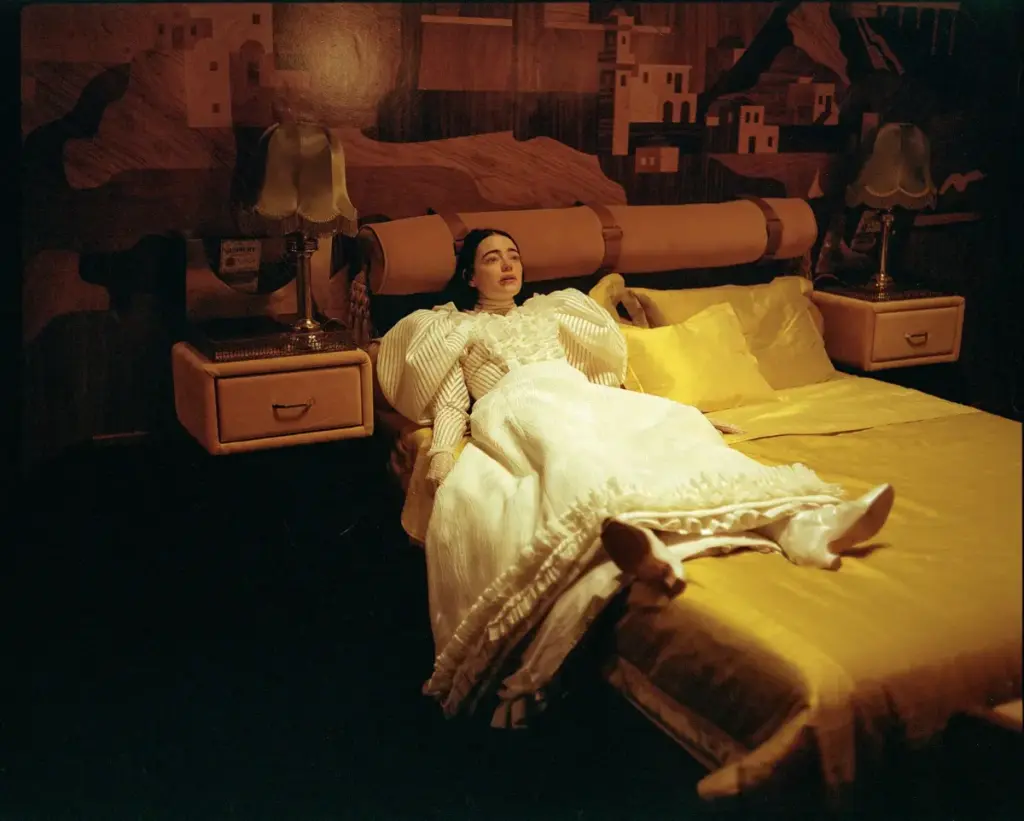
Perhaps no single costume captures the spirit of Poor Things quite as thoroughly as Bella’s wedding ensemble. When Bella is forced into a traditional marriage of convenience, the ceremony calls for a conventional bridal gown. Waddington spent days deliberating over how to approach the iconic garment without betraying the character’s inherently disruptive nature.
The resulting design is a voluminous, classically structured white bridal gown—topped off with an unexpected twist: a delicate white veil wrapped tightly across the lower half of Stone’s face. The decision to bind the bride’s mouth with her own wedding veil is a masterstroke of visual symbolism, representing the societal expectation that a wife should be seen and not heard. Yet, in typical Bella fashion, the look transforms from a symbol of oppression into an arresting statement of avant-garde power. Notably, this striking configuration was revealed to be Emma Stone’s personal favorite costume from the entire production.
Official Statements & Design Philosophy
The creative synergy between director Yorgos Lanthimos and costume designer Holly Waddington was rooted in a shared desire to avoid the dustiness of traditional period pieces. Lanthimos, known for his distinct visual style in films like The Favourite and The Lobster, encouraged his design team to treat history as a malleable palette rather than an unalterable rulebook.
Waddington’s approach was fundamentally anthropological yet playfully anachronistic. By studying the structural eccentricities of 1890s fashion—such as oversized mutton-leg sleeves and rigid corsetry—and feeding them through a modern, surrealist lens, she created a wardrobe that feels simultaneously antique and futuristic.
"We wanted the clothes to breathe with the character," Waddington noted during production discussions. "Bella is learning how to be human in real-time. Her clothes needed to reflect that sudden, shocking awakening—a collision between the stiffness of the Victorian age and the wild, untamed impulses of a mind experiencing the universe for the very first time."
This philosophy extended to the handling of fabrics. Rather than utilizing stiff, traditional period-accurate textiles that would have anchored the actors to the floor, Waddington favored materials that offered fluidity, catch-light brilliance, and kinetic energy. Every ruffle, puff sleeve, and hemline was constructed to emphasize motion, ensuring that whenever Emma Stone moved across the frame, her garments told an active story of momentum and escape.
Future Outlook: The Enduring Legacy of Poor Things‘ Aesthetic
As Poor Things continues to captivate global audiences and dominate critical conversations during awards season, its cultural footprint is already extending far beyond the silver screen. The film has reignited a mainstream appetite for avant-garde historical fashion, proving that contemporary audiences are eager to see traditional period aesthetics shattered and rebuilt through a modern, feminist lens.
Holly Waddington’s work on the film sets a new benchmark for how costume design can function as an active narrative engine rather than passive background dressing. By treating Bella Baxter’s wardrobe as a visible timeline of psychological liberation, the film demonstrates how clothing can articulate complex themes of bodily autonomy, patriarchal resistance, and self-actualization.
In an era where cinematic costume design frequently leans toward safe, historically sanitized replicas, Poor Things stands as a vibrant, chaotic, and unapologetic reminder of what happens when artists dare to tear up the rulebook. Bella Baxter’s journey from a caged scientific experiment to a fully realized, self-possessed woman is stitched into every ruffle, sleeve, and veil—securing the film’s place not only as a masterclass in modern filmmaking, but as an enduring milestone in cinematic style.