Executive Overview
In the hyper-connected, high-stakes ecosystem of modern social media, few phenomena are as satisfying—or as publicly devastating—as a high-profile "ratio." On January 10, 2025, the official X (formerly Twitter) account for Ubisoft’s blockbuster franchise Assassin’s Creed delivered what many internet historians are already calling the corporate roast of the year. Targeting platform owner Elon Musk, the account dismantled his credibility with a single, surgically precise callback to his recent, highly publicized gaming scandals.
The incident began as a standard online culture-war skirmish involving video game commentary, political streamers, and corporate marketing. However, it quickly escalated into a wider spectacle that highlighted the precarious relationship between tech billionaires, the gaming community, and the platforms they inhabit. By questioning the authenticity of Musk’s gaming achievements, the Assassin’s Creed social media team generated over 400,000 likes overnight, sparking a tidal wave of memes, public amusement, and renewed scrutiny over Musk’s online persona.
This report provides a comprehensive investigative breakdown of the event, tracing the chronological sequence of the feud, examining the technical and cultural context of Musk’s prior gaming controversies, and analyzing the broader implications of corporate accounts engaging in high-profile internet crossfire.
Detailed Chronology: From Twitch Sponsorships to a Billion-Dollar Burn
The Catalyst: Grummz, Hasan Piker, and Assassin’s Creed Shadows
The seeds of the dispute were planted over promotional strategies for Ubisoft’s upcoming title, Assassin’s Creed Shadows. As part of its marketing campaign, the development team partnered with prominent, left-wing Twitch streamer Hasan Piker, sponsoring him to showcase the game to his massive audience.
This decision drew immediate ire from right-wing video game commentator and critic "Grummz" (known historically for his work on World of Warcraft and Firefall), who has frequently criticized modern gaming studios for aligning with progressive internet personalities. Grummz took to X to lambist Ubisoft for the sponsorship, framing it as a misstep that alienated traditional gamers.
Elon Musk Enters the Fray
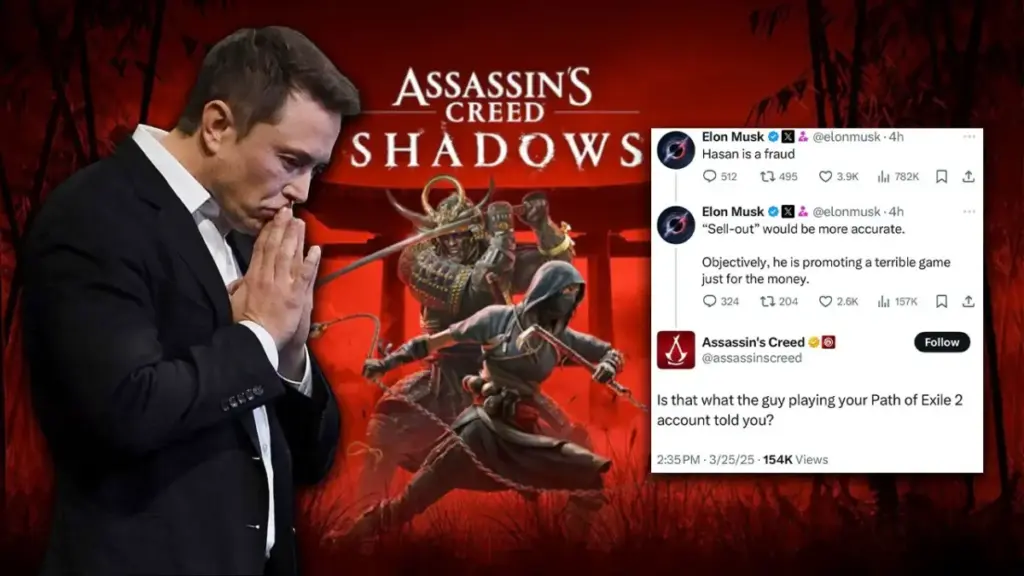
Sensing an opportunity to weigh in on a culture-war flashpoint, Elon Musk stepped into the comment section. Quoting and amplifying the criticism, Musk branded Hasan Piker a "fraud" and a "sellout," accusing the streamer of promoting a "terrible game just for the money."
For a platform owner who frequently fancies himself a supreme arbiter of free speech, authenticity, and internet culture, the critique was par for the course. However, Musk’s decision to throw stones in the glass house of gaming credibility immediately backfired.
The Strike: The Assassin’s Creed Ratio
Recognizing the opening, the social media manager behind the verified @AssassinsCreed account deployed a masterclass in modern snark. Bypassing standard corporate PR protocols, the account fired back at Musk with a devastating rhetorical question:
"Is that what the guy playing your Path of Exile 2 account told you?"
The response was an instantaneous viral sensation. Within hours, the tweet eclipsed Musk’s original post in engagement, securing over 400,000 likes and transforming into a watershed moment of online schadenfreude. Users across the political and cultural spectrum unified in their appreciation of the burn, frequently utilizing the meme format: "I wasn’t really familiar with your game," to praise Ubisoft’s sudden tactical prowess.
Supporting Context & Metrics: The Anatomy of a "Fraud Gamer"
To understand why the Assassin’s Creed comeback struck such a massive nerve, one must revisit the events of early January 2025, when Musk was forced to defend himself against accusations that he faked high-level proficiency in Grinding Gear Games’ action-RPG Path of Exile 2 (PoE 2).
The Path of Exile 2 Account Boosting Scandal
Just weeks prior to the platform clash, Musk had been livestreaming his gameplay sessions of Path of Exile 2, proudly parading a high-rank character and showcasing endgame capabilities. However, veteran players of the notoriously complex and punishing title quickly noticed glaring discrepancies.

- Mechanical Incompetence: Observers noted that while Musk operated a top-tier character, his actual in-game navigation, decision-making, and tactical execution resembled that of an absolute novice—blundering across maps and failing basic mechanics.
- Geographic Anomalies: Publicly available game telemetry and server data revealed that the account in question was actively being played from Asian servers, or via a VPN routing traffic to Asia, during hours when Musk’s public schedule placed him elsewhere.
- The Admission: Facing mounting evidence and merciless mockery from PoE 2 communities, Musk eventually copped to "account boosting." In a post on X, he attempted to normalize the behavior, writing: "It’s impossible to beat the players in Asia if you don’t, as they do!"
This admission cemented a narrative among gaming enthusiasts that Musk was desperate to project an image of "epic gamer" status without putting in the foundational hours required to achieve it. Consequently, when Musk accused Hasan Piker of being a financial fraud, the gaming world viewed the accusation as the ultimate projection.
The Aftermath: Elden Ring Duels and Blocklists
Following the corporate ratio, the drama spilled over into adjacent digital spheres. A secondary feud erupted between Musk and Hasan Piker, mediated through screenshots shared by Grummz. Piker formally challenged Musk to a "duel" in FromSoftware’s notoriously difficult Elden Ring, testing whether the billionaire’s competitive boasts held any weight in a skill-based environment.
In response, Musk labeled Piker "chicken-s***" after discovering the streamer had previously blocked him on X. As the back-and-forth continued, internet users stood by with popcorn, watching a tech tycoon, a major gaming franchise, and a political streamer collide in a surreal web of digital theater.
Official Statements and Public Reaction
The incident prompted varied responses across the digital landscape, highlighting the shifting dynamics between corporate entities and platform leadership on X.
The Voice of the Consumers
Public reaction was overwhelmingly skewed against Musk, with users reveling in the irony of a platform owner being publicly humiliated on the very infrastructure he acquired for $44 billion.
- The Consumer Conversion: Several users noted that the sheer audacity of the roast inspired brand loyalty. X user
@soundaholismpublicly declared that they would purchase Assassin’s Creed Shadows at full price rather than waiting for a discount, solely as a reward for the social media team’s bravery. - Corporate Persona Shifts: Media analysts pointed out that the interaction marks a growing trend where corporate social media accounts abandon sanitized, risk-averse marketing in favor of edgy, conversational, and combative "shitposting" to capture viral mindshare.
Silence from the Top
As of this writing, Elon Musk has not directly responded to the Assassin’s Creed account’s jab regarding his Path of Exile 2 account. Given his propensity for rapid-fire replies, his strategic silence on the matter has only served to amplify the internet’s amusement, with commentators interpreting it as a rare instance of a public figure realizing they have completely run out of effective counter-arguments.
Future Outlook: Brand Safety, Platform Ownership, and Gaming Culture
The clash between Assassin’s Creed and Elon Musk is more than just a viral meme cycle; it serves as a case study for the current state of digital culture and corporate communications.
1. The Vulnerability of Platform Monopolies
When the owner of a social media network becomes an active participant in partisan and cultural debates, the platform itself takes on a volatile character. Brands that historically maintained neutral advertising postures now find themselves navigating a terrain where direct confrontation with the platform’s proprietor is not only possible, but uniquely rewarded by the platform’s algorithmic mechanics.
2. The Credibility Currency in Gaming
Gaming culture remains fiercely meritocratic in the eyes of its participants. Shortcuts, pay-to-win mechanics, and account-boosting (especially when disguised as authentic skill) are cardinal sins within hardcore gaming communities. Musk’s attempts to posture as an elite gamer while outsourcing the grind exposed a fundamental disconnect between his online branding and the realities of gaming subcultures—a vulnerability that savvy marketing teams will undoubtedly continue to exploit when pushed.
3. The Evolution of Corporate Social Media
We have officially moved past the era of the polite, customer-service-oriented brand account (the "Wendy’s Twitter" era of aggressive snark has matured into something sharper and more culturally integrated). When a AAA gaming franchise can publicly undermine the owner of a multi-billion-dollar tech conglomerate and receive universal applause, it signals a permanent shift in how corporate entities leverage irreverence to build brand affinity among younger, chronically online demographics.
As the dust settles on the great ratio of January 2025, one thing is abundantly clear: in the arena of modern internet culture, no amount of capital can buy you immunity from getting cooked.