Executive Overview
In the volatile ecosystem of modern social media, few metrics carry as much social currency as the "ratio"—the phenomenon where a reply accumulates significantly more likes and engagement than the original post, typically serving as a public rebuke. On a brisk day in early 2025, billionaire tech entrepreneur and X (formerly Twitter) owner Elon Musk found himself on the receiving end of one of the most viral and devastating ratios in platform history. The assailant? The official, corporate X account for Ubisoft’s blockbuster franchise, Assassin’s Creed.
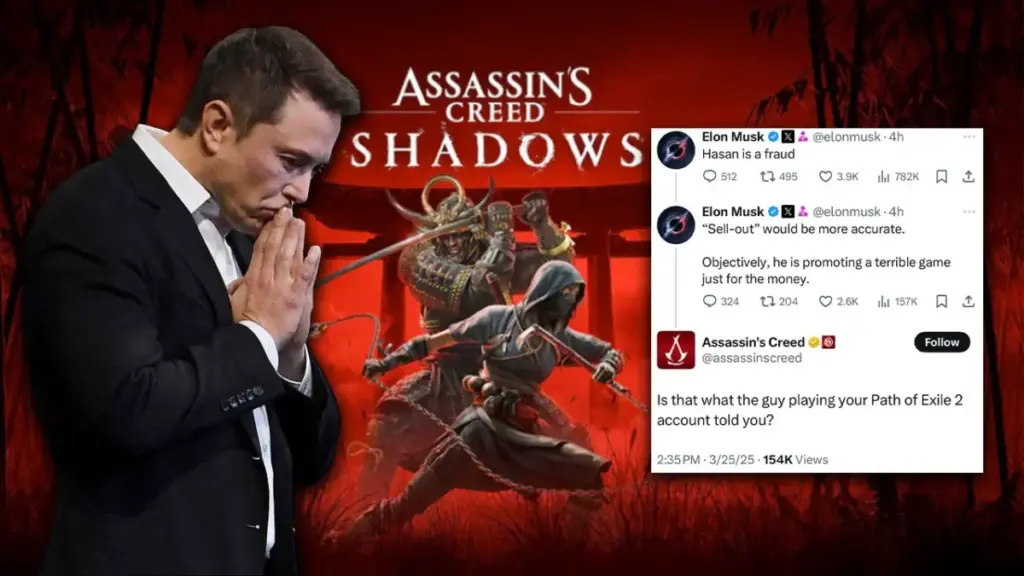
What began as a standard online culture-war skirmish involving partisan video game critique quickly metastasized into a sprawling public relations disaster for Musk. The billionaire attempted to publicly shame prominent leftist Twitch streamer Hasan Piker for promoting Assassin’s Creed: Shadows, labeling him a "fraud" and a "sell-out." However, the social media team behind Assassin’s Creed swiftly intervened, weaponizing Musk’s own well-documented gaming controversies against him. By asking, "Is that what the guy playing your Path of Exile 2 account told you?" the account triggered a massive internet pile-on.
Amassing upwards of 400,000 likes overnight, the masterclass in corporate snark not only overshadowed the initial political critique but also reignited intense public scrutiny regarding Musk’s authenticity as a gamer. This incident highlights a fascinating intersection of modern media: corporate brand accounts engaging in raw, internet-native meme warfare, the persistent deep-seated skepticism of billionaire authenticity, and the peculiar vulnerability of tech moguls operating within digital town squares they themselves own. This report provides a comprehensive examination of the events, cultural context, and systemic implications of the digital showdown that left the world’s richest man comprehensively "cooked" on his own website.
Detailed Chronology: From Culture War Grievances to Corporate Retaliation
Phase 1: The Inciting Incident and the Grummz Critique
The sequence of events leading to the historic ratio began with a targeted critique from notorious video game commentator and culture-war personality "Grummz." Known for his vocal opposition to modern diversity initiatives and corporate game development practices, Grummz took aim at Ubisoft over its promotional strategy for the highly anticipated Assassin’s Creed: Shadows. Specifically, he criticized the game development team for sponsoring Hasan Piker—one of the internet’s most prominent and outspoken leftist political streamers—to showcase and play the upcoming title on his Twitch channel.
Grummz’s framing was designed to ignite indignation among anti-woke gaming communities, framing Ubisoft’s marketing decision as an ideological capitulation and a desperate attempt to secure favorable coverage through politically aligned influencers. In an era where the gaming sphere is deeply fractured by ideological culture wars, sponsorships involving political commentators routinely act as flashpoints for synchronized outrage campaigns across X and YouTube.
Phase 2: Elon Musk Weighs In
Sensing an opportunity to amplify the anti-establishment sentiment and align himself with the vocal critics of the gaming industry’s corporate wing, Elon Musk waded directly into the discourse. Quoting or replying within the thread, Musk launched a sharp personal attack against Hasan Piker. The billionaire tech mogul accused the streamer of being a "fraud" and a "sell out," arguing that Piker was aggressively promoting a "terrible game just for the money."
For Musk, whose online persona frequently pivots between meme lord, defender of free speech, and self-professed hardcore gamer, taking shots at mainstream media figures and left-leaning influencers is standard operating procedure. However, by publicly questioning the integrity of individuals involved in gaming culture, Musk inadvertently opened a Pandora’s box regarding his own dubious and heavily scrutinized history within the gaming community.
Phase 3: The Assassin’s Creed Counter-Strike
The official @AssassinsCreed X account—run by social media handlers who clearly possessed an acute awareness of internet lore and community sentiment—recognized an immediate opening for a legendary counter-attack. Rather than issuing a standard, PR-vetted corporate defense of their marketing strategy or issuing a polite reminder of their product’s value, the account opted for maximum psychological damage.
Drawing direct inspiration from internet meme culture and recent public humiliations, the @AssassinsCreed account fired back with a surgically precise reference:
"Is that what the guy playing your Path of Exile 2 account told you?"
The response was instantaneous, viral, and historic. Within hours, the tweet blew past engagement metrics, easily out-pacing Musk’s original post and achieving a legendary ratio. By mocking Musk’s gaming authenticity using a scandal that had rocked his standing among hardcore gamers just weeks prior, the corporate account struck a nerve that resonated across the entire digital landscape.
Phase 4: Hasan Piker, Elden Ring, and Grummz in the Crossfire
As the Assassin’s Creed ratio dominated the trending tabs, the feud expanded horizontally. Hasan Piker, catching wind of Musk’s accusations of being a "sell-out," engaged in a rapid-fire exchange of barbs with the billionaire. Mediated ironically through screenshots shared by Grummz, the conflict escalated into a digital chest-bumping match.
Piker publicly challenged Musk to a high-stakes "duel" in FromSoftware’s notoriously punishing action-RPG, Elden Ring, a move designed to test whether the self-proclaimed tech genius could back up his public persona with actual mechanical skill. Musk, in turn, lashed out at Piker, calling him "chickens—" for allegedly blocking him on X. The surreal spectacle of the world’s wealthiest man bickering with a Twitch streamer over gaming credentials—supervised and egged on by a divisive internet commentator—showcased the utterly bizarre nature of contemporary online discourse.

Supporting Context & Metrics: Unpacking the Path of Exile 2 Scandal
To fully understand why the Assassin’s Creed clapback resonated so deeply—and why it stung Musk so profoundly—one must examine the public relations disaster that preceded it: the Path of Exile 2 "boosted account" controversy.
The Fake Gamer Allegations
Earlier in the year, Musk had been livestreaming his playthrough of Grinding Gear Games’ complex, punishing action-RPG Path of Exile 2. Sporting a high-rank, overpowered character, Musk attempted to present himself to his followers as a dedicated, elite-tier gamer who had ground his way to the top through sheer skill and perseverance.
However, the internet—and particularly the hardcore Path of Exile community—possesses an almost forensic attention to detail. Veterans of the game quickly began dissecting Musk’s streams and noticed glaring anomalies. Despite operating an endgame character, Musk was repeatedly blundering across maps, struggling with fundamental mechanics, and making rookie errors that betrayed a fundamental ignorance of the character’s build and high-level strategies.
Public Data and the "Asia Server" Admission
Suspicious fans began digging into publicly available game data and telemetry. They discovered undeniable proof that the account Musk was using was actively playing from Asian servers or utilizing a VPN to route connections through Asia. For a game with a notoriously competitive international player base, this geographical anomaly pointed to only one conclusion: Musk had outsourced his progression.
Faced with mounting proof that he had hired professional Asian gamers to "boost" or grind his account to high status so he could parade it around for clout, Musk eventually broke down and admitted to the practice. In a defensive justification, he wrote: "It’s impossible to beat the players in Asia if you don’t, as they do!"
For the gaming community, this confession confirmed what they had suspected all along: Musk was trying to "fake it till he made it." The incident permanently damaged his credibility within gaming circles, transforming him from a relatable tech billionaire who loved video games into the ultimate poser. Thus, when the Assassin’s Creed account referenced a hired proxy player, they were poking at a very fresh, very sensitive bruise.
Official Statements and Digital Reactions
The aftermath of the ratio saw an outpouring of commentary from across the internet, capturing the zeitgeist of a public eager to witness a corporate titan humbled.
The Internet Reacts: "I Was Unfamiliar with Your Game"
The sheer audacity of a major corporate brand openly roasting the owner of the platform on which they were posting sent shockwaves through X. Users immediately rushed to adopt classic internet meme formats to express their awe.
- The Apology Meme: Countless users posted variations of the viral meme, "I was unfamiliar with your game," playfully conceding that the Assassin’s Creed social media team had executed a masterclass in public relations warfare.
- Economic Retribution: Several users leaned into consumer solidarity. X user @soundaholism publicly quoted the viral tweet, vowing to purchase Assassin’s Creed: Shadows immediately at full price—abandoning their usual policy of waiting for a Steam sale—purely out of respect for the team’s willingness to "cook" Elon Musk.
- The $44 Billion Irony: The most prominent narrative threading through the thousands of replies and quote-tweets was the supreme irony of Musk’s current situation. Commentators repeatedly pointed out the poetic justice of a man spending $44 billion to purchase a premier social media platform, only to become the central punchline of a multi-hundred-thousand-like roasting session on that very same infrastructure.
Future Outlook: Brand Voice, Corporate Agility, and the Fragility of Tech Titans
The clash between Elon Musk and the Assassin’s Creed social media team is far more than a transient internet joke; it serves as a fascinating case study in modern digital culture, corporate marketing, and the evolving dynamics of power between platform owners and corporate tenants.
1. The Evolution of Corporate Brand Voice
For decades, corporate communications were rigidly sterile, heavily vetted by legal teams, and designed to avoid controversy at all costs. However, the rise of platform-native marketing has completely revolutionized how brands interact with consumers. The success of the Assassin’s Creed X account proves that modern audiences reward brands that exhibit internet literacy, humor, and a willingness to engage in aggressive banter—even if it means locking horns with the platform’s eccentric billionaire owner. Expect more brands to adopt this adversarial, culture-aware marketing style as traditional advertising fatigue sets in among digital natives.
2. The Perils of Platform Ownership for Public Figures
Elon Musk’s stewardship of X has fundamentally altered how public figures manage their online reputations. By transforming the platform into his personal megaphone and frequently injecting himself into culture-war debates, Musk strips away the traditional buffers that protect high-profile executives. When the owner of a platform actively engages in mudslinging with streamers and gaming companies, they forfeit the traditional corporate immunity that keeps brands at arm’s length. Musk’s vulnerability to being ratioed highlights a core paradox of the modern internet: owning the town square does not protect you from being publicly booed out of it.
3. Gaming Culture as an Untamed Wilderness
Finally, this incident underscores the unique volatility of the gaming community. Gamers are notoriously protective of their subculture, fiercely critical of outsiders attempting to co-opt their spaces, and merciless when authenticity is faked. Whether it is a Twitch streamer navigating industry sponsorships or the world’s richest man trying to pass off boosted Path of Exile 2 accounts as his own hard-earned achievements, the gaming internet maintains a zero-tolerance policy for impostors.
As the digital landscape continues to evolve, the lesson of the great Assassin’s Creed ratio remains clear: no matter how many billions of dollars you spend to buy the website, you can never buy your way out of getting thoroughly and irrevocably cooked by an internet-savvy brand account.