Executive Overview
As the boundaries between human creativity and artificial intelligence continue to blur across digital media, major user-generated content (UGC) platforms find themselves walking a precarious tightrope. On one side lies the lucrative, high-efficiency allure of generative AI—promising limitless scale, rapid content production, and engagement metrics that captivate stakeholders. On the other side stands a formidable obligation to the human creators, musicians, and artists who spent decades building the foundational communities that made these platforms cultural juggernauts in the first place.
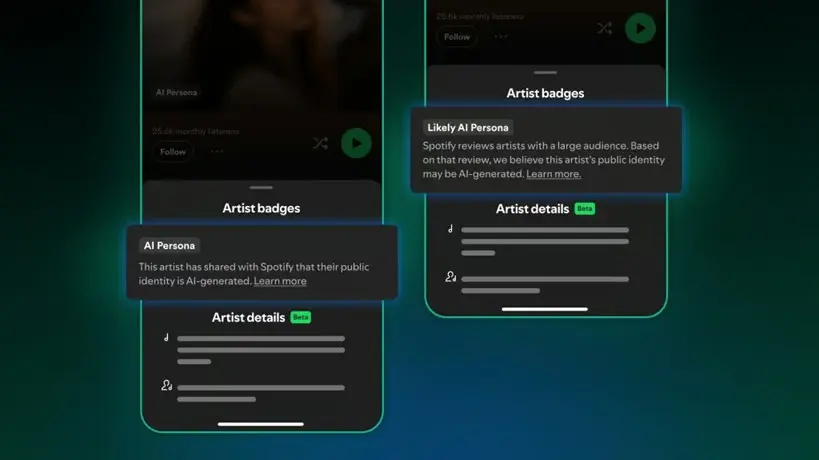
For Spotify, the world’s leading audio streaming platform, this balancing act has reached a critical inflection point. In a decisive move to combat the rising tide of synthetic noise—colloquially termed "AI slop"—Spotify has announced the impending rollout of a dedicated "AI Persona" profile tag. This new mandatory identifier is designed to clearly label artists whose public identities, names, and imagery are synthetically generated rather than representing real human beings.
Coupled with an upcoming user-reporting mechanism and a aggressive self-disclosure window ending in mid-September, the policy marks a profound evolution in how streaming services govern digital identity. Yet, the nuance of Spotify’s approach is striking: the platform is not banning generative AI music outright. Instead, it is drawing a sharp regulatory line based on who (or what) claims to be behind the microphone, rather than how the digital audio files were synthesized. This comprehensive report explores the mechanics of Spotify’s new mandate, the staggering scale of the streaming platform’s ongoing war against algorithmic spam, the financial pressures exerted by third-party tools, and what this means for the future of the global music economy.
Detailed Chronology of the AI Wave on Streaming Platforms
To understand the urgency behind Spotify’s latest policy shift, one must trace the rapid acceleration of generative audio technology and its integration into commercial streaming environments over the past several years.
Phase 1: The Incubation and Influx of Third-Party Tools
Long before Spotify introduced its own internal audio generation experiments—such as its controversial 24/7 AI chatbot for "Wrapped" data or the newly unveiled "Personal Podcasts" feature designed for private, bespoke audio—independent creators and tech entrepreneurs were utilizing third-party foundation models to generate full tracks. Unlike platforms such as YouTube, Instagram, or LinkedIn, which aggressively rolled out native tools allowing users to generate public-facing content directly within their respective ecosystems, Spotify maintained a different posture. It did not provide a native button for generating publicly accessible tracks.
Instead, Spotify became a passive receptacle for third-party uploads. Users could freely feed prompts into advanced music-generation models, export the resulting WAV or MP3 files, and distribute them through normal aggregator channels straight to Spotify’s catalog.
Phase 2: The Proliferation of Synthetic Noise
By late 2024 and throughout 2025, this open-door policy led to an unprecedented volume of low-effort uploads. Bad actors quickly realized that automated workflows could generate thousands of ambient tracks, soundalikes, and pseudo-genres designed purely to game streaming metrics, siphon royalties, and pollute algorithmic recommendation systems.
Streaming fraud and artificial listening farms coalesced with generative AI to create a deluge of digital filler. Realizing the existential threat this posed to the listening experience, Spotify ramped up its automated detection systems. Last year, leadership revealed staggering statistics regarding the platform’s enforcement efforts: Spotify removed a staggering 75 million spammy and low-effort tracks within a single 12-month window.
Phase 3: The Verified Human Badge and the Verification Gap
In an effort to carve out a safe harbor for authentic creators, Spotify implemented a "Verified" badge specifically tailored for human artists in April of this year. This visual indicator was intended to help everyday listeners differentiate between flesh-and-blood musicians and the rapidly multiplying wave of algorithmic uploaders.
However, the badge proved insufficient on its own. While it identified verified humans, it left a massive gray area for accounts that deliberately obscured their origins. Listeners routinely complained that generated content was either inadequately disclosed or slipped stealthily past automated filters, popping up persistently on weekly algorithmic playlists like Discover Weekly and Release Radar.
Phase 4: The AI Persona Mandate and Self-Disclosure Window
Recognizing that verification alone could not plug the leak, Spotify announced its structural policy update: the AI Persona profile tag.
Under the new guidelines, accounts identified as representing photorealistic or purely synthetic AI identities will be automatically tagged and systematically excluded from all editorial and algorithmic recommendations. To ease the transition, Spotify has opened a self-disclosure window extending through mid-September. Uploaders of generated music are expected to step forward and voluntarily apply the tag. Those who fail to self-disclose risk severe penalties, ranging from loss of profile privileges to complete removal from the service. Furthermore, Spotify has confirmed that a reporting mechanism—functioning similarly to content-flagging tools seen across professional platforms like LinkedIn—will be deployed in the coming months, allowing listeners to act as the final line of defense against deceptive profiles.
Supporting Context & Metrics: The Scale of the "Slop" Crisis
The economic and psychological toll of generative AI on the streaming ecosystem cannot be overstated. As algorithms grow more sophisticated at mimicking human vocal delivery, instrumentation, and production styles, the boundary between genuine artistic expression and industrial-scale content farming has dissolved.
The Financial Drain: Real Musicians Versus Synthetic Uploaders
The friction between automated content and human livelihoods is quantifiable. Industry watchdog organizations, most notably SlopTracker, have cataloged the financial impact of unlabelled and deceptive AI tracks on independent artists. According to data from SlopTracker, a mere 49 distinct AI music uploaders managed to siphon approximately $2.5 million in streaming royalties that otherwise would have been distributed to human musicians.
These figures underscore why listeners and professional trade organizations have grown increasingly vocal. When an algorithmic persona successfully impersonates a human artist, it captures passive streams, capitalizes on casual listener trust, and dilutes the compensation pool for human creators who invest years developing their craft, touring, and recording.
The Algorithmic Dilemma: Engagement vs. Integrity
Platforms face a fundamental design paradox. Recommendation engines are historically engineered to optimize for engagement metrics: watch time, stream counts, repeat listens, and click-through rates. Generative AI tools are exceptionally well-suited to manufacturing audio that satisfies the baseline acoustic preferences required to keep a listener zoned out or passively streaming ambient soundscapes.
Consequently, without aggressive intervention, recommendation algorithms naturally favor high-volume, low-cost synthetic content over meticulous, human-crafted art. By stripping AI Persona-tagged accounts of editorial and algorithmic recommendations, Spotify is deliberately breaking this feedback loop. It is signaling to developers and creators that algorithmic favor cannot be bought through sheer volume if the foundational identity of the creator is fraudulent.
Official Statements and Policy Nuances
To fully grasp the intent behind Spotify’s new regulatory framework, it is crucial to analyze the precise language used by the company’s executive leadership.
Targeting Identity, Not Artistry
The most critical distinction in Spotify’s policy is its explicit separation of how music is made from who (or what) is claiming to have made it.
In a public corporate statement detailing the rollout of the badges, Spotify clarified:
"Listeners have been clear in telling us that they don’t like seeing an artist profile that seems human, only to find out that the persona is AI-generated. The [AI Persona] badge signals to listeners that an artist’s identity may be AI-generated and does not represent a real person."
This sentiment was reinforced by Spotify’s Global Head of Artists, Marketing, and Policy during a briefing last month, where he addressed the broader philosophy governing the platform’s curation standards:
"Slop, spam, low-effort content, no one wants that polluting their experience on Spotify or any streaming service. We tag all those tracks. We remove them completely from recommendations. If it’s egregious spam, we remove them from the service overall."
Importantly, Spotify’s official stance acknowledges that generative AI is a broad spectrum. Many legitimate, human-led musical acts utilize advanced digital tools, synthesized plugins, and AI-assisted mixing or compositional aids as part of their modern creative workflow. Therefore, Spotify has consciously avoided a blanket ban on AI-assisted audio production.
Instead, the company draws the line firmly at deception. As the platform noted in its policy guidelines:
"Although there’s a broad spectrum in how artists use AI as a creative tool, the question of whether a profile represents an actual human is one where Spotify can help make a clear determination. This badge is about the artist’s public identity, not about how the music was made."
Future Outlook: Navigating the Synthetic Era of Audio
As the mid-September deadline for self-disclosure approaches and Spotify prepares to roll out its community-reporting tools in the coming months, the streaming landscape stands at a crossroads. Several vital questions remain regarding the long-term viability and enforcement of these new measures.
1. The Rise of Virtual Artists and Digital Avatars
The music industry has long toyed with virtual personas—from animated bands like Gorillaz to fully synthetic vocaloid stars like Hatsune Miku. However, these historical projects were always transparently fictional or clearly distinct from everyday human artists.
Spotify’s new policy opens the door for a sophisticated evolution of the virtual artist. Could platforms like Spotify eventually play host to the audio equivalent of Tilly Norwood or fully autonomous, AI-generated pop stars that build massive, dedicated fanbases while openly wearing their "AI Persona" badge with pride? It is entirely possible. If transparency is guaranteed, listeners may willingly embrace synthetic performers, much as they embrace virtual influencers on visual platforms like Instagram and TikTok.
2. The Commercialization of Virtual Concerts and Merchandising
Beyond passive audio streams, the monetization of synthetic artists points toward lucrative virtual ecosystems. By establishing clear regulatory guardrails now, Spotify is insulating itself against regulatory crackdowns and consumer lawsuits while positioning itself as a secure hub for virtual merchandise, digital ticket sales, and immersive audio experiences driven by synthetic creators.
3. The Burden of Enforcement and Evasion Tactics
Despite the sophistication of Spotify’s manual reviews and profile audits, bad actors will undoubtedly attempt to circumvent the AI Persona mandates. As generative models grow more capable of producing hyper-realistic biographical details, high-resolution lifestyle imagery, and simulated social media footprints, distinguishing between a genuine independent artist working entirely remotely and a sophisticated synthetic persona will become increasingly challenging.
The introduction of the user-reporting button—mirroring professional trust-and-safety mechanisms found on corporate networks—acknowledges that internal auditing teams cannot catch everything. Crowdsourced vigilance will play a vital role in policing the fringes of the platform.
Conclusion
Spotify’s introduction of the AI Persona badge represents a mature, pragmatic acknowledgment of the technological realities shaping modern media. Rather than retreating into an unworkable Luddite prohibition against digital tools, or surrendering entirely to an uncurated wasteland of algorithmic spam, Spotify is betting on transparency as the ultimate currency of trust.
For human musicians, the policy offers a much-needed defensive barrier against royalty erosion and deceptive impersonation. For generative creators, it provides a clear, regulated space to operate—provided they are honest about their digital origins. Ultimately, Spotify’s message to the audio world is clear: use whatever technological tools you wish to forge your sound, but when it comes to your identity, the truth must play loud and clear before you ever hit "upload."