Executive Overview
For decades, the boundaries dividing the fashion industry, the fitness sector, and the culinary wellness space were distinct and well-guarded. High-end couture lived on glittering runways and glossy magazine pages; athletic wear occupied gym bags and running tracks; and nutrition, green juices, and mindfulness practices were strictly the domain of health clubs and wellness retreats. Today, those boundaries have entirely dissolved.
In a seismic shift that is transforming retail marketing, fashion houses, luxury labels, and streetwear icons are aggressively pivoting toward health and wellness. Across global fashion capitals—from Milan and Paris to New York, Los Angeles, and Shanghai—brands are no longer merely selling garments; they are selling a holistic lifestyle. In-person marketing campaigns now routinely feature bespoke Pilates sessions, sound-healing workshops, protein smoothie pop-ups, and run clubs.
This convergence is not accidental. It is a calculated response to a fundamental evolution in consumer identity. According to recent industry data, 84% of Americans now consider wellness to be a top priority, and the U.S. wellness market alone commands a staggering $500 billion annually, expanding at a robust 5% clip each year. Furthermore, post-pandemic consumer behavior heavily favors experiential spending over traditional retail acquisition. By embedding themselves into fitness and longevity touchpoints, fashion brands are tapping into an affluent, highly engaged demographic that demands deeper emotional connections with the companies they support.
Yet, this gold rush carries distinct hazards. As brands flood the wellness zone with green juices and yoga mats, savvy consumers are increasingly adept at sniffing out superficial trends. Navigating this intersection requires authenticity, strategic partnerships, and a genuine commitment to community-building. This in-depth report explores how fashion’s elite and nimble upstarts alike are conquering the wellness landscape, the economic drivers behind the trend, the strategies fueling successful campaigns, and the critical risks of missing the mark.
Detailed Chronology: How Fashion Embraced the Sweat Life
The integration of health and wellness into fashion marketing has accelerated rapidly over the last several quarters, evolving from sporadic athlete collaborations into a fully realized, immersive retail strategy.
The timeline of this movement reveals a steady escalation of ambition:
- Late Fall: McKinsey & Company releases its landmark Future of Wellness report, underscoring that American spending on wellness products and experiences has surged past the half-trillion-dollar mark, cementing health as a permanent economic fixture rather than a fleeting fad.
- December: Industry collaborations begin testing the waters of hybrid lifestyle marketing. Agencies like CNC Agency orchestrate campaigns that fuse apparel with adjacent sensory experiences, such as Gap’s winter partnership with skincare innovator Summer Fridays.
- February: During Milan Fashion Week, sustainability-focused materials brand Pangaia debuts a sonic-branding initiative, creating custom musical soundscapes for its runway presentation—a creative asset that would soon double as the soundtrack for its entry into physical wellness.
- Early Spring: Luxury powerhouse Balenciaga executes a massive global lifestyle rollout, opening branded smoothie and juice pop-ups across major international hubs including Paris, Beijing, Shanghai, and Bangkok. Simultaneously, the brand launches a sweeping series of fitness studio takeovers at high-end Barry’s gym locations across Los Angeles, New York City, London, Paris, Milan, Dubai, Singapore, and Sydney.
- Mid-Spring: Outdoor and running stalwart Salomon deepens its brick-and-mortar experiential strategy by partnering with boutique fitness spaces like Los Angeles-based Natural Pilates, integrating community workouts directly into its retail footprint as part of a global store expansion push.
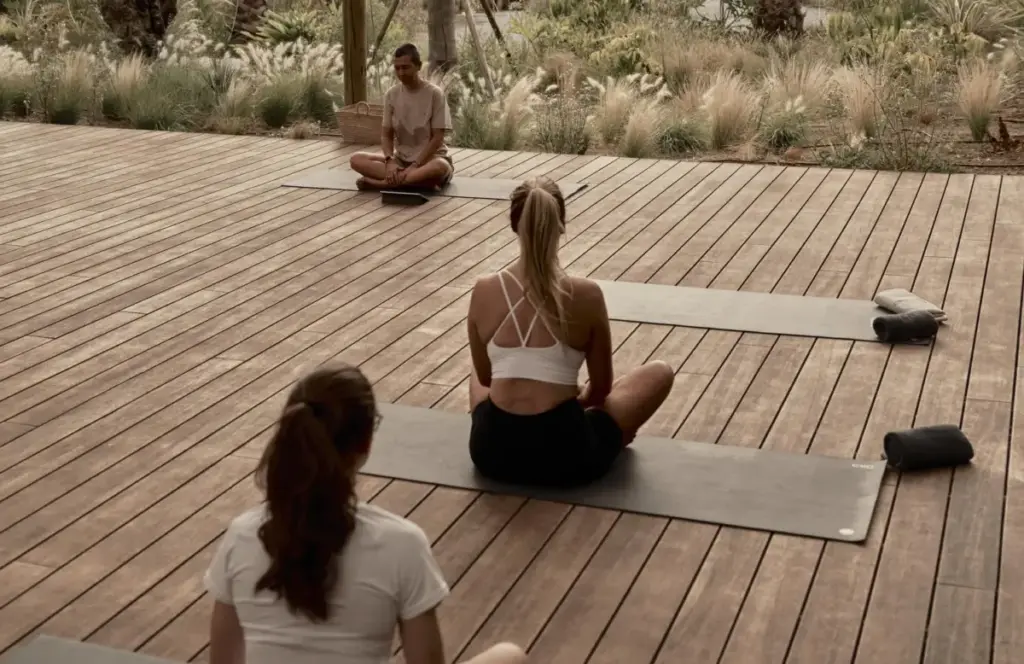
- Early Current Month: Pangaia formally launches the Pangaia Wellness Club in collaboration with OKU Hotels in Spain. The multi-sensory initiative features localized yoga, Pilates, and sound-healing classes backed by its Milan Fashion Week audio tracks, complete with an exclusive on-site nourishment bar and a limited-edition apparel capsule.
This chronological progression demonstrates that brands are moving past digital-only advertising. They are creating physical spaces where consumers can touch, test, and sweat in their products, fundamentally rewriting the playbook for experiential retail.
Supporting Context & Metrics: The Economics of the Wellness-Fashion Nexus
To understand why luxury conglomerates and streetwear labels are investing heavily in fitness experiences, one must look closely at shifting consumer economics and behavioral psychology.
The Half-Trillion-Dollar Opportunity
The health and wellness industry is no longer a niche market for marathon runners and organic purists. According to McKinsey’s comprehensive market research, the U.S. wellness economy exceeds $500 billion and continues to grow at an annualized rate of 5%. Globally, the market is valued in the trillions. This massive capital allocation by consumers has not gone unnoticed by boardrooms in the fashion sector. When consumers prioritize longevity, mental health, fitness, and clean nutrition, their discretionary spending naturally migrates away from traditional apparel toward items and experiences that reinforce a healthy self-image.
The Shift Toward Experiential Spending
Consumer habits have undergone a permanent structural change in the wake of macroeconomic pressures. Recent data compiled by macroeconomic researchers indicates that while shoppers have pulled back on indiscriminate discretionary retail spending, their wallets remain wide open for travel, leisure, and live experiences.
Ryan Glick, founder of CNC Agency—a creative firm that has engineered high-profile campaigns for Prada (including roaming floral and aromatherapy installations) and Gap—notes that these shifts are rewriting the rules of engagement.
"Fashion brands are leaning into wellness because the definition of lifestyle has expanded," Glick explains. "What you wear, how you work out, what you eat, where you spend your time—they’re increasingly part of the same identity. Wellness gives fashion brands permission to show up in more of these moments."
Glick emphasizes that physical events solve a major modern retail challenge. "A Pilates class, run club, or smoothie bar gives people something to actually participate in rather than simply shop," he says. "That creates community, as well as a much deeper interaction with the brand."
The Psychology of "Product in Motion"
For fashion brands, static window displays and mannequin-lined aisles are losing ground to dynamic, real-world demonstrations. When Pangaia launched its Wellness Club at OKU Hotels in Spain, the strategic appeal went far beyond cross-promotion with a luxury hospitality brand.
A Pangaia brand representative articulated the core philosophy behind the activation to industry analysts at Glossy, noting that there is "something particularly valuable about seeing our products in motion and allowing guests to experience how they look, feel, and function in moments of movement and relaxation."
By putting garments through the physical rigor of a Vinyasa flow or a reformer Pilates session, brands prove the technical utility, comfort, and durability of their textiles in ways that a digital advertisement or a static hanger simply cannot replicate.
Official Statements & Industry Perspectives
The convergence of fashion and wellness is championed by diverse voices across the retail landscape, from legacy outdoor brands to avant-garde luxury houses and independent boutique fitness founders.
Salomon’s Foot-on-the-Ground Strategy
While high-end fashion houses are utilizing wellness for cultural cachet, performance and activewear brands are leaning into their heritage. Salomon, the heritage running and outdoor brand, has aggressively expanded its brick-and-mortar footprint, opening 13 new stores in the U.S. alone last quarter and bringing its global total to 315 locations.
Rather than relying solely on traditional retail promotions, Salomon has embedded in-person fitness communities into its core DNA. Jenny Taylor, Vice President of Marketing for Salomon North America, emphasizes that community workouts are foundational to the brand’s identity.
"In-person experiences have always been a part of our DNA as a brand," Taylor states. "We have launched ‘How to Trail Run’ video series on YouTube, our Gravel tour of community running events, community hikes with our retail partners, and so much more. Now that we have some of our own Salomon stores, it’s been fun to test different event formats to see what resonates."
Through localized partnerships—such as hosting classes at Natural Pilates in Los Angeles alongside sponsors like Aesop and Saint James—Salomon transforms its retail stores into community hubs.
Balenciaga’s Immersive Scale
At the high-end luxury spectrum, under the creative vision of Pierpaolo Piccioli, Balenciaga has masterminded some of the most ambitious wellness crossovers to date. By executing global studio takeovers at Barry’s gym locations across cultural capitals spanning Los Angeles, New York City, Paris, Milan, Dubai, Singapore, and Sydney, the brand has blurred the lines between high fashion and high-intensity interval training. These takeovers are comprehensive, featuring custom-curated classes, bespoke workout playlists, specialized interior decor, and exclusive co-branded smoothies served at the gym’s fueling bar.
The Authenticity Check: A Word of Caution
Despite the enthusiasm, industry veterans warn that opportunistic cash-grabs can severely alienate consumers. Natalie Trice, founder of Rare Street Pilates who transitioned her wellness enterprise into the fashion space with the launch of the activewear brand Stay Rare, offers a sobering perspective on the trend.
"In my mind, adding a Pilates class or putting a green juice into a pop-up doesn’t automatically make a fashion brand a wellness brand," Trice cautions. "Consumers are increasingly savvy, and can spot a marketing exercise over a brand that genuinely understands and wants to offer something new and different."
Trice’s warning highlights an emerging friction point in lifestyle marketing: as wellness becomes ubiquitous, consumers demand congruence between a brand’s core values and its health-centric activations.
Future Outlook: Where Fashion and Wellness Go From Here
As the dust settles on the initial wave of juice bars and branded yoga mats, the intersection of fashion and wellness is maturing into a permanent structural pillar of modern retail. What does the horizon hold for brands seeking to maintain relevance in a wellness-obsessed consumer market?
1. Hyper-Personalization and Longevity-Focused Design
The next evolution of wellness fashion will move beyond basic moisture-wicking activewear and promotional smoothies. Industry analysts anticipate a rise in functional apparel infused with health-monitoring technology, far-infrared fabrics designed to aid muscle recovery, and circadian-aligned materials. As consumers increasingly view wellness through the lens of longevity and preventative health, their wardrobes will be expected to actively contribute to their physical well-being.
2. Permanent Community Ecosystems over Fleeting Pop-Ups
While global smoothie pop-ups and one-off Pilates collaborations generate immediate social media buzz, long-term brand loyalty will require permanent infrastructure. Expect more fashion labels to invest in permanent community spaces—flagship stores that double as wellness clubs, complete with digital app integrations, run-club headquarters, recovery lounges, and nutritional bars. Brands that successfully transition from hosting events to building lasting communities will capture the most resilient consumer relationships.
3. Rigorous Authenticity and Accountability
With 84% of consumers identifying wellness as a primary life focus, the margin for tokenism is shrinking. Brands that attempt to inject themselves into the wellness conversation without an authentic product offering or a credible commitment to health will face swift consumer skepticism. Future campaigns will require deeper integration with certified practitioners, nutritional experts, and fitness leaders to ensure that style and substance walk hand-in-hand.
Ultimately, the marriage of fashion and wellness reflects a profound democratization of lifestyle. Consumers no longer wish to compartmentalize their identities; they do not want to separate what they wear from how they move, what they eat, or how they care for their minds. For the fashion industry, adapting to this reality is no longer an experimental marketing tactic—it is the baseline requirement for survival in a holistic new world.