The intersection of jewelry and wearable technology has undergone a profound transformation over the past half-decade. For years, the smart ring market was viewed as a niche category—a compromised alternative for individuals who rejected the utilitarian, screen-heavy aesthetic of traditional smartwatches and fitness bands. Devices like the third-generation Oura Ring pioneered passive health tracking, yet they frequently stumbled on hardware limitations: they were prone to bulkiness, suffered from rapidly degrading battery performance, and required frequent charging cycles that broke the seamless continuity of 24/7 biometric monitoring.
Enter the Oura Ring 5. Released amidst a rapidly crowding marketplace that now includes heavyweights from Samsung, specialized competitors like Whoop, and legacy tech giants, the fifth-generation iteration arrives at a pivotal moment. This review—informed by weeks of rigorous, real-world testing overlapping with major personal milestones, including engagement and marriage—explores whether Oura’s latest hardware adjustments successfully resolve historical grievances.
Priced around £399 ($399) with an ongoing monthly subscription model of $5.99 (or $69.99 annually), the Oura Ring 5 promises a 40 percent reduction in size compared to its predecessor, alongside substantial battery life optimizations. For users balancing traditional symbols of commitment (such as a wedding band) with advanced biometric hardware, this device represents a critical test case: Can a smart ring truly disappear into your daily wardrobe while delivering institutional-grade health analytics? The answer, as detailed below, points to a resounding success tempered by the inherent limitations of passive health tracking ecosystems.
Detailed Chronology: From First Impressions to Long-Term Testing
The Hardware Dilemma: Marrying Tradition with Tech
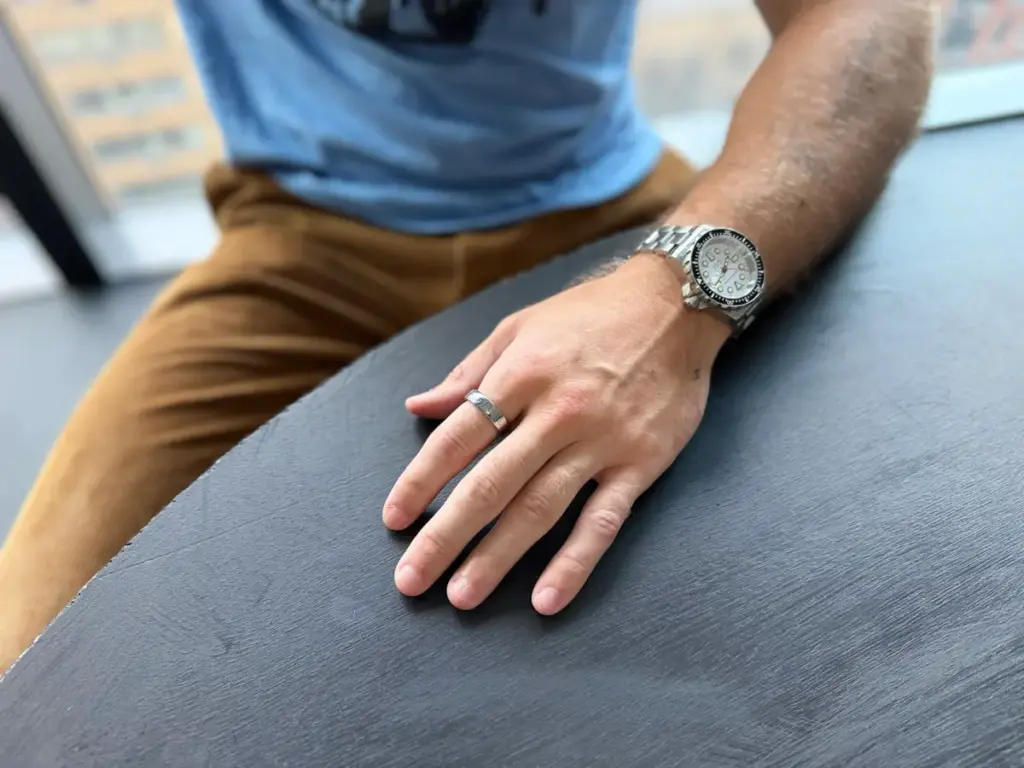
The journey with the Oura Ring 5 began at an intersection of lifestyle changes. Having recently navigated the rituals of engagement and marriage, the process of selecting a wedding band introduced a new physical reality: the addition of new metal to the left ring finger. Placed beside a silver third-generation Oura Ring on the index finger, the older tech felt immediately anachronistic. It was heavy, noticeably unwieldy, and burdened by a battery architecture that seemed to degrade with every successive charge cycle, demanding power every few days.
When the silver Oura Ring 5 was introduced for testing, initial skepticism centered on redundancy. By deliberately choosing a silver wedding band rather than traditional gold, the goal was to maintain a cohesive aesthetic alongside ornamental tech. Yet, the core question remained: Did anyone genuinely want to stack multiple pieces of smart jewelry on a single hand, especially when competing wrist-based wearables offered superior battery metrics and immediate, real-time feedback?
Weeks One Through Four: Comfort and Daily Wear
After several weeks of continuous integration—spanning office hours, sleep tracking, and rigorous athletic training—the initial doubts dissipated. The Oura Ring 5 marks an evolution in form factor. Oura’s engineering team managed to shave down the physical profile dramatically, rendering the Ring 5 roughly 40 percent smaller and lighter than the previous generation.
This reduction in mass changes how the device behaves during high-intensity physical activity. While previous iterations frequently found themselves relegated to the gym locker during heavy movements like bicep curls or farmer’s carries due to fears of scratching or pinching, the Ring 5 proved remarkably unobtrusive. It remained comfortably in place throughout running sessions and standard weightlifting routines, requiring removal only during maximal-effort lifts like heavy barbell deadlifts.
Furthermore, the physical footprint allowed it to sit adjacent to a traditional wedding band without looking like a piece of industrial hardware. It transitioned from a bulky health gadget into an integrated piece of modern adornment.
Battery Performance: Solving the Achilles’ Heel of Wearables
Perhaps the single most transformative update in the Oura Ring 5 lies within its power architecture. Historical smart rings suffered from an inverse relationship between longevity and sensor density; as rings added more advanced photoplethysmography (PPG) sensors, skin temperature monitors, and electrodermal activity (EDA) trackers, battery life often plummeted.
With the third-generation ring, charging intervals had shrunk to a frustrating two to three days, turning the ring from a passive background monitor into a high-maintenance chore. The Oura Ring 5 fundamentally alters this metric. Throughout the testing window, the device consistently delivered eight to nine days of continuous use on a single charge.
This extended longevity shifts the psychological barrier of adoption. When a wearable requires weekly—rather than bi-weekly—maintenance, users are far more likely to keep it engaged, maintaining uninterrupted longitudinal data collection for critical metrics like resting heart rate, heart rate variability (HRV), and sleep staging.
The App Interface and Passive vs. Active Tracking
Oura’s software companion remains a masterclass in UI/UX design within the health tech sector. While competing fitness applications often lean toward aggressive, utilitarian, data-dense layouts, Oura employs an inviting aesthetic characterized by cool color palettes, legible typography, and intuitive hierarchy. High-priority metrics—such as sleep scores, readiness indices, and stress tracking—are brought to the foreground without overwhelming the user.
However, the fundamental philosophical debate of the Oura ecosystem remains: Passive versus Active Tracking.
The Passive Advantage: Oura excels at long-term trend analysis. Its readiness scores provide an invaluable daily compass based on physiological recovery, making it exceptionally powerful for sleep optimization and cyclical health monitoring (particularly beneficial when pacing oneself toward athletic milestones, such as preparing for a major race).
The Active Friction: For real-time, task-specific workouts, the ring reveals its limitations. Unlike a dedicated smartwatch (such as a Garmin Fenix 8 or an Apple Watch) that allows immediate, wrist-based workout initiation, Oura’s active tracking requires a multi-step process involving the smartphone application. This friction leads many users to forget about active tracking altogether, relying instead on the ring’s automated activity recognition, which—while improved—lacks the granular, instant feedback of screen-based hardware.
Hardware Accessories: The New Charger Debate
Every hardware refresh brings trade-offs. While the Oura Ring 5 itself is an unqualified triumph of miniaturization, its accompanying charging base—carried over from the fourth-generation design language—drew mixed reviews. The new square charging puck possesses a larger physical footprint than the beloved, compact circular charger of earlier generations. While it remains easy enough to pack into a travel dopp kit, it lacks the discreet, minimalist bedside footprint of its predecessor. Given the dramatic improvement in battery life, however, the charging dock is visited far less frequently, rendering this aesthetic grievance relatively minor.
Official Statements and Industry Perspective
Industry analysts and biomechanical experts have long debated the viability of the smart ring form factor as consumer patience wears thin with notification-heavy smartwatches. The "digital detox" movement—a growing cultural pushback against constant wrist-based alerts—has positioned passive smart rings as the preferred vehicle for health tracking.
In statements accompanying the rollout of Oura’s latest hardware initiatives, company leadership has consistently emphasized the philosophy of "invisible technology." The objective is to engineer sensors that collect data reliably without demanding psychological bandwidth from the wearer.
Independent fitness researchers note that while ring-based PPG sensors often rival or exceed wrist-worn sensors in accuracy due to the snug vascular bed of the finger, the true differentiator lies in adherence. As one wearable tech specialist noted:
"The best health tracker is not the one with the most features; it is the one the user refuses to take off. By reducing the physical profile of the Ring 5 and tripling battery endurance, Oura has directly addressed the primary driver of device abandonment."
Future Outlook: Where Smart Rings Go From Here
As the smart ring market matures, competition is intensifying from all directions. Consumer electronics giants and specialized fitness brands alike are eyeing the finger as the next frontier for biometric intelligence.
Key Questions for the Horizon:
Subscription Model Resistance: Oura continues to enforce its recurring subscription model ($5.99/month or $69.99/annually). While the depth of the software insights justifies the cost for dedicated biohackers, market resistance remains a looming hurdle as competitors introduce robust hardware with zero-fee companion apps.
Expanding Health Metrics: Future iterations will likely need to push beyond cardiovascular and sleep metrics into non-invasive glucose monitoring, blood pressure trends, and advanced hydration tracking to maintain dominance against multi-thousand-dollar medical-grade wearables.
The Wrist vs. Finger Divide: The future of personal tech may not be an "either/or" proposition, but rather a symbiotic ecosystem where rings handle passive, 24/7 recovery and sleep telemetry, while specialized sports watches manage high-intensity, real-time athletic output.
Final Verdict
The Oura Ring 5 successfully re-establishes the benchmark for smart ring technology. By addressing the twin historical complaints of its user base—excessive bulk and inadequate battery endurance—Oura has engineered a device that lives up to the promise of seamless, 24/7 biometric tracking.
For the consumer who prioritizes understated aesthetics, exceptional sleep analytics, and long-term recovery trends over real-time workout stats, the Oura Ring 5 stands out as the premier choice in its class. Paired with a traditional wedding band or worn independently, it proves that the future of fitness technology doesn’t need a screen to make its presence felt.