Executive Overview
For millions of consumers shopping within the UK market, the simple act of purchasing a pair of jeans remains a fraught, psychologically taxing experience. Traditional high-street retail has long operated on a homogenous design template, routinely ignoring the complex realities of bodies operating above the national average size of a UK 18. The systemic failure of brick-and-mortar stores to adequately stock, display, or design for curvy, full-bellied, and pear-shaped silhouettes forces an overwhelming majority of shoppers online. Here, they are left to navigate a labyrinth of inconsistent sizing matrices, misleading product imagery, and disheartening return rates.
This comprehensive investigative report evaluates the current state of plus-size denim through rigorous, real-world testing. By analyzing physical fit, fabrication mechanics, and trend forecasting, this feature strips away marketing euphemisms to spotlight what actually works. Centered around hands-on evaluation by industry insiders who refuse to compromise on style, this article provides an authoritative roadmap to navigating plus-size denim—moving past basic everyday staples and into forward-thinking, trend-led silhouettes that celebrate curves rather than merely concealing them.
Detailed Chronology: The Anatomy of Plus-Size Denim Development
To understand why finding a well-fitting pair of jeans remains so difficult today, it is necessary to examine the historical trajectory of plus-size garment engineering and how contemporary e-commerce disrupted—and occasionally complicated—the landscape.
Phase One: The Era of the Afterthought (Pre-2010s)
Historically, mainstream denim brands treated plus sizes as a linear mathematical scaling exercise. Designers took a straight-size pattern—typically a UK size 10 or 12—and graded it upward without accounting for substantive anatomical shifts. This meant that as waistlines expanded, rises grew uncomfortably high, hip-to-waist ratios remained flat, and fabrics lacked the recovery properties needed to prevent sagging. The high street offered tokenistic racks tucked away in back corners, housing stiff, unyielding denim that offered no fashionable silhouettes beyond rudimentary dark-wash bootcut styles.
Phase Two: The E-Commerce Boom and the Rise of Digital Specialists (2010–2020)
As digital-first retailers entered the market, the virtual landscape expanded choices significantly. Brands like ASOS revolutionized the category by introducing dedicated curve ranges, proving that consumers above a size 16 wanted access to distressed finishes, bold colorways, and avant-garde cuts. However, this period also introduced a new set of hurdles. Without physical dressing rooms, shoppers were forced into a cycle of "bracket buying"—ordering multiple sizes and styles with the expectation of returning the majority. The lack of standardisation across global manufacturers meant a size 22 in one brand could easily fit like an 18 in another.
Phase Three: The Contemporary Curve-First Movement (2020–Present)
Today, we are witnessing a paradigm shift. Influenced by body-positivity advocates, curve models, and social media styling communities, forward-thinking brands are no longer just making clothes larger; they are engineering garments specifically for diverse proportions. Modern denim development incorporates advanced stretch-recovery yarn blends, contour waistbands that eliminate the dreaded back-gap, and daring silhouettes—such as balloon cuts and barrel legs—that were previously gatekept exclusively by straight-size markets.
Supporting Context & Metrics: The Reality of Curve Retail
The friction between consumer demand and high-street supply is heavily documented by retail analytics and consumer rights data.
The High-Street Void
Market data consistently highlights a profound disconnect between the average consumer’s body type and the inventory displayed on high-street shop floors. With the average UK woman measuring at or above a size 18, standard high-street boutiques rarely stock sizes above an 18 or 20 on physical racks. When larger sizes are available, they are routinely relegated to online-only channels. This forces plus-size shoppers to absorb the physical, financial, and emotional labor of home-fitting—a process plagued by environmental waste from excessive shipping and returns.
The Science of Fit: Measurements Over Vanity Sizing
Understanding why jeans fail or succeed requires a breakdown of anatomical geometry. Bodies above a UK size 20 rarely conform to a single uniform measurement. Common challenges include:
- The Waist-to-Hip Delta: A narrow waist coupled with expansive hips and a full posterior creates an automatic gap at the back of standard waistbands.
- The Full Abdominal Profile: Many plus-size bodies carry weight centrally, requiring a mid-to-high rise with structural reinforcement across the front panel to prevent rolling or cutting.
- Thigh Friction and Fabrication: Without adequate elastane or spandex blends woven into high-quality cotton denim, inner-thigh blowouts become an inevitable reality within months of wear.
Official Guidelines: Expert Methodology and Shopping Strategies
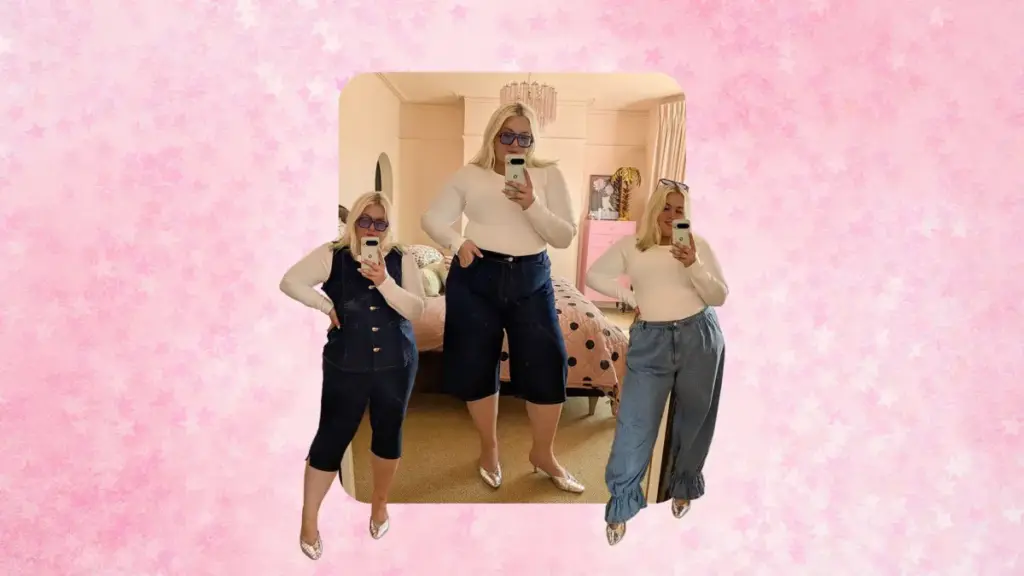
Navigating this complex landscape requires a methodical approach. Drawing from exhaustive personal testing—utilizing a standard testing protocol involving structural styling (paired with a Good American bodysuit and silver croc kitten heel mules to evaluate drape and hem break)—industry experts have established a definitive toolkit for plus-size denim acquisition.
+-------------------------------------------------------------------+
                   THE EXPERT FIT CHECKLIST
+-------------------------------------------------------------------+
  [ ] 1. CONSULT REVIEWS FOR SIZING ANOMALIES
         Always check user feedback to see if items run large/small.
  [ ] 2. ANALYZE FABRIC COMPOSITION
         Look for cotton-elastane blends ensuring proper recovery.
  [ ] 3. HAVE EXACT MEASUREMENTS READY
         Rely on brand-specific size charts rather than vanity tags.
  [ ] 4. EVALUATE RISE AND WAISTBAND CONSTRUCTION
         Prioritize contoured waistbands to eliminate back-gapping.
+-------------------------------------------------------------------+
Essential Pro-Tips for the Digital Shopper
- Leverage Peer Reviews for Sizing Intelligence: Because vanity sizing remains rampant, customer review sections serve as the ultimate truth serum. Look specifically for reviewers who list their measurements and purchased size.
- Scrutinize Fabric Composition Tags: 100% rigid cotton offers an authentic vintage aesthetic but requires absolute precision in sizing. For everyday comfort and curve-hugging movement, look for a blend featuring at least 1% to 3% elastane or spandex with high-recovery memory yarn.
- Keep Your Tape Measure Handy: Never assume standard sizing applies. Measure your natural waist, fullest hip, and inseam before browsing any size chart.
Spotlight Evaluation: The Benchmark Style
To ground these principles in a practical recommendation, one standout piece exemplifies the evolution of modern curve denim:
ASOS LUXE Curve Balloon Jean
- The Design Concept: Historically, avant-garde silhouettes like balloon or barrel-leg jeans were unavailable to curve consumers. ASOS breaks this mold with a light-blue wash architectural cut designed specifically for fuller frames.
- Styling Potential: Featuring fitted cuffs at the ankle, this silhouette is tailor-made for contemporary accessorising—including the viral trend of attaching charms and hardware to the hem.
- Value and Accessibility: Retailing competitively (with frequent promotional markdowns around £54.99 from an original £70), it bridges the gap between high-fashion runway trends and accessible inclusive sizing.
Future Outlook: Where Plus-Size Denim Is Heading
As the retail sector slowly bows to economic and social pressures, the future of plus-size denim points toward hyper-personalisation and sustainable material engineering.
Industry analysts predict several key developments over the next decade:
- 3D Body Scanning Integration: Virtual fitting rooms driven by accurate digital avatars will soon eliminate the guesswork of online shopping, allowing consumers to preview exact drape and tension points before purchasing.
- Eco-Friendly Stretch Innovations: Traditional elastane degrades fabric longevity and complicates textile recycling. The next frontier involves plant-based elastane alternatives that offer high-performance stretch without compromising circular fashion frameworks.
- Inclusive Physical Retail Spaces: Forward-thinking brands are beginning to pilot fully stocked physical spaces where every size from UK 6 to 32 is represented on the shop floor, dismantling the stigma of online-only segregation.
Ultimately, the market is waking up to a simple truth: curve consumers do not want to hide behind shapeless, uninspired denim. They want—and deserve—the same structural integrity, trend-forward design, and effortless cool afforded to every other segment of the fashion industry.